Oxford University Museum of Natural History

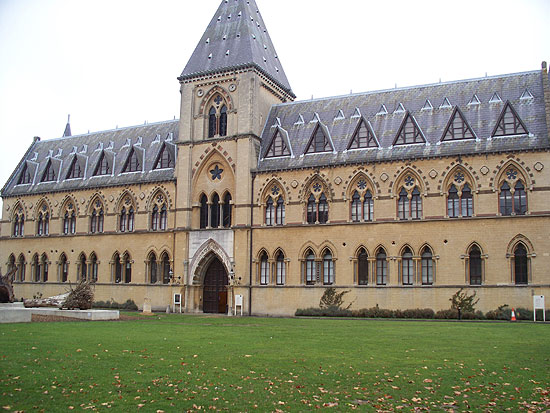
Museum frontage
Oxford University Museums
The OUMNH is located in a spectacular Grade I listed neo-Gothic building in Parks Road. Among its most famous features are the Oxfordshire dinosaurs, the dodo, and the swifts in the tower. The Museum’s permanent exhibits are devoted to the history and diversity of life on earth, and to the rocks and minerals from which it is formed. The Museum is an important centre for research and teaching, and is organised into four collections: entomology, geology, mineralogy and petrology, and zoology. It also houses several research libraries, and is home to an environmental archaeology unit.

I spent about an hour in the OUMNH and mainly looked at the dinosaur and mammal skeletons, with a quick look at the insects and other things in the gallery. It’s well worth a visit, and one could spend longer there.
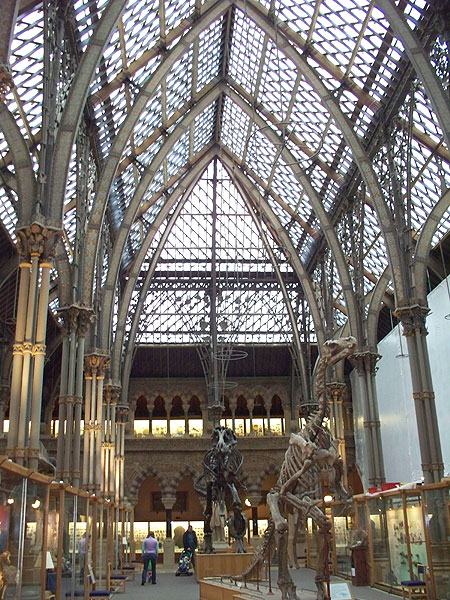
Don’t miss looking at the pillars supporting the upper galleries. Each one is made from a different mineral, identified on the base. Note also the spectacular vaulted metal and glass roof.

I recommend looking at the Museum’s website to help plan your visit.

Practical details: Admission is free. There is no museum café in the Pitt Rivers or the OUMNH, and nothing obvious outside. Travel: Arrival by car is not recommended. The Museum is easily accessible by Park and Ride. The council now charges £1.50 for Park & Ride parking, so have this with you in coin in case you see a bus about to depart! You are not required to display the ticket.
Museum interior
Museum interior
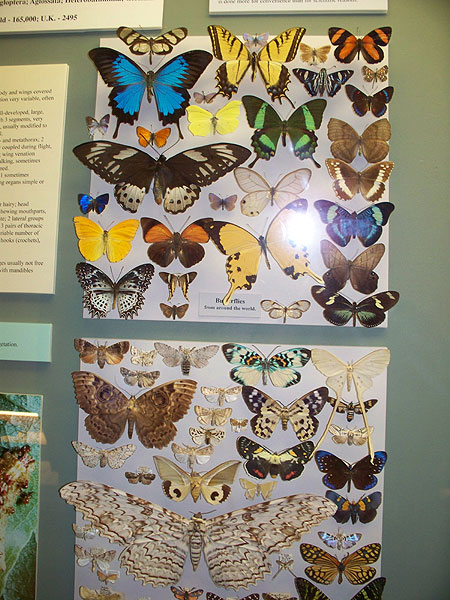
Butterfly display
Butterfly display

Pitt Rivers Museum, Oxford

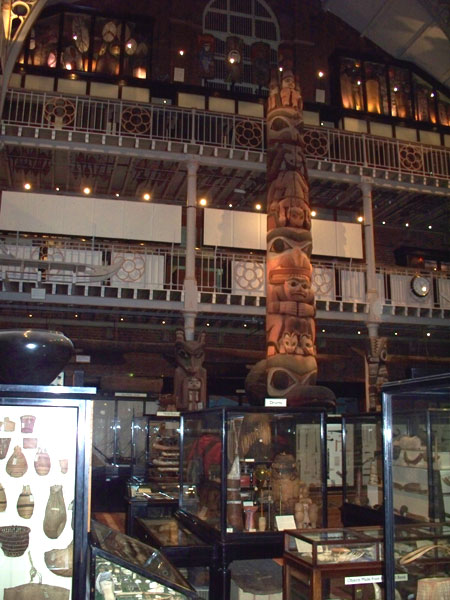
Pitt Rivers interiorOxford University Museums
The Pitt Rivers Museum is located behind the OU Museum of Natural History in Parks Road, and is reached by walking through the OUMNH. The Pitt Rivers Museum cares for the University of Oxford’s collection of anthropology and world archaeology.
Permanent displays in the Museum are ethnographic and archaeological and include the following:

Pacific island objects, a collection of ceremonial brasses and ivories from the Kingdom of Benin; a fine group of early masks worn by actors in Japanese Noh dramas; more masks from Africa, Melanesia and North America; sculpture from all over the world in wood, pottery, metal and stone; boats, ranging from full-sized sailing craft to model canoes; baskets in all possible shapes and sizes; pottery from Africa and the Americas, including many pre-Columbian pieces; costumes from North America; magic objects; locks and keys; tools and weapons; musical instruments.

The cases appear to be very crowded, as a very large percentage of the collection is on view. In some instances the ‘displays’ are primarily visible storage, due to the museum being first and foremost a teaching and research institution and the curators are also university lecturers in either cultural anthropology or prehistoric archaeology.

I spent several hours in the Museum. The sheer variety of objects is fascinating, and some are of great interest, while others, like the mummified vulture head, seem a bit mad. Note the fine collection of Japanese Noh masks, the religious objects, or the shrunken heads. The cases are often dimly lit – the Museum apparently can supply torches, or you could bring your own!

I recommend looking at the Museum’s website to help plan your visit.

Practical details: Admission is free. There is no museum café in the Pitt Rivers or the OUMNH, and nothing obvious outside. Travel: Arrival by car is not recommended. The Museum is easily accessible by Park and Ride. The council now charges £1.50 for Park & Ride parking, so have this with you in coin in case you see a bus about to depart! You are not required to display the ticket.
Museum of the History of Science, Oxford


Oxford University Museums
The museum is housed in the world’s oldest surviving purpose-built museum building, in Broad Street. The present collection of the Museum preserves the material relics of past science. Particular strengths include the collections of astrolabes, sundials, quadrants, early mathematical instruments generally (including those used for surveying, drawing, calculating, astronomy and navigation) and optical instruments (including microscopes, telescopes and cameras), together with apparatus associated with chemistry, natural philosophy and medicine.
In case this sounda a bit dry, I should point out that the Museum also has special exhibitions from time to time, and these have included Steampunk Art, and Eccentricity (eccentric objects and behaviour.)

I spent several hours in the museum, and I remember large amounts of polished brass, and a vast collection of astrolabes of all sizes and materials, and different designs, some elaborately engraved.

I recommend looking at the Museum’s website to help plan your visit.

Practical details: Admission is free. The Museum is closed on Mondays. There is no museum café, but you should find refreshments in busy Broad Street. Travel: Arrival by car is not advised. The Museum is easily accessible by Park and Ride. The council now charges £1.50 for Park & Ride parking, so have this with you in coin in case you see a bus about to depart! You are not required to display the ticket.
Ashmolean Museum, Oxford

Oxford University Museums
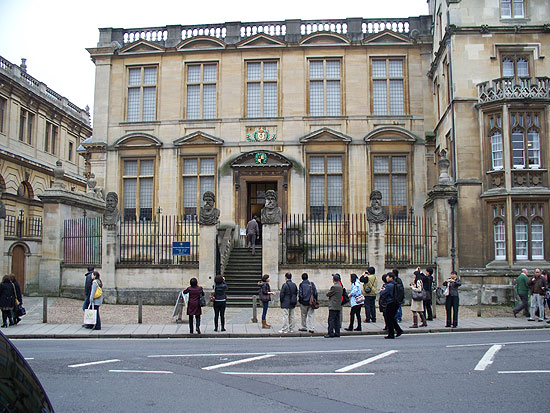
The Ashmolean, a museum of art and archaeology, is housed in an elegant classically-fronted building in Beaumont Street. Collections include antiquities, Western art, Eastern art, coins, and a cast gallery. Western Art includes some Old Masters. Each of the four main floors has an Orientation Gallery to help you decide what to look at first.

Looking at everything in the Ashmolean would be a major effort, so it would be as well to go armed with some idea of what you want to look at first. If you don’t, there are four Orientation Galleries to help you decide what you are really interested in. I spent several hours in the museum, with a break for lunch, and had a look in most of the galleries, including the coins, and the Japanese galleries (the Japanese collection is in just two rooms). The museum is well worth a visit, and you should fnd something to interest you.

I recommend looking at the Museum’s website to help plan your visit.

Practical details: Admission is free. The Museum is closed on Mondays. There is a museum café in the basement. Travel: easily accessible by Park and Ride. The council now charges £1.50 for Park & Ride parking, so have this with you in coin in case you see a bus about to depart! You are not required to display the ticket.

Grassington, Yarnbury mining area, W. Yorks

The former mining landscape near Grassington makes an interesting area for a walk. Take the road north-eastwards from Grassington High Street towards Yarnbury. If you are in a car, just keep going till you run out of tarmac road. There’s plenty of room to park at the end, so don’t worry.
Around here is Yarnbury House, which was the mine agent’s house and office. Head along the track in the direction of the chimney, which can be seen in the distance to the east. Look out for noticeboards describing relics of interest. The track passes an area dotted with shallow shafts, and other relics including a post-war reprocessing plant. As you approach the chimney and leave the track, you should encounter the long horizontal flues running from the smelter sites up to the chimney. The structure of the flues can be seen in places where they have collapsed.

You should take with you a map that identifies the various relics, so that you can check out any that are on your line of walk. The tracks continue southwards to Hebden Moor mines and Hebden village. If you go far enough to the north-east, you will reach Mossdale (use a map). If you don’t want to retrace your steps, satellite pictures indicate that taking a left at a crossroads near Coalgrovebeck Dam will loop you back to Yarnbury, passing 3 more disused mines.

Malham Cove, Tarn, Gordale Scar

I visited this area in 2006. I started my walk at the foot of the Cove (a semicircular cliff formation) and climbed up a track to the top of the Cove, then explored the terrain above, including the Limestone Pavements (flat-topped areas of exposed limestone). I can’t remember now if I explored the Tarn, which is accessible to the north, but I made my way over to the Gordale Scar (a ravine with a river at the bottom) and made my way down a steep track to the river level. I continued downstream to the waterfall, where I was able (with a bit of assistance from other walkers) to climb down to the lower path. I then walked towards the village via Janet’s Foss (a pleasant area of woodland with a stream and the Janet’s Foss waterfall) finally returning to my starting point.

Please note that while I had a map of suggested walks and was trying to follow one of them, I would caution that I found descending into the upper Scar quite challenging. The recommended track descends close to the waterfall. Climbing down the mostly dry waterfall was even more of a challenge and I only persisted because the alternative of spending some time retracing my steps was even less appealing.
The various walks usually route up the waterfall (which is probably easier than scrambling down it), but lone walkers or those not used to scrambling up rocks should exercise due caution. Walking boots must be worn. The whole walk took me most of the day.