Wellcombe Collection, London

The Collection was founded by wealthy pharmaceutical magnate Sir Henry Wellcombe.
The Collection “explores the connections between medicine, life and art in the past, present and future. The venue offers visitors contemporary and historic exhibitions and collections, lively public events, the world-renowned Wellcome Library, a café, a bookshop and conference facilities.” The permanent collections on the first floor are “Medicine Man” Sir Henry’s historic collection of objects, and “Medicine Now” an exhibition of modern medicine, and also modern art inspired by medicine. On the ground floor are the temporary exhibitions, which typically are of modern art.

On my visit I looked first at “Medicine Now” which was quite interesting. Note the stacked volumes of books containing the printed human genome, the artwork of medicine pills carved by the artist to represent their function, the section of a plastinated human body, and the video of the prehistoric fish that seamlessly and slowly evolves into a man. Some people might find the historic “Medicine Man” collection more interesting, and the more gruesome items, such as the Chinese torture chair, the mummified Peruvian corpse, or the large collection of bone saws, may particularly appeal to boys. There are also paintings, masks, glassware, artificial limbs and curios. And let’s not mention the Japanese sex aids… 🙂

At the time of my visit, the temporary exhibitions included Charlie Murphy’s The Anatomy of Desire and Other Objects (glass castings of intimate body parts), Infinitas Gracias: Mexican miracle paintings (naïve paintings commissioned to give thanks), and Felicity Powell: Charmed Life – the Solace of Objects (an exhibition of objects from the historic Lovett collection of charms, plus modern art by Felicity Powel.) The Powell wax bas-reliefs were beautiful and well worth seeing.

Just as it says on the website, the Wellcombe Collection is “a free destination for the incurably curious”. I spent over 3 hours here.

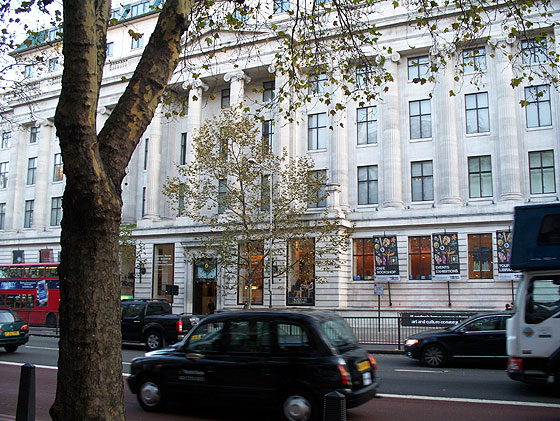
To say that the Wellcombe building is well-served by public transport would be an understatement, as it’s on the south side of Euston Road, and almost opposite Euston Station. It’s also close to Euston Square underground and Euston bus station.
Sir John Soane’s Museum, London

Wealthy architect and self-made man Sir John Soane bequeathed his London home and collections to a trust in 1837, stipulating that the house and collections be preserved just as they were. The collections are contained in three linked houses, nos 12, 13 and 14 on the north side of Lincoln’s Inn Fields. No.13 is the principal museum building.
Today the trust is still operating and the collection is still in place. Most of the collection is housed in the rear of the three houses. No. 12 is being renovated to open eight more Soane rooms, and the front of no. 14 was bought back in 1997 for institutional use.

The ground floor library and dining room of no.13 is an opulent room with an elaborate ceiling. The many mirrors make solid walls appear to be openings leading through to another space. This is a theme too in various other parts of the house. In the rooms at the back is a huge collection of sculptured and architectural items, mostly plaster casts, but including some genuine ancient classical items. In the basement is a large stone sarcophagus, and if you get close enough to it, you can see that it is completely covered with Egyptian carvings inside and out. It is about 3000 years old. Most of the art is in the Picture Room, and two-thirds of it is hidden from view, so wait about till the attendant swings out the outer panels to reveal what is behind. On the north side the hidden art includes Hogarth’s “Rake’s Progress”, and on the south side the hidden art is architecural drawings. On the south side a second set of panels swing back to reveal, disconcertingly, a very large and deep space, with a stained glass window and sundry pictures, drawings, models and carved items now exposed.
The Breakfast Room in no. 13 is another ornate construction, with a domed ceiling and many pictures, some of them on concealed swing-out panels. Upstairs is the elegant South Drawing Room, which has openings where one would expect the windows to be, leading onto the glazed front loggia.

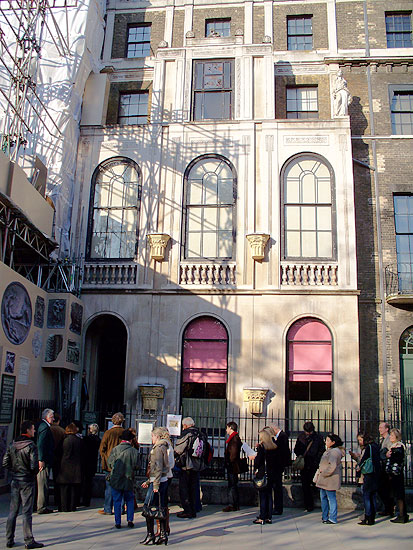
Currently, spotting the Museum as one approaches is a no-brainer – just head for the boxed-in scaffolding concealing no.12. The entrance is at no 13; be prepared to queue for the security check. Admission is free, but you might see more if you take the useful optional, and limited-numbers, guided tour for £5. I spent nearly 3 hours at the Soane Museum.
Nearest tube station is Holburn. There is some very expensive short-term metered parking near the Museum.