National Trust.
The Hall appears to date from the early sixteenth century, and apart from the removal of a gatehouse range that once enclosed the courtyard, and the insertion of eighteenth-century sash windows, the exterior seems not to have changed much. The interior has had repeated makeovers, with fashionable rococo decoration given to the principal rooms in the 18th century, and further changes in the 19th century. The house was ransacked in the Civil War, and the north wing suffered a devastating fire in 1942. The house has interesting contents, and some fine rooms. There is a notable staircase hall with a wide, straight staircase in the central block. Outside, there are gardens in which the visitor can stroll.
Month: October 2011
Oxburgh Hall, Norfolk
 National Trust.
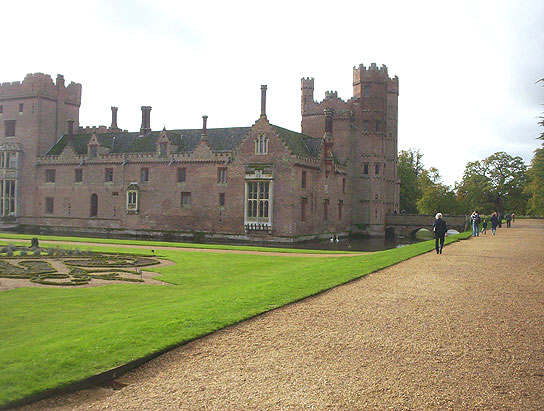
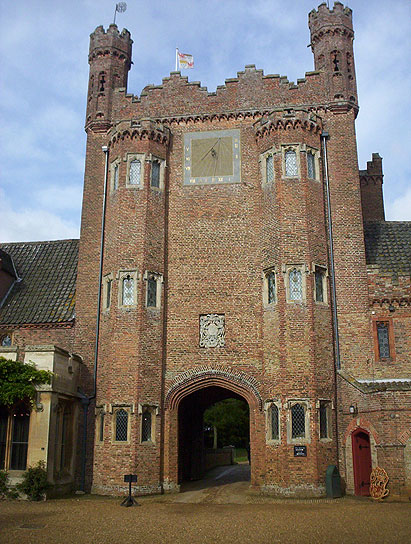
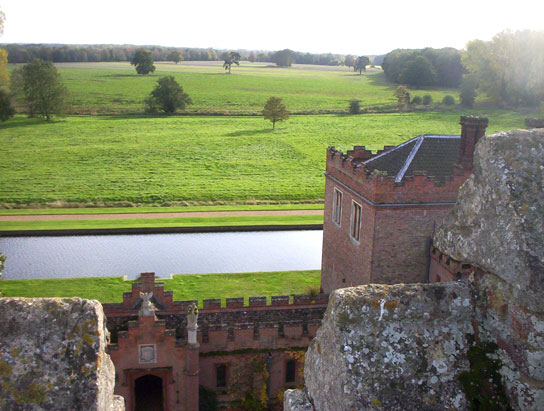
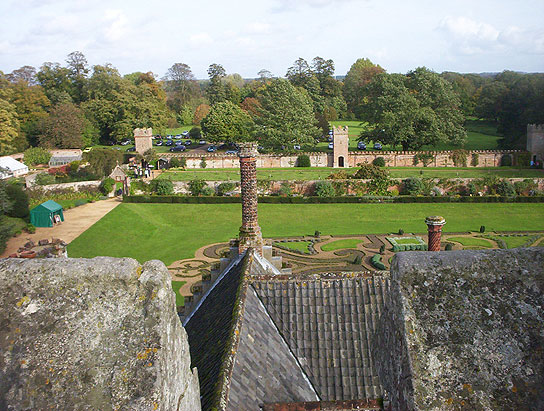
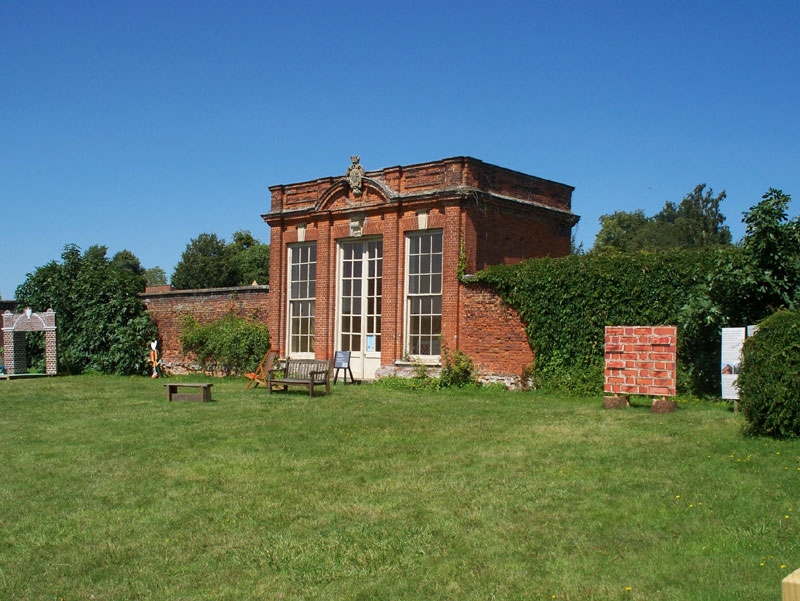
A red-brick moated house stands amongst extensive gardens and grounds. When it was founded in 1482, the house was in the middle of a marsh. Much has changed since, and while the great gatehouse is largely orginal, there was an extensive resoration of other parts in the 19th century. Stepped gables and twisted terracotta chimneys on the side ranges were added during the restoration. In the grounds is the Gothic Revival Chapel, designed by Pugin. It contains an elaborate altarpiece.
The King’s Room in the gatehouse is a great room with walls of exposed brick. An interesting circular staircase of fine brickwork leads up to another great room, the Queen’s Room. The staircase leads up to the flat roof, where other towers and chimneys can be viewed, and also the surrounding countryside.
There is a walled garden with turreted walls, and other areas of garden for the visitor to explore.
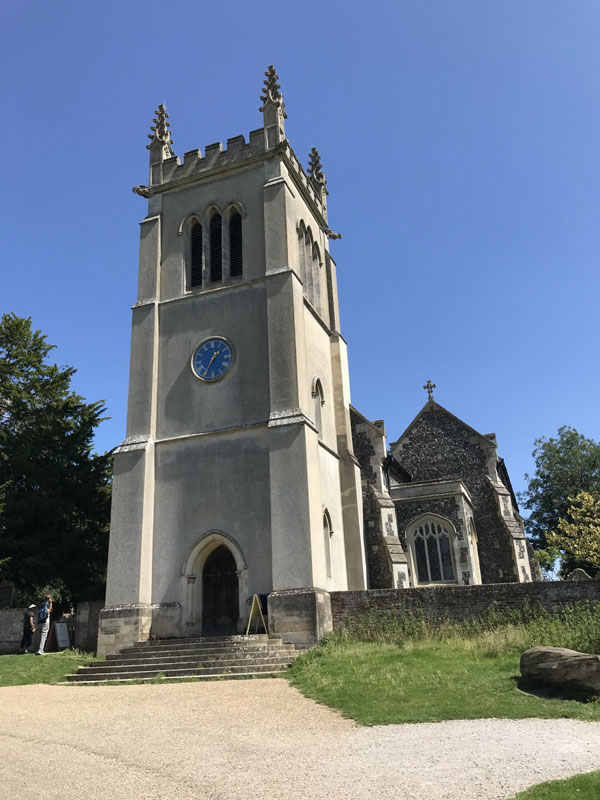
At the entrance to the estate is a rather startling ruined church, which can be reached from the car park. It was largely wrecked in 1948 when the steeple collapsed, destroying the nave and south aisle, but preserving the chancel and Bedingfeld Chantry.
There is a lot to look at on this estate, and it is well worth a visit.
Ickworth, Suffolk
 National Trust.
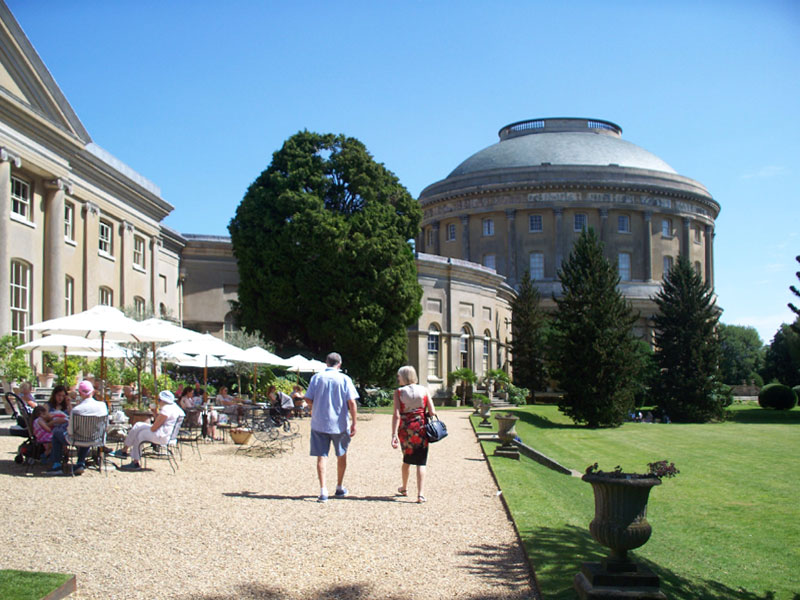
The house is unusual, having a huge and palatial central rotunda and two curving wings connected to it by corridors. It was built by the eccentric Earl-Bishop of Derry, Frederick Hervey, to house his collections, a plan realised by his descendants.
One of the wings leads to a Pompeian Room, the block beyond being occupied by the orangery and the modern visitor reception. The other, east, wing corridor terminates in an ante-room, with more collections. The block at the far end of the east wing was the family residence, now a hotel. There are also exhibits in the basement. Outside, there are 70 acres of formal gardens and 1800 acres of park. The Italianate garden is behind the house.
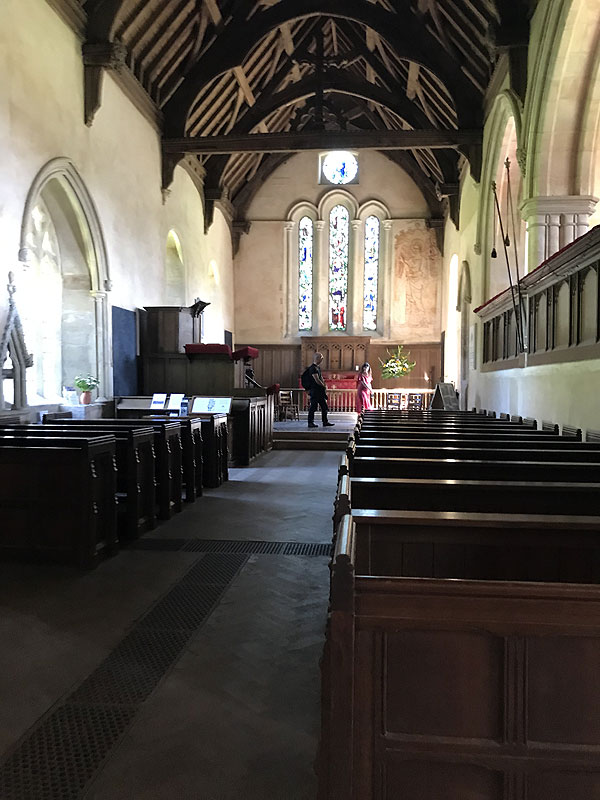
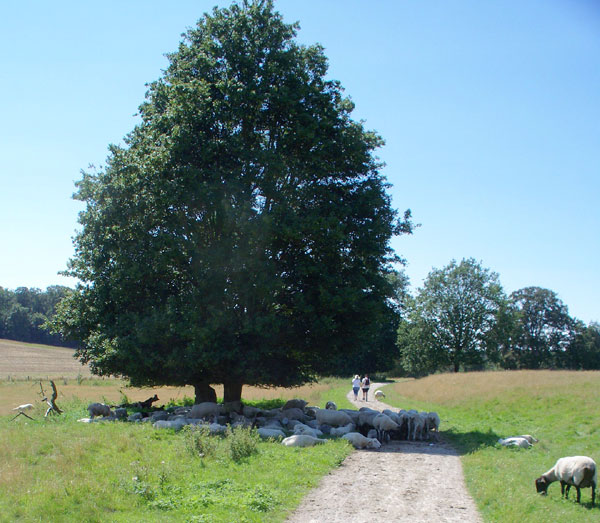
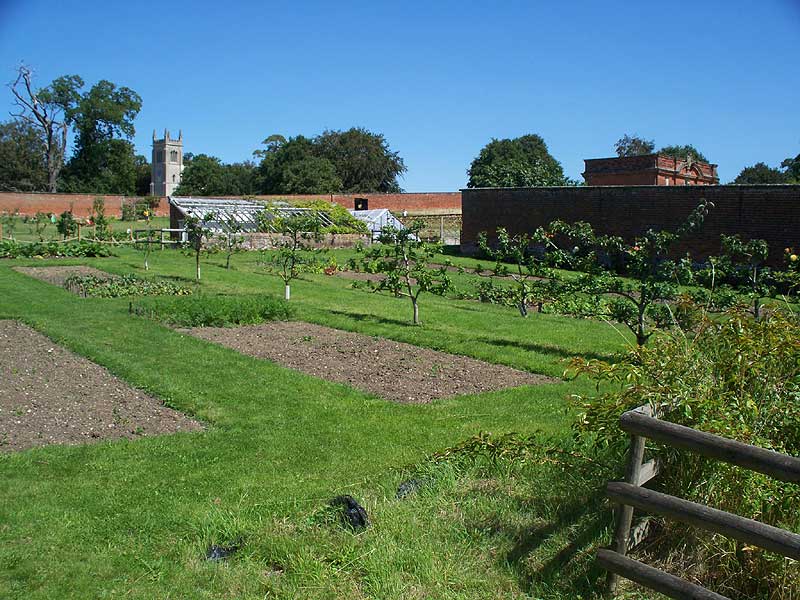
The grand rooms are impressive and the house contents are of interest. On my last visit I explored the park, in which it is posible to take a 7 mile walk. Some of the paths are hard-surfaced trackways on which you can cycle or use a mobility buggy. On a walk around the relatively short River Linnet trail I saw a lot of grassland and arable, the walled garden with listed summerhouse, and St Mary’s Church.
There is another church (St Leonards at Horringer) at the estate entrance.
The house and park together could be an all-day visit.
Or if you are coming a long way, you could also visit Melford Hall nearby.
Meldon Valley, Devon
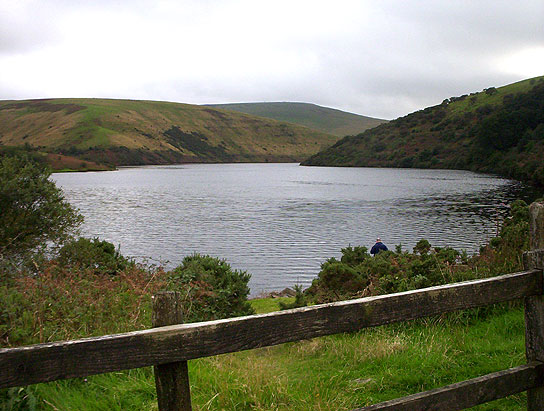
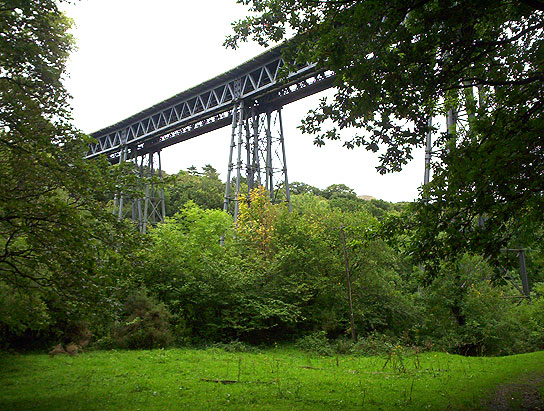
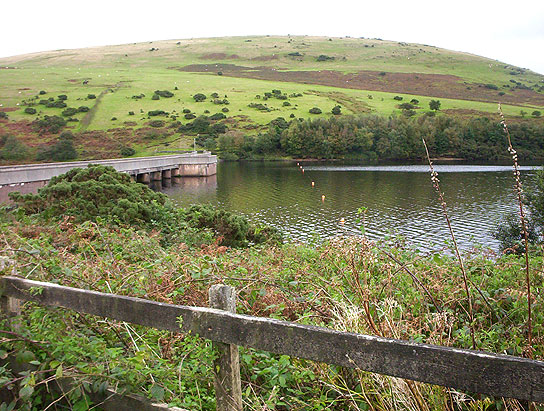
I parked near the reservoir and had a walk around, passing under the viaduct, and I photographed some holes that looked like old workings. None of the hole pictures came out very well. In the virtual tour (below), an old engine driver reminisces that winds on the viaduct used to be felt on the trains, so cyclists should take warning.
There is a virtual tour of the valley at Virtual Tours.
Higher Uppacott Dartmoor Long House, Devon
The Dartmoor longhouse is a type of medieval farmhouse once common in the area. Built on a slope, they housed people and animals in the same building. The people lived in the upper end, above a cross passage, and the cows were tethered in stalls in the lower end, or shippon, with their heads to the wall, and their other end near a central gully which discharged out of the lower end of the building. Once there were hundreds of these longhouses, but while some survive as cottages or farm buildings, almost none still have an unconverted shippon.
This one was purchased by the Dartmoor National Park Authority because of its original state. The living quarters have a large fireplace, old-fashioned rooms and an upstairs where original thatch still blackened by a medieval central fireplace can be seen. Below the cross-passage, the shippon still has animal pens and central drain.
The longhouse is not regularly opened to the public, partly because of that problem that afflicts ancient settlements that collide with the 21th century, i.e. “nowhere to park”. I saw it on a Heritage Open Day, when we had to rendezvous at a moorland car park half a mile away and be ferried to the site. The visit was most interesting, and I recommend that you check out visit opportunities and make the effort to see it. There is also an online virtual tour.
Lynton/Lynmouth, Devon
You might recall Lynmouth as the scene of a flood disaster some decades ago. Essentially, Lynton is on the clifftop and Lynmouth is down below, and the two are connected by steep roads and a famous cliff railway. Lynton is a Victorian village where it can be interesting to wander around and look at stuff. There should be fine sea views from here. You can take the water-powered railway 500ft down the cliff to Lynmouth and wander around there and look at stuff, including the harbour, and the interesting exhibition about the flood disaster of 1952.
The roads in this area are of the brake-testing variety. The A39 snakes around Lynton and the gorge in a very roundabout way with some step gradients, but if you go through Lynton, which is the way a sat-nav may direct you, you will descend to near sea-level and up again via 1 in 4 gradients.
Hartland Quay, Devon
This is a dramatic stretch of rocky coast with high cliffs, where ships used to run aground in large numbers, with much loss of life and property. Despite modern engines and navigation aids, they occasionally still do…
The land around the Quay is privately owned, and one usually has to pay a small charge to drive onto it and park. There is a parking area halfway down, if you don’t want to drive all the way down and up again. Down below is a hotel with public bar, a small museum with exhibits about wrecks, and an area of shore where the harbour used to be before it was demolished by storms. On the beach in the other direction there were some rusty bits of ship lying about.
It’s worth spending a few hours here, to look at the view, look down on any wrecks, visit the wreck museum, have a drink, and maybe paddle from the beach.
If you want more to do, in the same area are other look-out points, e.g. Hartland Point, and also the Hartland Abbey estate. There are also coastal paths.
Greenway, Devon
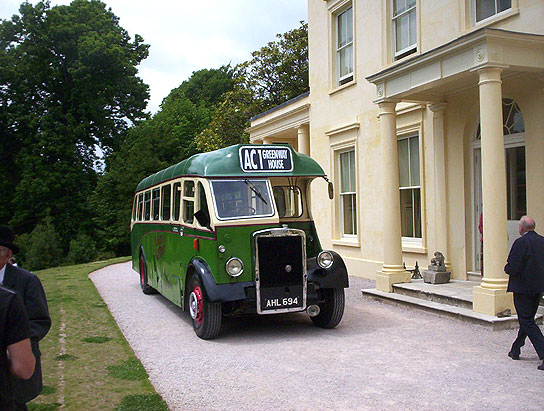
This is the former home of best-selling author Agatha Christie. The house is in a rural setting on the banks of the Dart estuary, and is set in extensive gardens and grounds that slope down to the riverbank. Many visitors, of course, are drawn here by the Christie connection. The house contains many interesting family collections (Christie’s husband was an archaeologist). The Georgian house dates from 1790, with early nineteenth-century additions.
There is an intriguing frieze in the library, painted by an American naval officer whern the house was requisitioned during WWII. Outside there is a stable block, and down by the river a substantial Georgian boathouse. The gardens are quite large and some time can be spent exploring them.
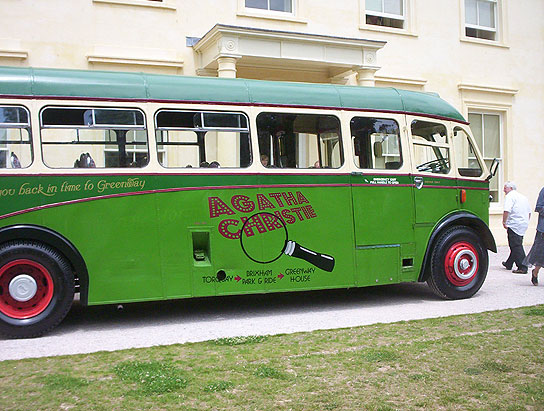
There are strong disincentives to arriving here by car – the roads are awful and the NT car park is very small, so visitors have to ring up and book a space well (i.e. days) in advance. I don’t remember my whole itinerary, but I arrived by minibus from a bus station in some town nearby. Apparently there is also a vintage shuttle bus service. You can also arrive by river ferry from Dartmouth etc.
Hound Tor Medieval Village, Devon
English Heritage.
This deserted medieval village comprises four thirteenth century stone farmsteads, which were probably abandoned in the 15th century. Walls survive to a height of about 3 feet, marking out the outline of various structures.
This is quite an interesting site to find and visit. You will need a detailed local map. If you park by the minor road that runs to the west, the village is more or less behind Hound Tor, so you have to climb the Tor or skirt around it till you see the remains. Distance about 1000 yards. Walking boots and stout trousers are recommended, as there may be dense vegetation in places.
Burrator reservoir, Devon
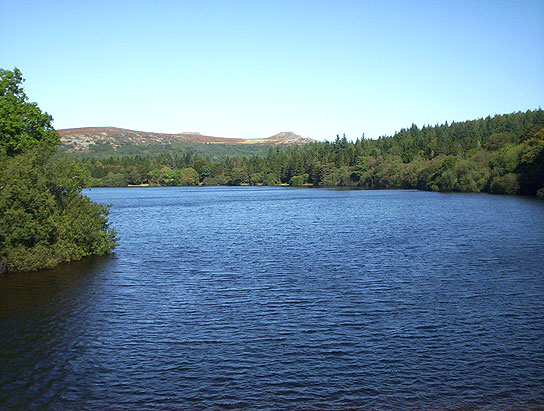 The reservoir, which supplies water for Plymouth, is situated in the western part of Dartmoor, near Yelverton. The banks are heavily wooded. Roads and footpaths go all the way around the reservoir, making it a popular route for cyclists and walkers. The circuit is about 3 ½ miles and fairly flat.
It doesn’t really matter where you start: there is parking by the main dam and at the opposite end where a stream enters the lake. Nor does it matter which way you go round, but if you start by the main dam and walk anti-clockwise you will soon come to another dam, which closes off a secondary valley. The head of the lake is still a long way off… If you walk along the lakeside paths on the northern side, you may come across an interesting ruin. To the north of the reservoir, in the woods, can be found old leats that supplied water to Plymouth, and also a disused tramway track with road bridge.