Old Royal Naval College, Greenwich, London

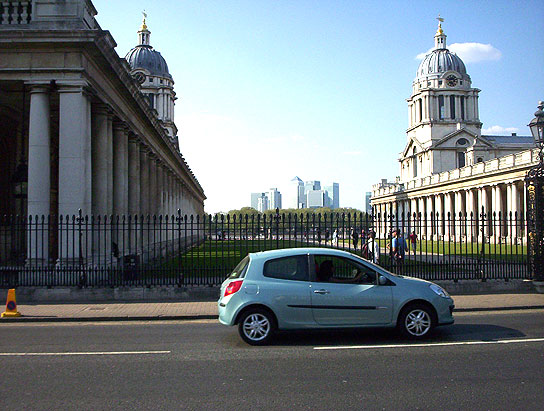
College, passing car, distant tall buildings
College buildings

The site was planned by Sir Christopher Wren in 1694 and executed by several famous architects of the day as the Hospital, a residence for seamen pensioners. The Hospital closed in 1869 and the Royal Naval College moved in, training naval officers till 1998. Today, some buildings are used by Trinity Laban college and the University of Greenwich.
The Chapel & Painted Hall are open to the public, free of charge.

Painted Hall: The Hall “probably the finest dining hall in the Western World” is decorated with huge paintings by James Thornhill. It was intended as a dining hall for the pensioners, but never used as such, for when finished it was considered too grand and too much of a tourist attraction. The body of Admiral Nelson lay in state here.
Not my taste, but it’s certainly worth visiting if you are in Greenwich.

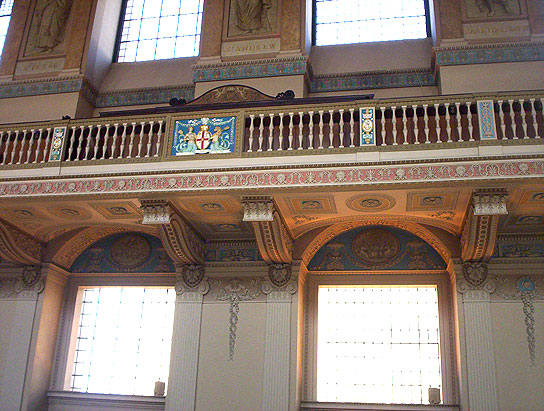
Chapel: The Chapel was first completed in 1751, gutted by a disastrous fire in 1779 and reopened in 1789. Unlike many churches which are a mixture of styles through the ages, the Chapel is a complete and unaltered neoclassical period piece.
I thought the Chapel had a very attractive interior. Well worth a visit.

The ORNC is part of the Greenwich World Heritage site, along with the National Maritime Museum etc. There is a visitor centre near the Cutty Sark restoration site. The site can be reached by various means of transport, including the river.
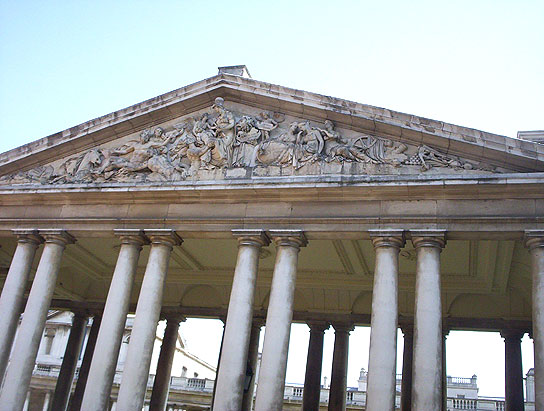
Classical temple-like frontage
Arcade
Period interior
The Chapel

Wellington Arch, London

The Wellington Arch stands at Hyde Park Corner, close to Wellington’s Apsley House. On top of it is a great bronze statue, the largest in Britain, depicting the angel of peace descending on the chariot of war. Visitors can go inside the Arch, to view three floors of exhibitions and enjoy views from the balconies near the top.

A visit inside is interesting, and the exhibition explains that the Arch originally was elsewhere and also had a different statue on top.
One can buy a joint ticket for the Wellington Arch and Apsley House. To make a day of it, one can also view the various monumental sculptures nearby, and then walk through the park to the Marble Arch, checking some more old and modern sculpture installations on the way.
You can travel here by tube or bus.

National Maritime Museum, Greenwich, London

Formally, the Queen’s House and the Royal Greenwich Observatory are part of the National Maritime Museum. The whole are set in Greenwich Park, in the Greenwich World Heritage area.

Maritime Galleries: It’s difficult to explain what the NMM contains without simply referring you to the website, but besides artefacts ranging from buttons to 10-ton anchors there are themed galleries devoted to such topics as trade or exploration, slavery, warships, etc. There is an increasing amount of interactive stuff, including the facility to collect images on a smartcard and look them up later. For the serious researcher, the Museum has a library and archives. The fusty rows of ship models that I recollect from 2002 have largely been banished.
There is a great deal inside for the interested visitor to see.

Queen’s House: The building itself is of some architectural importance as England’s first Classical building, finished in 1638. It was designed by Inigo Jones. A notable feature is the 40ft x 40ft cubical Great Hall on the northern side. The house was originally built in two halves bridging over a main road, but the middle sections have been partially filled in. It houses the NMM’s painting collection, which has a wider scope than one might expect. Various galleries cover national art, the Royal Hospital School, historic Greenwich, the Tudors, and Dutch marine artists.
The Queens House is well worth a visit if you are interested in art.

Royal Observatory – see separate entry.

Most parts of the complex are free admission, but there is a significant charge for admission to the Observatory, to the annoyance of many visitors who just want to be photographed standing on the Greenwich Meridian.

Minster Lovell Hall & Dovecote, Oxfordshire

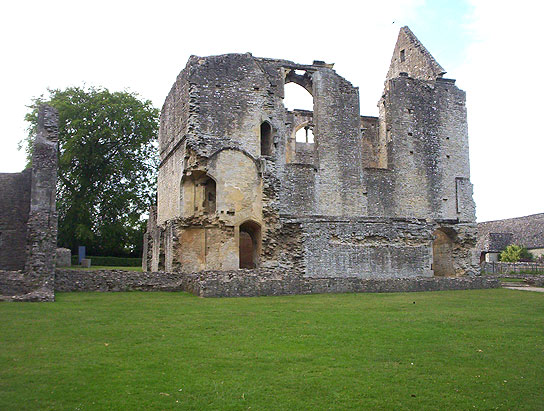
Ruin
English Heritage.
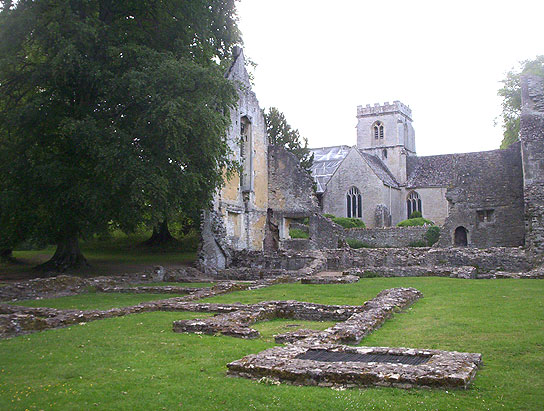
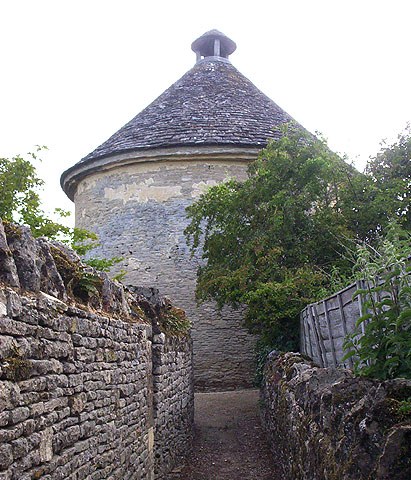
Minster Lovell Hall is, or was, a 15th century riverside manor house. The ruins of a fine hall and corner tower can be seen, also a complete dovecote.
The ruins are quite interesting and worth a look if you are passing that way. The setting is pleasant and peaceful.
I found that finding the Hall was more troublesome than it should have been, because of vague or absent signage. First find the village, then find the church. Park up and look behind the church. The signs directing you to the dovecote are also rather vague, but if you look for a circular building with a pointy roof, you should be able to spot it in the middle distance.

Ruin
Ruins
Ruins behind church
Ruins behind church
Conical roofed building
Dovecote

Kenwood, London

English Heritage.
Kenwood was remodelled by Robert Adam between 1764 and 1779 into a majestic villa for the judge, Lord Mansfield. In 1927 Lord Iveagh bequested Kenwood to the nation, along with a collection of pictures. The Iveagh Bequest includes important paintings by many great artists, including Rembrandt, Vermeer, Turner, Reynolds and Gainsborough. Upstairs is the Suffolk Collection of portraits, notable for the costumes depicted. The Kenwood interiors are also worthy of note.

I didn’t have a lot of time to enjoy Kenwood before it shut but I did manage to look at the pictures, which include some famous and impressive works. Surrounding the house is some pleasant leafy parkland.

Admission to Kenwood is free to all.
Bus 210 stops near Kenwood.
If you are planning a 3-in-1 day visiting Fenton House, 2 Willow Road, and Kenwood, don’t try walking across the Heath – it takes too long for the purpose and it is too difficult to find one’s way. A taxi might be quickest. Or use Bus 210.

Great Coxwell Barn, Oxfordshire

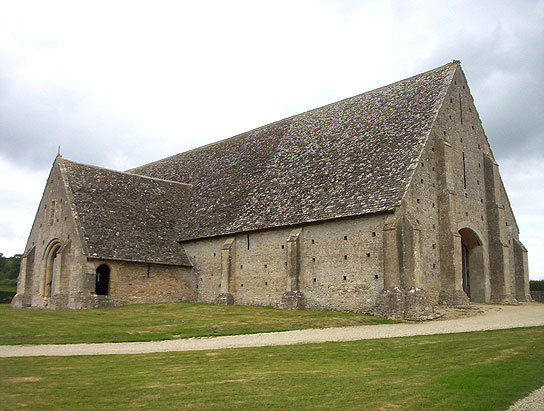
Barn
National Trust.
Great Coxwell Barn was built in the mid thirteenth century for the Cistercian abbey of Beaulieu. 152 feet long, it has buttressed walls of Cotswold stone, and a soaring stone-tiled roof with its rafters supported on slim oak timbers. Projecting porches either side of the barn house the original doors.
This is an impressive building and worth seeking out if you are in the area. The visit won’t detain you long, however.

Firepower – Royal Artillery Museum, Woolwich, London

The Royal Artillery Museum is hosted at the historic Royal Arsenal site beside the Thames at Woolwich. On display are a large number of guns and gun carriages ranging from medieval up to post WWII, together with exhibitions which tell the story of artillery, scientific discoveries made through warfare and human stories of courage and endeavour. The ‘Field of Fire’ audio-visual show puts visitors in the midst of battle as shells whiz overhead and guns roar. A world-class collection of artillery and associated weapons, uniforms, drawings, displays of diaries and medals records some 700 years of world artillery history.

The Royal Arsenal site itself is worth a stroll, with its wide spaces, many elegant listed buildings, and some modern outdoor sculpture. Less happy was the experience of finding Firepower still shut when it was supposed to be open. Right day? Check. Right times? Check. As a last resort I went to enquire at a café attached to the side of the building, and in the process rousted out the receptionist who didn’t seem to know what time of day it was.

The exhibits were interesting, and there was enough to look at to occupy a couple of hours or more. Building 41 with the large objects collection was not open on the date I visited, but it should be when you visit.
I travelled by train, but if you have to drive, there is a pay & display car park nearby at the Plumstead Road entrance. The Thames Barrier is not far away, and can be reached by bus.

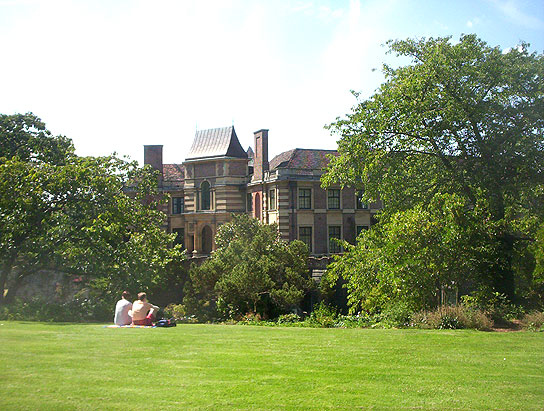
Eltham Palace, London

House and grounds
English Heritage.

There was a royal palace on the site, but all that remains is the great hall (much restored) which is incorporated into the 1935 Art Deco mansion. The Courtaulds bought a 99 year lease and demolished some old buildings (mostly not really old or interesting) before building their state-of-the-art Art Deco mansion.

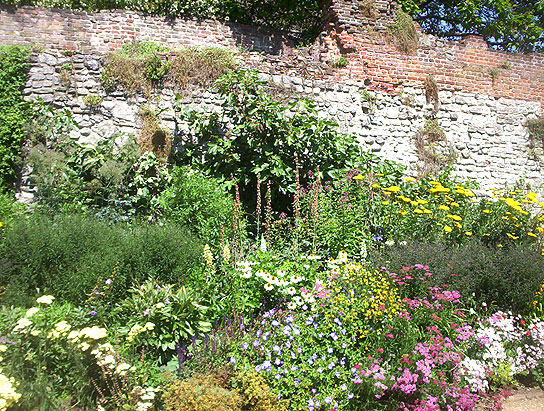
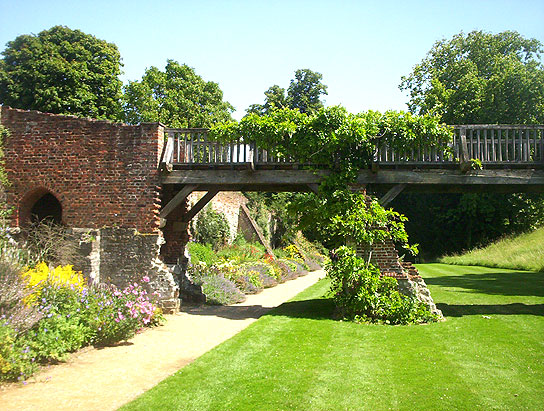
It appears that no expense was spared – it’s big, and the lady liked gold plated bath taps. The Courtaulds only enjoyed their house for about 8 years, before the war and persistent near misses from sundry German munitions caused them to move to Scotland. They never returned, and the house was leased to the Army education service, who used it for half a century. English Heritage have now restored the house to its 1935 appearance, using reproductions where items had disappeared. The principal rooms, with walls and ceilings in Art Deco styles with lots of wood veneer panelling, and some inlaid marquetry pictures, are well worth seeing. There are also extensive gardens, which have been restored to something like the 1930’s appearance (but minus the swimming pool and squash court). Medieval remains can be seen in the grounds. The original 1930’s outbuildings, greenhouses, etc are around the EH car park, outside the ticketed area and a little way off the pedestrian access.

The house and gardens are well worth a visit. Not to be missed if you are a fan of Art Deco style.
I travelled here by train.

Garden
Garden
Garden with bridge
Garden

Chiswick House and Gardens, London

English Heritage.
This Roman-style Palladian villa was built for the third Earl of Burlington in the 18th century, and designed as a grand pavilion for entertaining friends and displaying art. It is considered an outstanding example of an early Palladian villa in England. Inside, it has some sumptuous interiors in the central hall and upstairs, and a collection of art. The house as seen today is stripped of any service rooms. The original ones were in the old Jacobean house, long demolished, and the replacements, attached at each side, were in use after the house was gifted to the public, but demolished sometime after WWII.
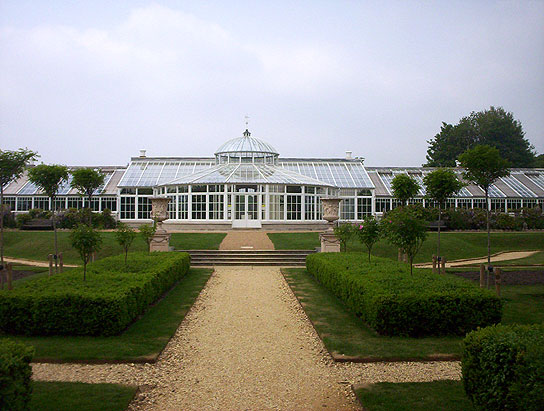
The extensive gardens are also considered of national importance. They contain walkways and vistas, and features such as a long lake, a cascade, a conservatory, walled gardens, Ionic temple, etc.

The house is well worth a visit. Externally it is an attractive building, and inside there are some impressive restored interiors, some fine paintings, and some exhibitions to look at. It is notable that there are no service rooms at all, apart from a cellar. While the surviving part was lived in at one time, it was built as a pavilion. The gardens are vast, and one can tramp around for some time finding fresh things to look at. I travelled by train.

Conservatory and grounds
Conservatory

Buscot Park, Oxfordshire

National Trust.
The house is a late eighteenth-century Neo-classical building. The pavilions to each side, and the imposing flight of steps leading up to the entrance front, were added in the 1930’s. The interiors are lavish, with extravagant chandeliers, inlaid and painted Regency and Empire furniture, and mahogany doors. Many noteworthy paintings hang in the house. The more prized contents form part of the Faringdon Collection. A cycle of Burne-Jones paintings, Legend of the Briar Rose, runs around the walls of the saloon.

Outside are extensive gardens and grounds. The entrance, ticket office, walled garden and tea-room lie to the west of the house, and the Pleasure Grounds, with the larger lake and various garden features of interest lie to the east. There is a notable water garden with features leading down to the lake. Frescoes can be found in the archway leading to the (private) outdoor swimming pool, and in the tea-room.

The house interior and Faringdon Collection are well worth seeing, and the gardens provide plenty of scope for sightseeing and walking.
Opening days and dates are somewhat restricted.