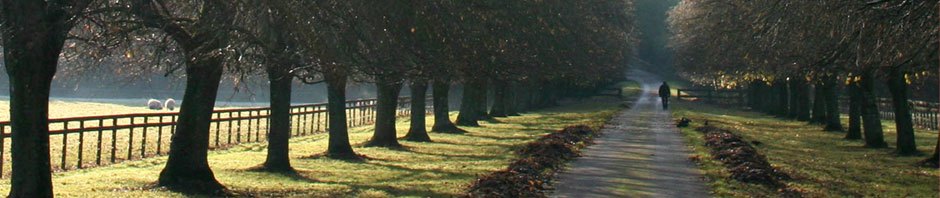
In the 1820’s a tramway with granite stone rails was constructed from granite quarries around Haytor to a canal terminal near Bovey Tracey. The tramway was required to get the granite down a steep gradient from the quarries on the moor to a location where it could be loaded onto water-bourne transport. The tramway was in use for several decades, and sections of the branching tracks can still be seen on the moors around the old workings, and crossing modern roads.
It’s interesting to follow these on the ground, and it also makes for a healthy walk. To get started, you need a large scale map that shows the tramways in relation to the modern roads and the Tor. Boots and stout trousers may be required in the more rubble-strewn or overgrown spots. My sister lives in Devon so I just borrowed her maps…
Month: October 2011
Lanhydrock, Cornwall
National Trust.
The house dates from the 1630’s, but was largely rebuilt after a disastrous fire in 1881. Only the Jacobean gatehouse and the north wing survived. The Jacobean-styled house in silver-grey granite extends around three sides of a courtyard and contained every Victorian convenience except gas and electricity, which the owner found too hazardous. Inside, the newer and restored interiors contain interesting portraits and furniture, and a complete set of Victorian domestic paraphenalia in the service rooms. The old North wing has a 116-foot gallery with a barrel ceiling covered with remarkable 17th century plasterwork. Male and female servants had separate quarters. A large informal garden covers the steep slopes above the house.
The house makes an interesting visit, as the fine rooms and bedrooms are deeply elegant, while the numerous rooms devoted to nurseries, kitchens and servants quarters give an insight into Victorian life ‘below stairs’. I don’t recall the gardens, but the day was rather damp. For the able- bodied, there is a 600-yard walk between car park and house.
Trelissick Garden, Cornwall
National Trust.
The garden was developed from the 1930’s onwards and contains many sub-tropical plants. The grounds slope down to the waterside of the Fal estuary, with gardens on many levels, set in hundreds of acres of woods and parkland. The gardens contain many species of flowering shrubs. A road leading down to the chain ferry which links the east and west sides of the estuary divides the garden into two parts, and a rustic bridge over the road links the old and new gardens. For the walker, the gardens contain many hundreds of yards of pathways.
If you enjoy gardens, this one is well worth a visit. The house is not open, and in fact it’s quite awkward to see it from the gardens, though its white front is a landmark when viewed from downriver.
It is possible to reach the gardens by riverboat from Falmouth etc.
St Michael’s Mount , Cornwall
National Trust.
The house, perched on a rock off the Cornish coast, is a strange hybrid of monastery, fortress, and elegant country house. A Benedictine priory was established here in the twelfth century, and a fourteenth-century church survives. The site was later converted into a fortress armed with cannon, and was key in the defences against the Spanish Armada in 1588. It was ocupied by Royalists during the Civil War, before surrendering in 1646 to a Parliamentarian whose family have occupied it ever since. Inside are Georgian interiors, some rare plasterwork, and fine Chippendale furniture. Outside, there is a terraced rock garden below the house, and an eighteenth-century walled garden.
Approaching the house is, to say the least, unusual. At low tide you can walk across the causeway, while at high tide small boats ferry visitors across to a little harbour on the landward side of the Mount. One then has to negotiate a steep cobbled path up through the gardens to the house entrance a long way above.
The house with its varied architecture is interesting, and the contents are worth seeing. There are also fine sea views, and there is more to see in the gardens and around the harbour. Altogether a visit to St Michael’s Mount is not to be missed if you are in the area.
Burgh Castle, Norfolk
English Heritage.
This is a Roman “Saxon Shore” fort in countryside near Yarmouth, and close to the River Waveney. Three walls and various towers stand to near their original height, the fourth wall having collapsed into the river centuries ago.
Both the size of the site and the degree of preservation of the wall and towers are quite impressive. It’s worth seeking it out if you are in the area. There is no charge for visiting. Visitors should find somewhere to park near the church, and follow the signed footpath.
Buckland Abbey, Devon
National Trust.
Buckland Abbey was bought by Sir Francis Drake after his triumphant return from his circumnavigation of the globe in 1580. He was able to purchase a house that had recently been converted from the abbey church by his rival Sir Richard Greville. The house contains many mementoes of Drake, while its fabric contains many relics of the thirteenth-century abbey church in the form of its crossing tower, blocked arches and traces of monastic windows, and inside, the tracery of the chancel arch. The house has Georgian alterations, and the only complete interior surviving from early times is the sixteenth-century great hall. This is warmly panelled in oak, with an elaborate ceiling, box frieze, and relics of Grenville’s retirement to Buckland. In the upper part of the house, rooms of no architectural interest contain displays.
The interior and the Drake relics are interesting. Outside is a great monastic barn, built about 1300, and one of the largest in Britain. To my mind this is a more satisfying piece of architecture than the mongrel church conversion. Also to be seen are a little herb garden, and a re-created Elizabethan garden, and the wider estate.
As the crow flies, Buckland is quite close to Cotehele (NT), but if you are planning to do both in one day, be cautioned that they are not so close via the local roads!
Grimspound, Devon
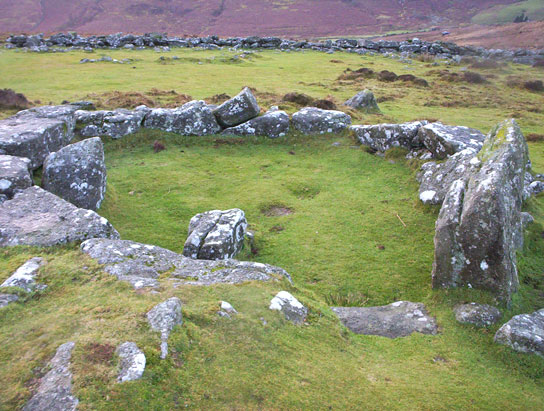
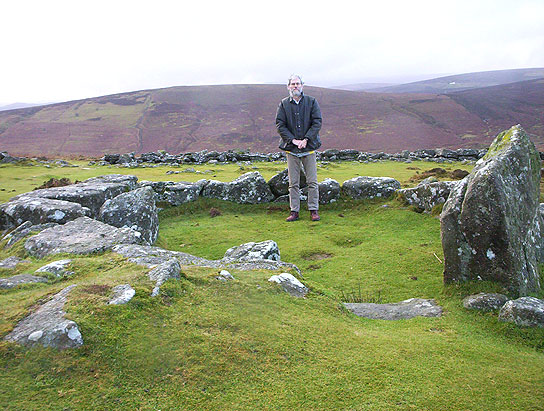
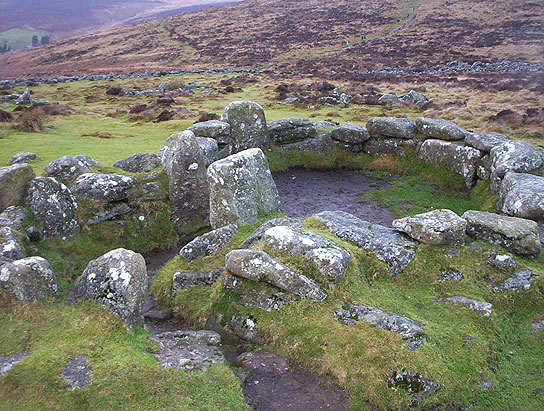
Grimspound is a late Bronze Age settlement on Dartmoor, Devon. It consists of a set of 24 hut circles surrounded by a low stone wall. It was probably first settled around 1300BC. Each of the roundhouses had a massive perimeter wall built of granite.
Today, the ring wall that enclosed the settlement can be clearly seen, and many of the hut circles are clearly identifiable. The surrounding country is desolate, with few signs of human habitation.
This is an inspiring place to visit, as one rarely has the opportunity to stand in the ruins of anything so old but still identifiable as housing. It can also be rather difficult to find, as there is little signage and there are few obvious landmarks on the nearby roads.
If you have the kind of sat-nav that lets you enter the OS ref or lat/long directly, that no doubt would be a great help. Otherwise, drive west along the B3212 from Moretonhampstead for about 8 miles, passing the Minature Pony Centre and ascending a hill. The road sweeps right, then left, and about 2 miles past the Minature Pony Centre there is a tarmac turning to the left, showing as a 40 deg. fork on the satellite view. (& possibly signed for Dunstone or Widdecombe). At about 1.2 miles look out for a dip and kink in the road with stopping place and an inconspicuous sign immediately preceding. Grimspound is about 400 yards above here to the left. (The surrounding wall shows faintly on the satellite view as a circle.)
If you see a track on the right joining from below, you are passing the place where you should stop…
Hartland Abbey & Garden, Devon
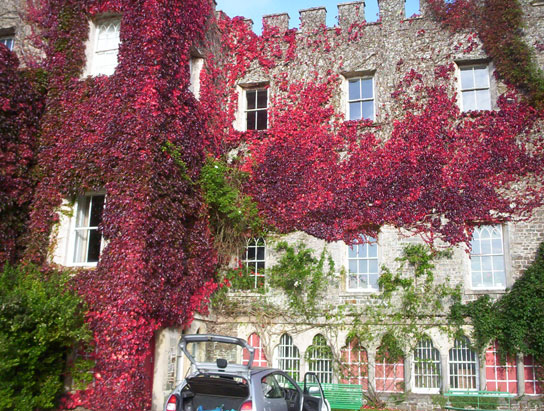
There are extensive gardens and grounds leading down to a rocky cove on the coast.
The house and contents were interesting and I remember exploring parts of the gardens.
Chambercombe Manor, Devon
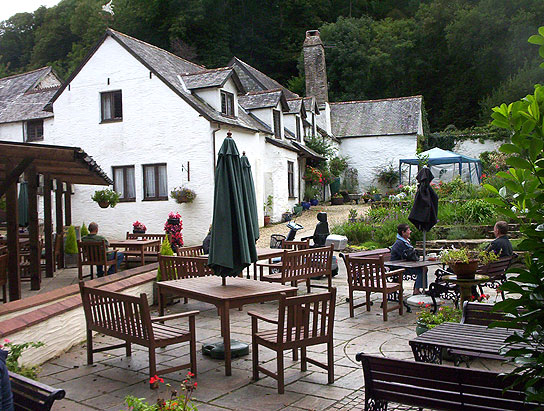
The house and contents are of some interest, and there are several acres of gardens which can be explored. The website makes much of the paranormal in an effort to stir up more interest in the place.
Tapeley Park, Devon
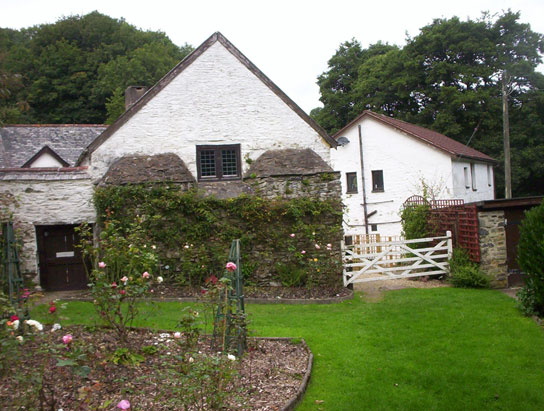
Tapely Park stands in a superb position overlooking the estuary. It’s an attractive imposing but elegant ‘Queen Anne’ style Georgian villa of brick with stone pilasters, parapet and a pediment, sitting above the impressive terraced gardens.
The owner, Hector Christie, had a reputation as an eccentric young aristo, but in recent years he seems to have put all that behind him, and since featuring in Channel 4’s “Country House Rescue” has made efforts to run the house and estate as a proper business. As evidence, there are now two websites, one for weddings, the other for garden visitors.
My nephew lived at Tapeley for a while, and helped build the “Straw Bale” house which stands in the grounds. As the name suggests, this is a small environmentally friendly building constructed of straw bales.
Besides the formal Italianate gardens, there are kitchen gardens, nature gardens, and when I visited, various animals including pigs.
The interiors apparently are of note, featuring a grand staircase hall and also several good fireplaces and plaster ceilings. At the back and upstairs, and in the big kitchen, the rooms definitely had what one could kindly call a period, lived-in look.
Website (for garden visits): http://www.tapeleygardens.com/