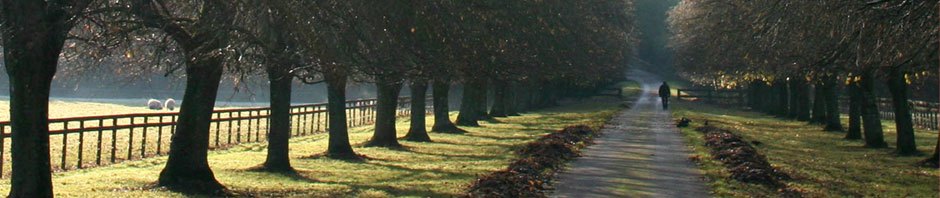
National Trust.
This unique Modernist home was designed by architect Erno Goldfinger in 1939 for himself and his family. The house has surprising design details that were groundbreaking at the time and still look fresh today. By comparison, the average estate house of today looks timid and boring. The house also contains the Goldfingers’ impressive collection of modern art, intriguing personal possessions and innovative furniture.
As a fan of good modern architecture, I found the visit most interesting. By the way, the houses at each end of the short terrace were built at the same time but do not belong to the Trust. As I left, I noticed that one of them has an application posted seeking to replace the Goldfinger windows with UPVC. (I hope the planners told this philistine where to get off.)
The terrace with no. 2 does look a bit like a small commercial block, but is not unattractive. Goldfinger had great trouble getting his design passed by the local planners, who wanted something more in keeping with the rest of the street. Unfortunately for their case, the nearest pre-existing Victorian houses are oversized and ugly.
Entry before 3pm is by timed guided tour. An introductory film is shown at regular intervals.
The house is about ¼ mile from Hampstead tube station – No.2 is at the far end of Willow Road. If you have to drive, you might find parking at East Heath Road or at parking meters.
Month: October 2011
Fenton House, London
National Trust.
This 17th-century merchant’s house has remained largely unaltered during more than 300 yars of continuous occupation. Inside, there are notable collections of furniture, pictures and porcelain. In almost every room stand early keyboard instruments collected by Major Benton Fletcher. The walled garden has terrace walks framing a lawn and sunken brick-paved rose garden. On the other side of a high wall is an orchard and vegetable garden.
The house and contents are well worth a visit, as is the garden. It’s an easy walk up from Hampstead tube station, through some interesting streets. Driving and parking here looks like a no-no.
Thetford Church of Holy Sephulcre, Norfolk
English Heritage.
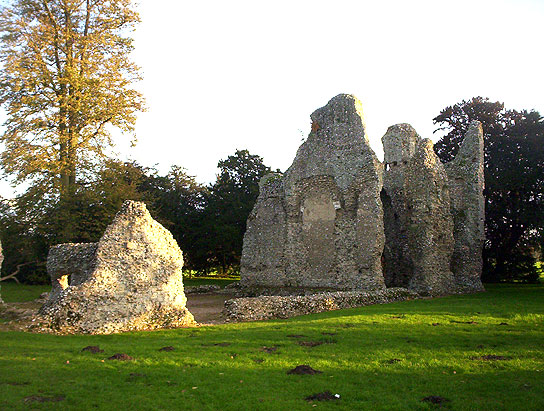
This is the only surviving remains in England of a priory of Canons of the Holy Sepulchre, who aided pilgrims to Christ’s tomb. The ruined nave of their 14th century church was later used as a barn.
Sat-nav can take you to Canons Close in a housing estate, where the back of the site is at the end of a short cul-de-sac to the right. If you arrive there, you may as well look, but a better view can be had from the other side, on the A134, where there are one or two interpretation panels. The walls stand to near original height.
Thetford Priory, Norfolk
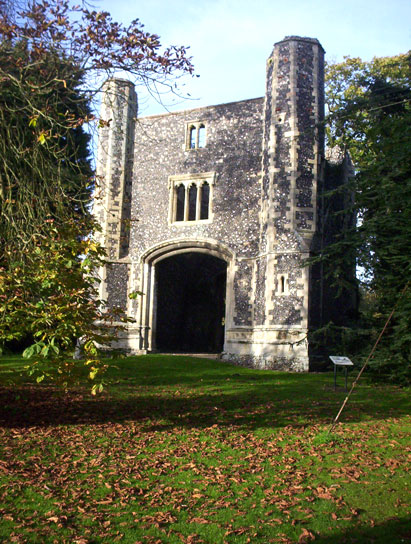
Thetford Priory was founded in the early 12th century and was a burial place for Earls and Dukes of Norfolk, and a magnet for pilgrims. Surviving parts include the lower walls of the church and cloister, and the impressive shell of the prior’s lodging, and, further away from the main site, an almost complete 14th century gatehouse.
The surviving ruins are impressive and quite extensive. A pathway from the main site leads to the gatehouse. The priory site is tucked away behind modern housing and may be awkward to find. Road access is at the S. end of Abbeygate. In the late afternoon, it seems to be a gathering place for the local youth, and when I was about to leave, I found that the lane leading to the car parking area was blocked by the police and a parked car, as the police obliged some scruffy individuals to help them with their inquiries.
Castle Acre, Norfolk
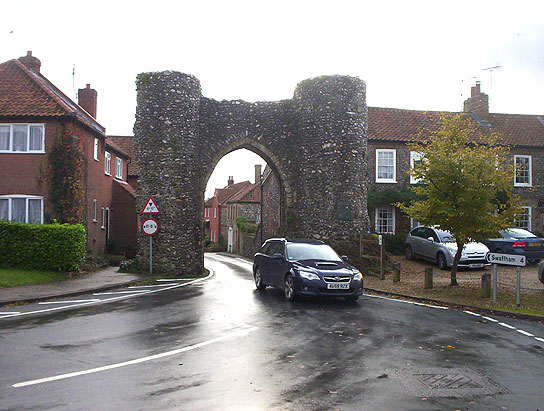
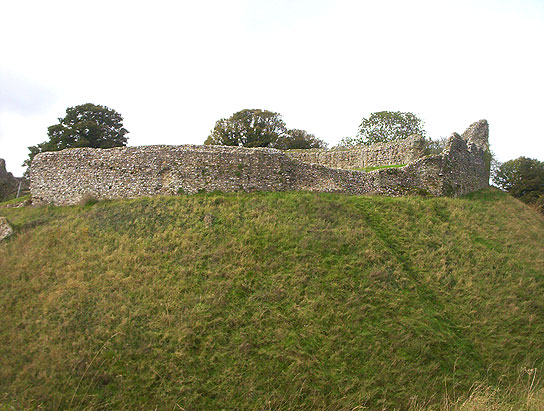
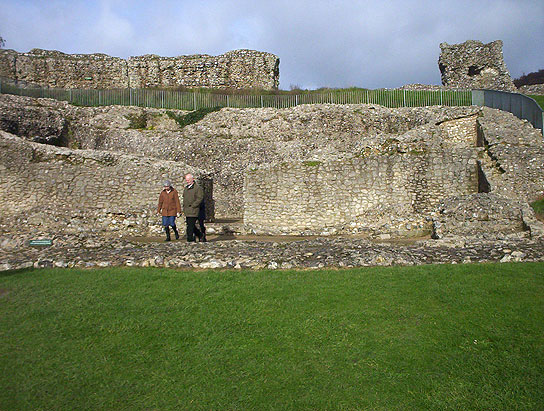
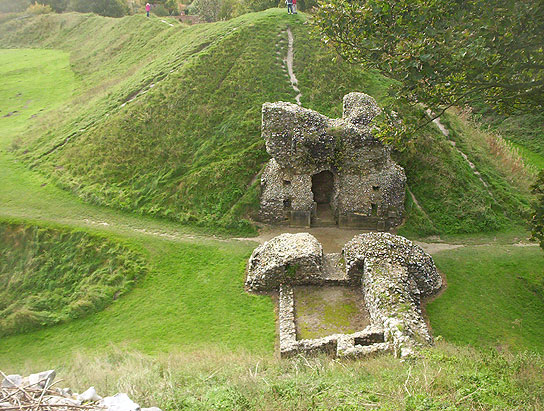
There are three separate attractions in Castle Acre, but as one would hardly travel to look at one without checking the other two, I’ll deal with all three here.
Castle Acre Castle: Founded in the 11th century as a stone built country house, it was progressively converted into a strong keep, defended by stone walls and surrounded by immense earthworks. The castle is now much ruined but the scale of the earthworks and baileys is impressive.
Castle Acre Village and Bailey Gate: At the same time that the castle was being fortified, a planned town was being built alongside, protected by earthwork defences and stone gatehouses. The north or Bailey Gate still survives, with the village street running between its towers. The village streets have some older buildings, and the ancient street layout can still be traced.
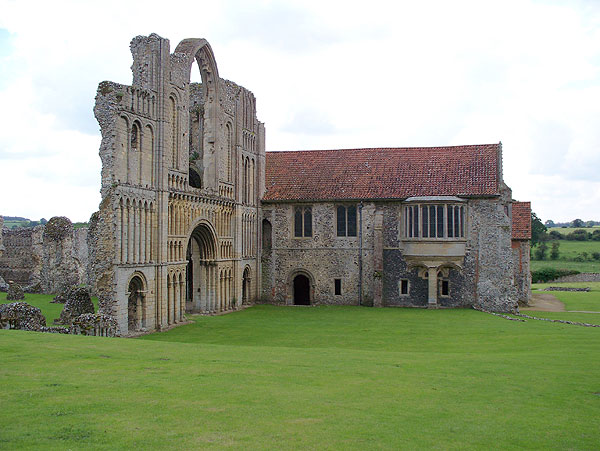
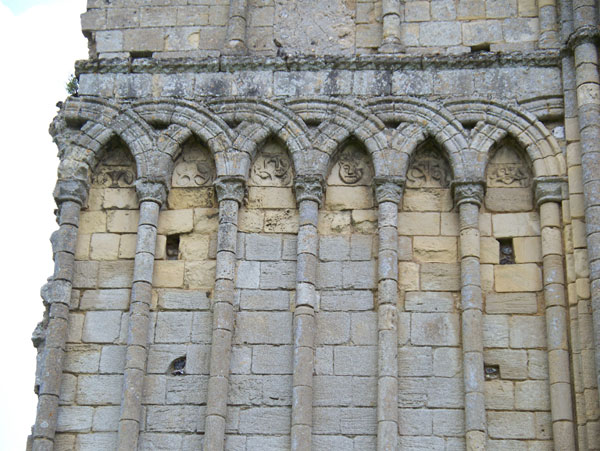
Castle Acre Priory: This is one of the largest and best preserved monastic sites in England, founded around 1090. The remains of the church have interlocking round arches. The west range of accommodation is virtually complete and full roofed, and includes a chamber sumptously revamped in Tudor times. There is a lot to look at, including exhibitions.
If you visit the EH Castle Acre Priory website, you can download maps and walking routes for the Priory and the castle and town.
Update 2012: The Priory is well worth a visit of an hour or two. A free audio guide is available which is almost too verbose at times – you should probably listen to the first two items before leaving the Visitor Centre. It is clear that the buildings were very fine before they were stripped of cut stone and other valuable materials at the Dissolution. Most of the West Front with its carved stone still survives. The Prior’s lodgings which formed a useful residence after the Dissolution are still roofed and relatively complete. The Priory is about ¼ mile west of the village – turn left on exiting uphill at the Bailey Gate.
Peckover House, Cambs
National Trust.
Peckover House is a classic Georgian merchant’s house, facing onto the River Nene which runs through Wisbech. The owners, the Peckovers, were staunch Quakers, but ran a successful private bank. Inside the house, the panelled rooms have fine Georgian fireplaces and a wealth of elaborate woodwork and plasterwork by local craftsmen. Relics include a cabinet of curiousities. The spacious two-acre garden extends behind several other properties on the riverfront. Its size comes as something of a surprise – these days a whole housing estate could be crammed into it. It is divided into a number of sections, mostly planted in a Victorian style, and including lawn, wilderness walk, orangery, glasshouses, climbing roses and flower beds.
As Peckover House is now in the town, parking outside the house is time-restricted. Apparently there is free parking at Chapel Road, 273 yards away, but I parked outside the house and had to nip out mid-visit to move my car.
Little Moreton Hall, Cheshire
National Trust.
Little Moreton Hall was built in the fifteenth and sixteenth centuries, entirely of timber framing. It surrounds a central courtyard. While most of the hall is of two storeys, the south wing has three storeys, the top floor being filled with a magnificent long gallery, possibly added as an afterthought. At any rate, the weight of the gallery and its heavy stone roof has distorted the structure below, and the floor of the gallery now resembles a wave-tossed sea frozen in oak.
(Those of an engineering turn of mind may note that the Trust recently inserted hidden steelwork to hold up the 3rd floor, and that the Hall’s undulations owe less to a medieval lack of string and spirit levels than the tendency of vertical posts to rot at the bottom and slump downwards over the centuries.)
Apart from three pieces, all the original furniture has disappeared and the rooms are shown unfurnished. The interior is corridor-less, with one room leading into another.
The building is of exceptional interest, and the external timbers have been cut in a variety of patterns to glorious effect. The whole is a testament to the ingenuity and skill of Tudor workmen.
Besides the house, there is a chapel with wall painting dating from the 16th century. The built-in dog kennel in the courtyard may amuse visitors.
Shaw’s Corner, Herts
National Trust.
The house is undistinguished, but is filled with fascinating mementoes of the great Irish dramatist and critic. Apart from the museum room, which shows gems such as the Oscar that Shaw was awarded in 1938 for the screenplay for the film version of Pygmalion, and his membership card for the Cyclists’ Touring Club, the house is still arranged very much as it was in his day. The rear garden is of a considerable size, and contains a curious rotating shed in which Shaw did much of his writing. The trees have grown rather bigger than they were in Shaw’s day, transforming parts of the garden into a small wood.
I enjoyed my visit to the house and garden, and departed much better informed about Shaw than I was when I arrived. Despite its proximity to London and some large towns, the village can only be accessed by some narrow and twisty roads, but the small NT car park can be very busy.
Castle Rising, Norfolk
 English Heritage.
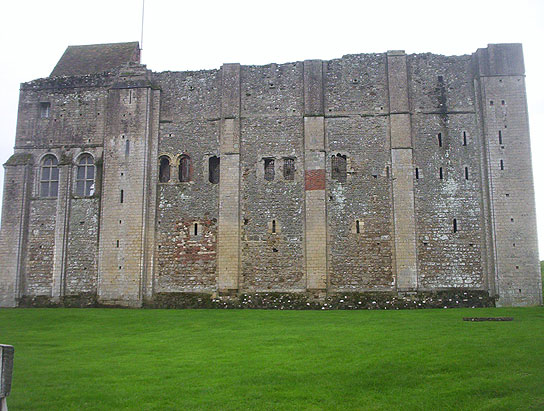
This is one of the most important twelfth-century castles to survive in England. A great square keep is surrounded by an oval earthwork, pierced by a gatehouse. A ruined church is half-buried in the surrounding earthwork. The external stonework is quite ornate, suggesting that the castle was built to impress more than to be defended against siege.
Parts of the castle are still roofed and can be visited, and other sections can be accessed by passages built into the thick walls. The Great Hall and Great Chamber have lost their roofs and floors.
An interesting and relatively complete castle, worth the effort of visiting it. Audio guide available.
If you have come a long way and want something else to do, the interesting riverside town of King’s Lynn is nearby.
Killerton, Devon
 National Trust.
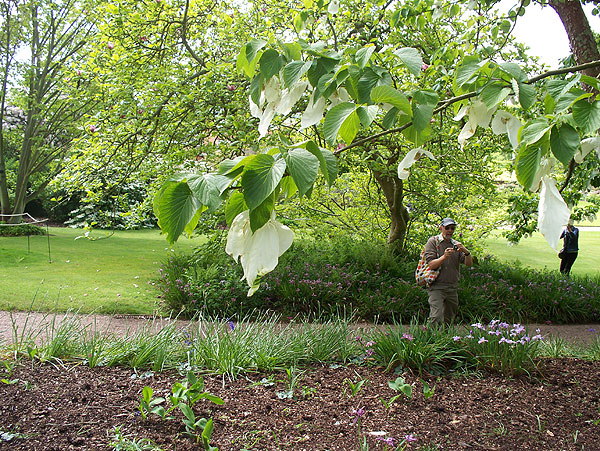
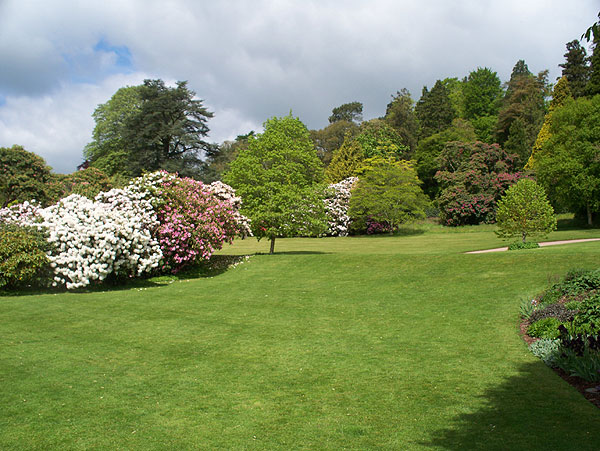
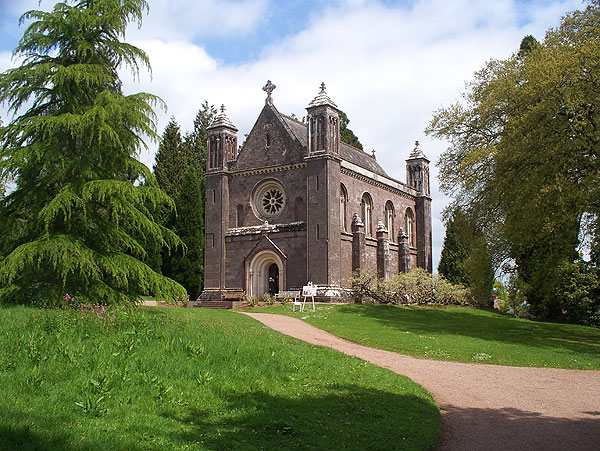
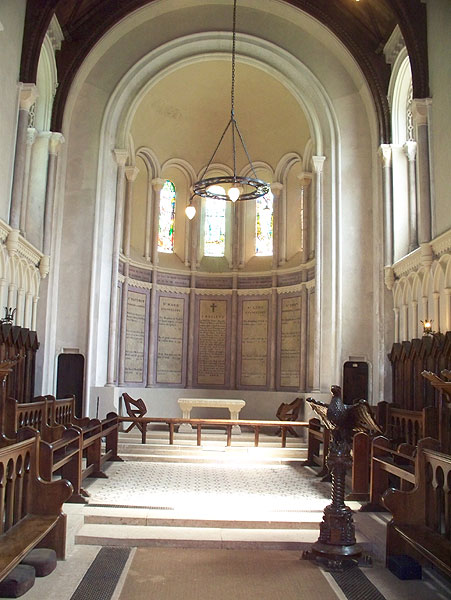
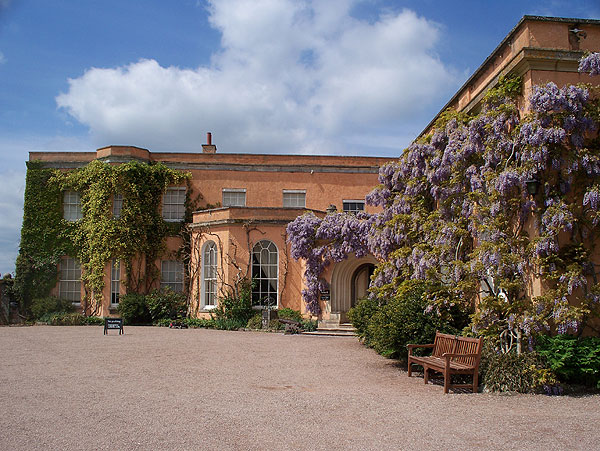
The house was built in 1778-9 but was considerably expanded in the early nineteenth century and again in Edwardian times. Elsewhere are magnificent stone stables and a Victorian Norman Revival chapel. The house is unpretentious outside, but inside downstairs has some grand rooms. The contents reflect country house life in the 1930’s. Upstairs is the noted costume collection of Paulise de Busch. Outside, to one side of the house and above it, are magnificent gardens. The former walled garden is now the car park. Nearby is a large Chapel.
The house stands in a large estate, and elsewhere on it are the Marker’s Cottage (NT) and Clyston Mill (NT), and Budlake Old Post Office (NT). I don’t recall that I saw these, but they have separate entries in the NT guidebook.
I recall that this was rather a tedious place to get to, despite its proximity to Exeter. No major roads run near the estate.