Ashridge House

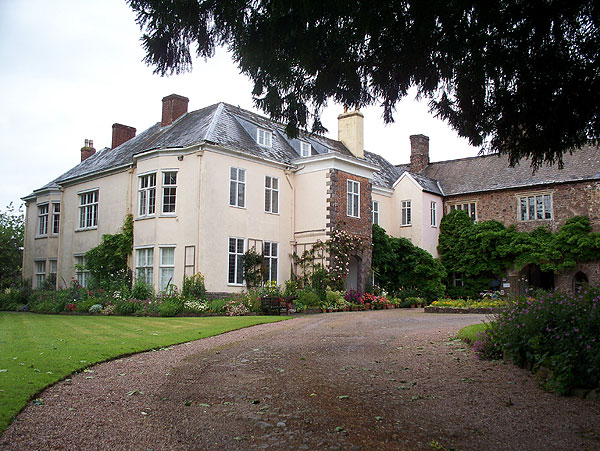
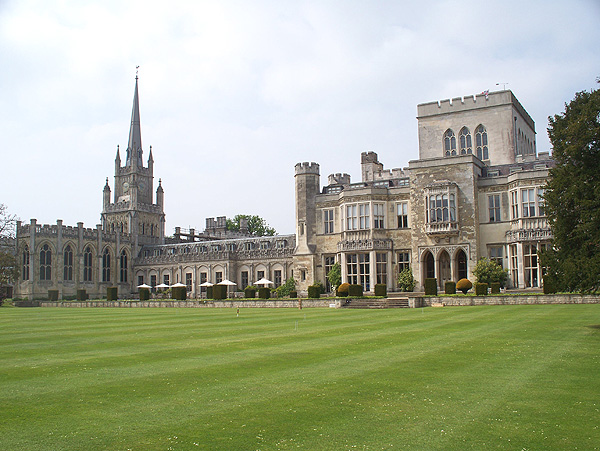
House from gardens Private (business college)
Ashridge House is a grand mansion in Hertfordshire, built in the 19th century. Adjoining the house is a large private set of formal gardens and tree planting.
Please be aware that unlike the adjoining Ashridge Estate, the house and gardens are NOT owned by the National Trust.
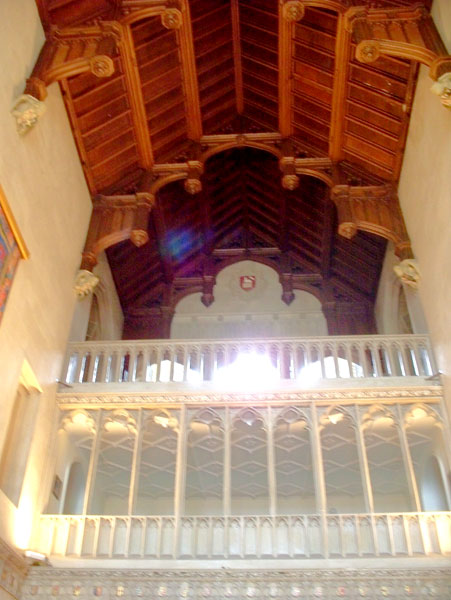
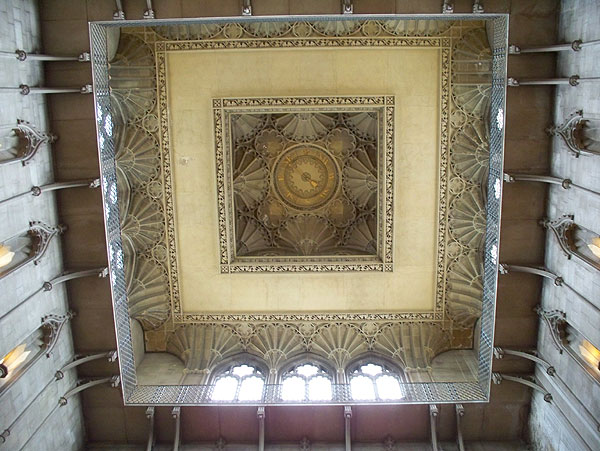
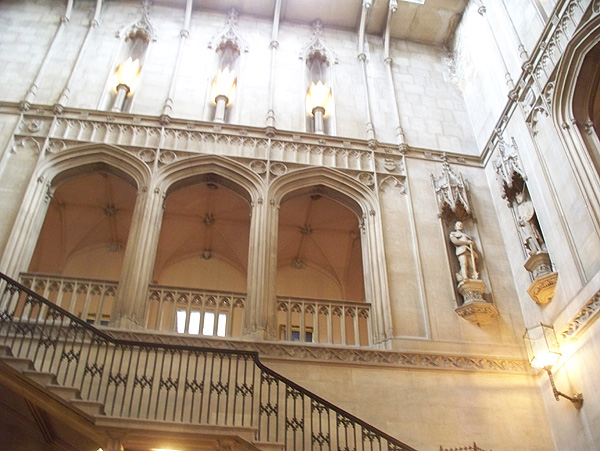
The house was built between 1808 and 1822 in a neo-Gothic style, including a crenellated central tower and a prominent chapel with tower and spire. Inside are a series of magnificent rooms. The Entrance hall has a hammerbeam roof. The Main Hall under the tower rises to 29m (70ft) and has impressive fan vaulting and a series of statues. The cantilevered staircase has a cast iron balustrade with brass handrail.
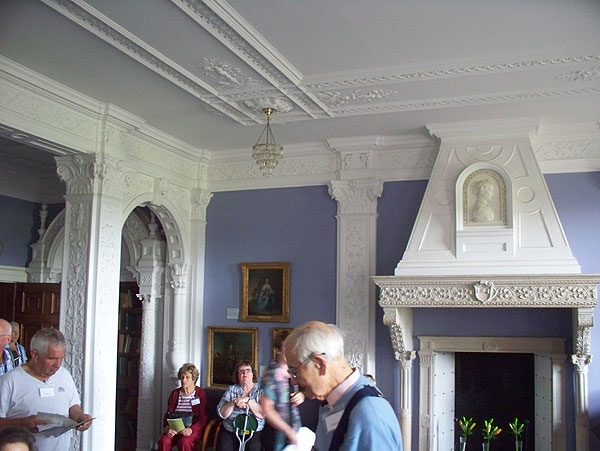
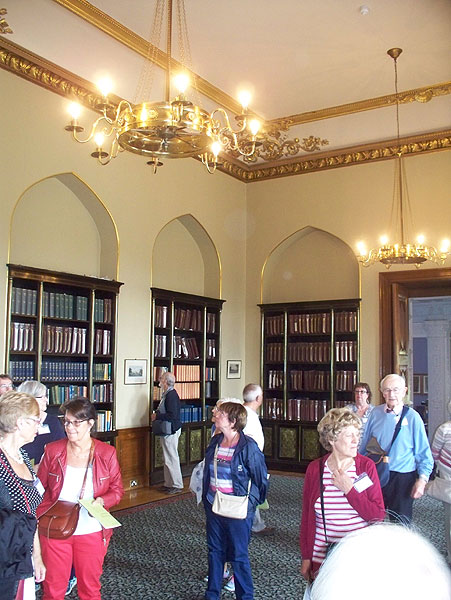
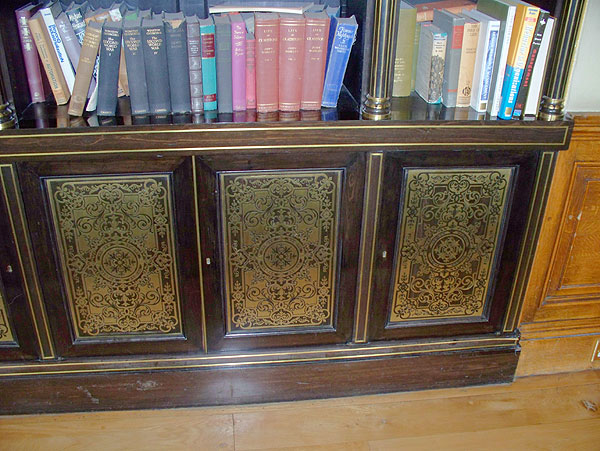
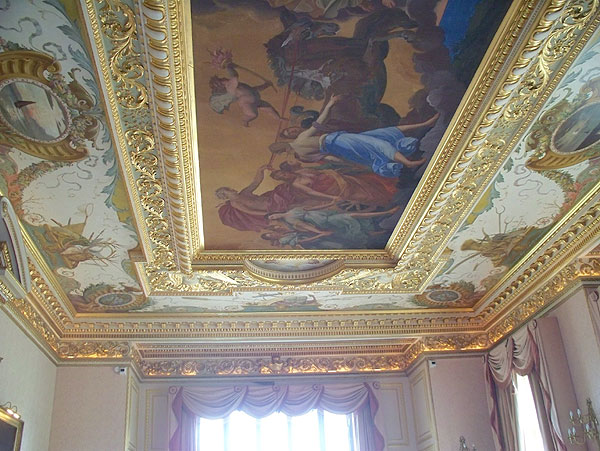
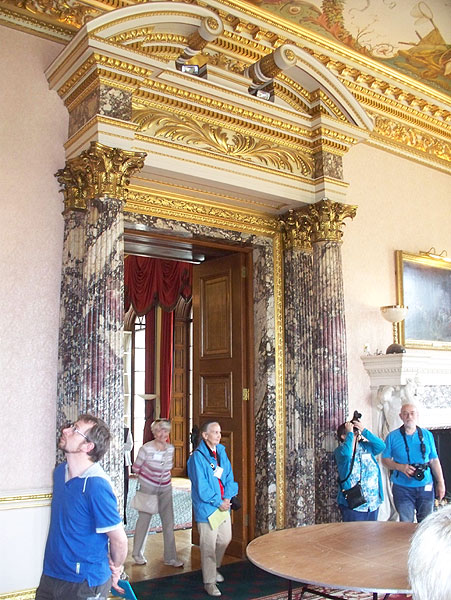
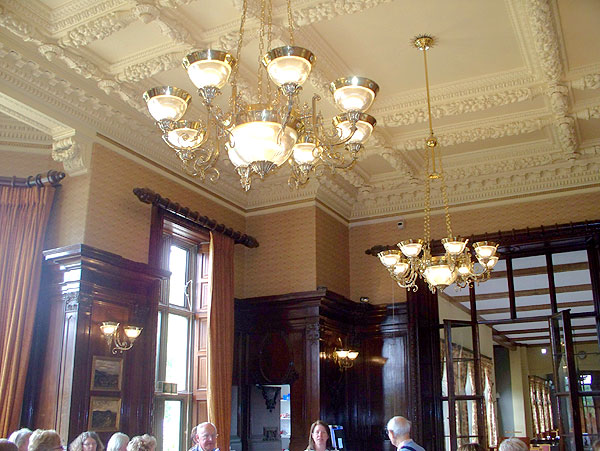
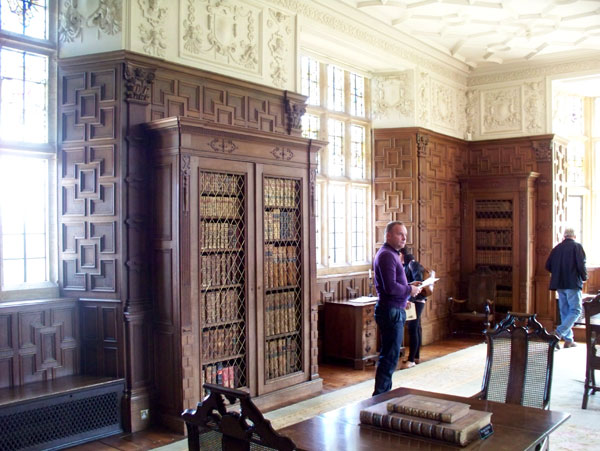
The Hoskins Room, with a blue and white theme, has fine plasterwork. The Ante Room has high ceilings and much woodwork including three pairs of English oak doors. The Lady Marion Alford Room has a fine ceiling with a painting depicting the goddess Aurora, and twin marble fireplaces based on those in the Doge’s Palace, Venice. The Wyatt Room has oak paneling and an ornate plaster ceiling. The (former) Library has ebony bookcases with brass inlays in a Boulle style.
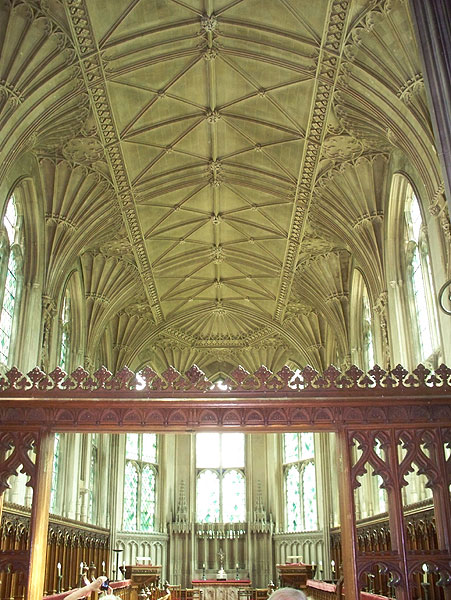
The Chapel, designed by James Wyatt, is a fine example of his work. It contains stained glass windows which are replicas of the original 16th century Bavarian stained glass. The originals were sold in 1928 for £27,000.
Under the Chapel is the Well House, which pre-dates the main house and contains a deep well sunk by the monks in the 13th century.
At least one of the outbuildings pre-dates the house, but the ‘Old Stables’ were built in 1817.
The house was built for the Egerton family, replacing an earlier house built on a monastic site. The house once belonged to Henry VIII and then Princess Elisabeth. The Egertons owned the house until 1849. Later owners the Brownlows sold it off in 1921. In later years it was a hospital, a Conservative Party training centre, a finishing school, and finally a management college and business school.

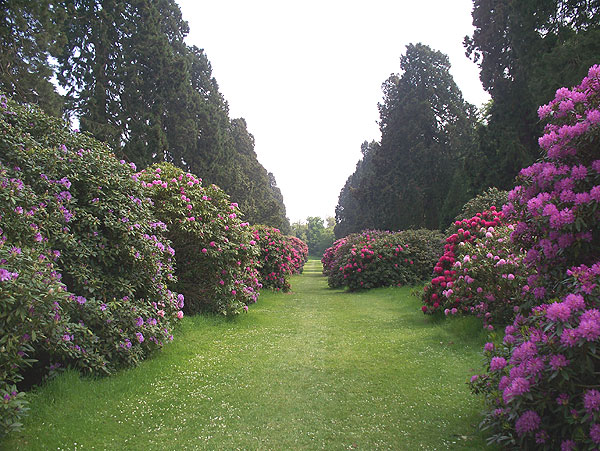
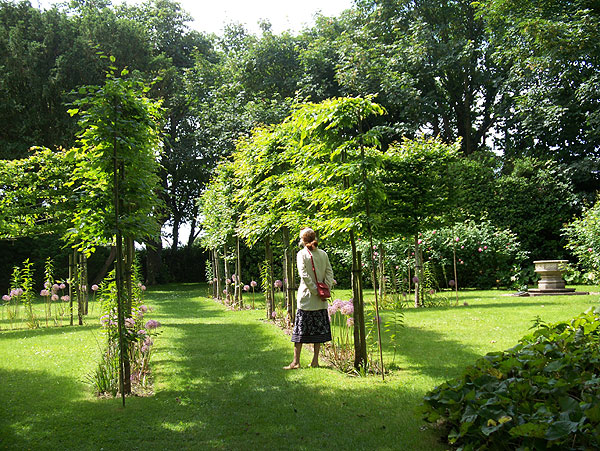
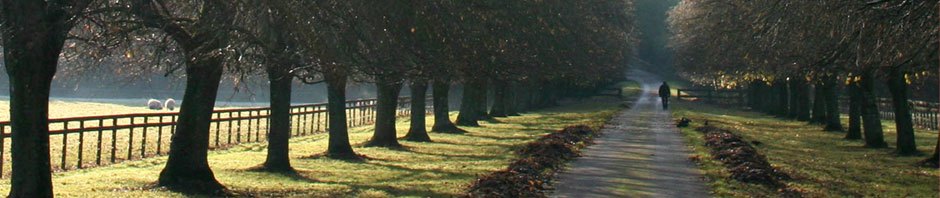
The gardens cover 77 hectares (190 acres) and include a formal Italian garden, and various other gardens and features as well as avenues of trees and open grassland. They are well worth a visit.

Visiting: The gardens are open daily except when the house is booked for a wedding (which are usually at weekends). Tickets, currently £5, are available from the Bakehouse cafe.

On a few dates in July and August, guided tours of the house and gardens were available. This is the only way of seeing inside the house. It is best to book by phone so you can ask what counts as a concession and what times the tours start, and whether you can go around the gardens on your own instead of paying for the garden tour (apparently not). Most visitors, it seems, book for both the house tour and the gardens tour that follows after complimentary refreshments.
Main Hall ceiling
Main Hall ceiling
Main Hall stairs
Main Hall stairs
Ent. hall roof
Ent. hall roof
Blue & white room
Hoskins Room
Old Library
Library
Boulle detail, library
Boulle detail
Garden room vaulting
Garden room
Ceiling, Lady Marion Alford Room
Ceiling, Alford Room
Ornate Doorway, Alford Room
Doorway, Alford Room
Wyatt Room, ceiling
Wyatt Room
Chapel ceiling
Chapel ceiling
Chapel exterior
Chapel
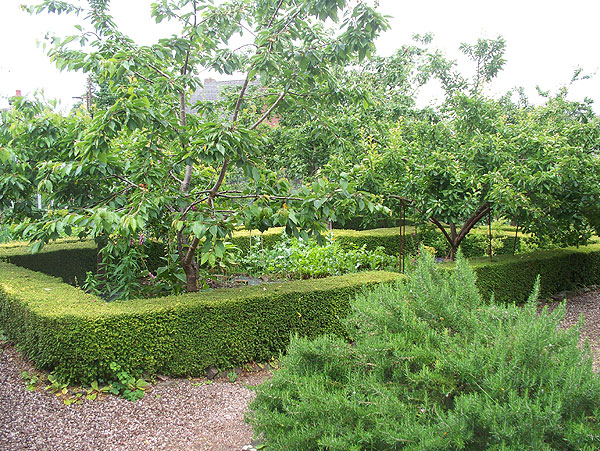
Border in gardens
Border
Avenue in gardens
Avenue
Flower close-up, gardens
Flowers
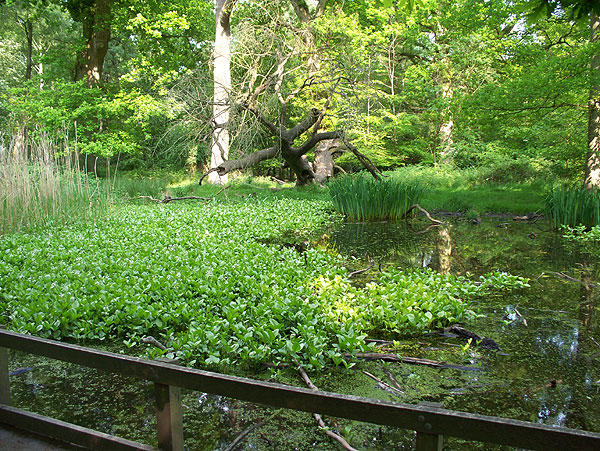
Woods, Ashridge
Woods

Tiverton Castle, Devon

Tiverton Castle, mansion Private
A castle was built on the site in 1106, and passed through various owners. In 1645 it was captured by Fairfax during the English Civil War. Subsequently the castle was partly demolished, and a mansion build on the site. Parts of the old castle are incorporated into the current buildings on the site.
Today, the visitor can see some pleasant gardens in the grounds, a ruined tower, views down to the river Exe, and a number of rooms mostly in the ‘Castle Barton’ wing with the round tower etc. Some interesting arms, armour, paintings and 17th century furniture can be seen.
The Castle website rather talks up Tiverton Castle, but don’t plan a half-day visit: I was able to see all of the public parts in one and a quarter hours.

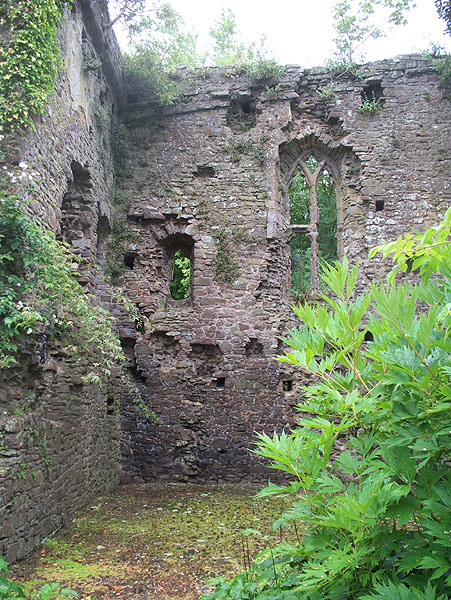
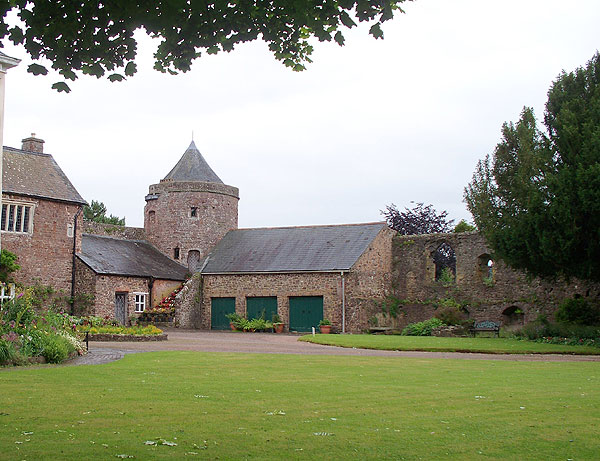
Ruin in castle grounds
Ruin in grounds
Castle Gardens
Gardens
Older (Barton) wing)
Old wing

Prideaux Place, Cornwall

South front Private (HHA)
The house lies on the outskirts of Padstow. The Prideaux family has owned the house and estate for hundreds of years. The house is Elizabethan with 18th century and 19th century additions. In the 19th century a Drawing room, Hall and Library were added, decorated in a Strawberry Hill Gothic style. The tour of the house includes the dining room, panelled in dark oak, the Morning Room, the part-circular Drawing Room, the green Grenville Room, the Library with stained glass window, the hall and cantilever staircase and the Great Chamber with its newly discovered and restored plaster ceiling depicting Susanna and the Elders.
Prideaux Place is still a family home and has interesting furniture and contents. Some items are new and made on the estate.
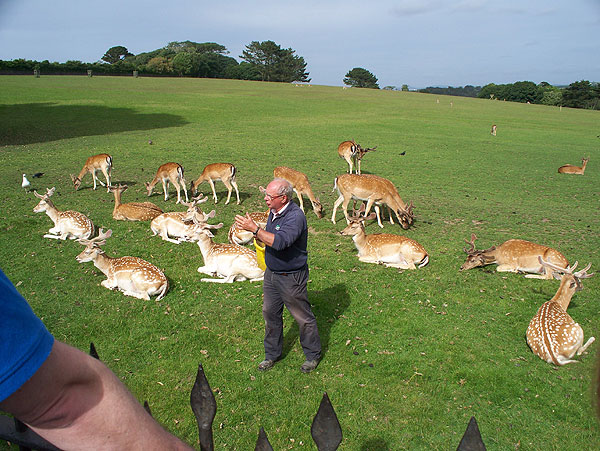
Outside are various outbuildings to the rear. The stableyard has an exhibition. The attractive gardens have been restored in recent years and contain formal and informal areas. Across the road is the deer park. If you are around at feeding time, you can see the fallow deer run up to get fed. They are very used to the keeper and you may see them lie down and even start dozing off next to the fence.

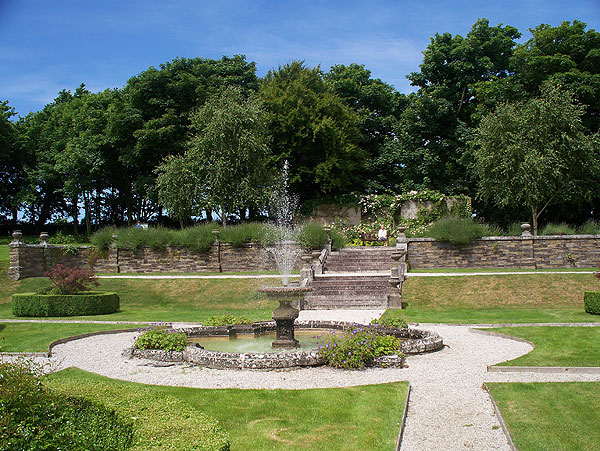
Formal garden
Formal garden
Woodland
Woodland
Deer and keeper
Deer

Lydiard Park, Swindon

House front Swindon Borough Council
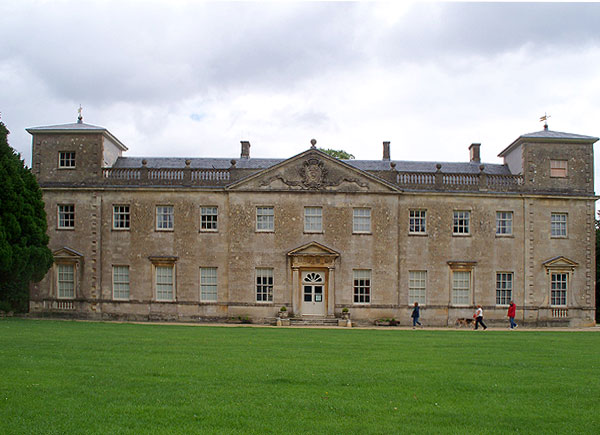
Lydiard Park is a grand house standing in extensive grounds to the west of Swindon. The estate was the home of the St John family for several centuries. The house was remodelleded to its present form in the early 18th century. The house was sold and in 1943 was bought by Swindon Borough Council. By this time the house was in poor condition. Town Clerk David Murray John lobbied to preserve the house and park. Over the years most parts of the house have been restored and important contents and furnishings bought back.
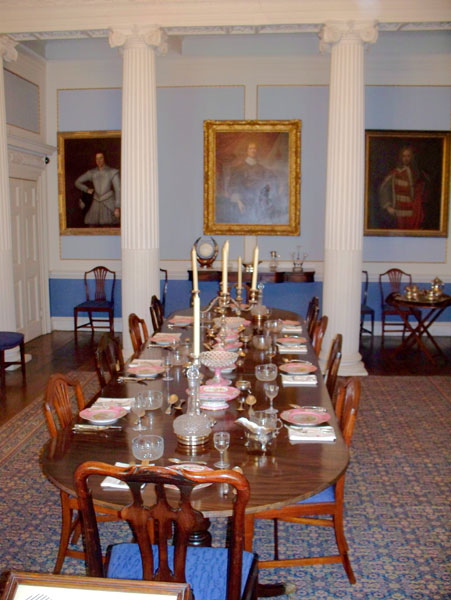
Visitors today can see a series of ground floor state rooms, freshly decorated and with contents that are either original or typical of the period. There is a Hall, Dining Room, Library, Drawing Room, State Bedroom and Dressing Room.
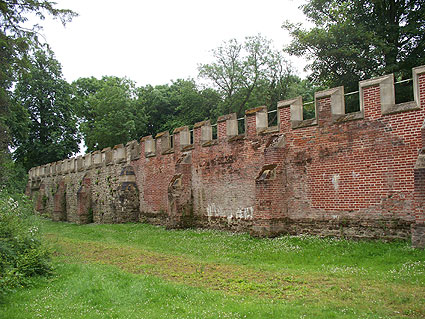
Outside, the extensive grounds, which have grassland, tree plantings and a large lake, have also been restored. Note the interesting castellated dam wall at one end of the lake. A church lies immediately behind the house and contains interesting monuments and fragments of medieval wall painting. Note the life size gilded cavalier statue, the St John Polyptich and the stained glass.
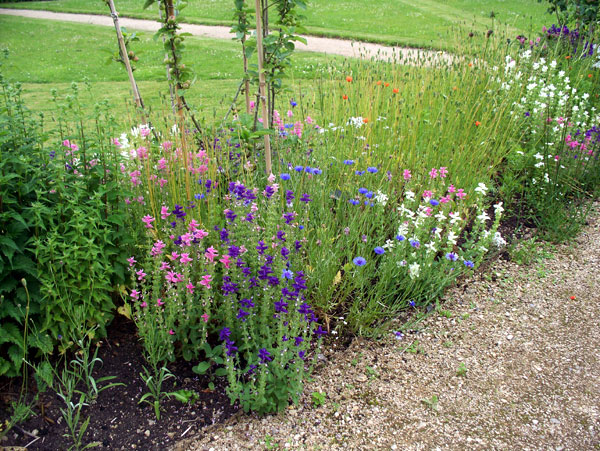
Also visit the Walled Garden which contains borders filled with attractive perennials. (Access via the café). The Conference Centre is also said to serve coffee and light refreshments.
Lydiard Park is well worth a visit. Nearest junction off the M4 is J16. You may see signs for Lydiard Park or Lydiard Park and House – the latter takes you close to the house (and conference centre).

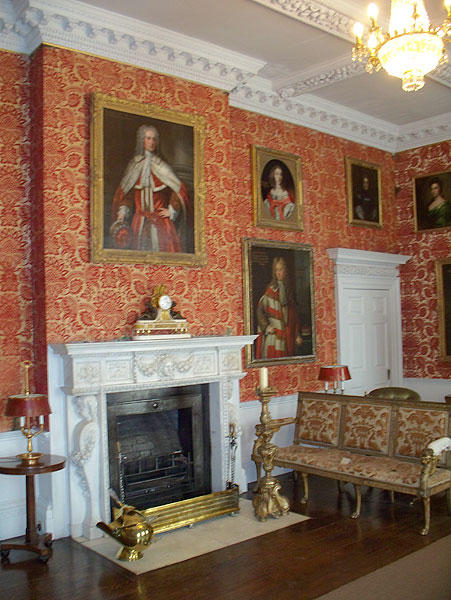
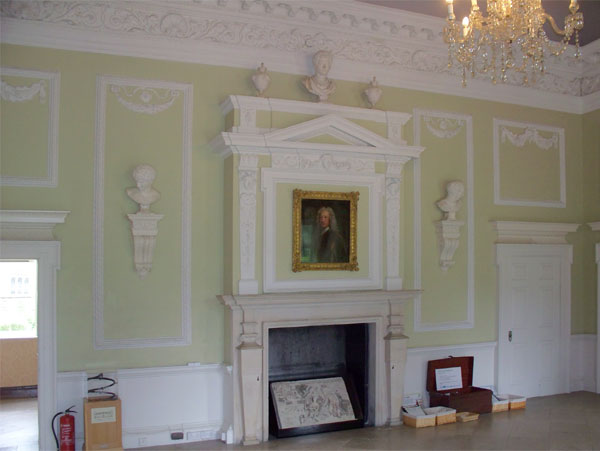
Hall fireplace
Hall
Dining Room
Dining Room
Drawing Room
Drawing Room
Garden
Garden
Dam wall
Dam wall

Montacute House

West & South fronts National Trust
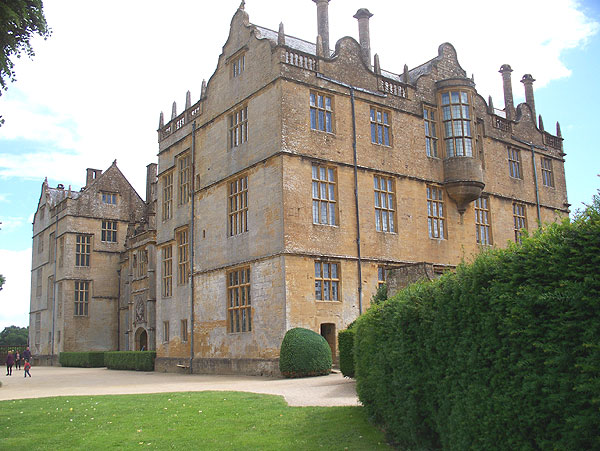
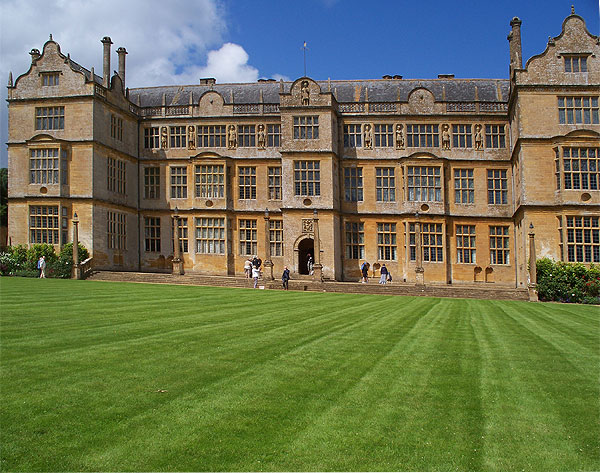
This great Elizabethan mansion was built about 1590-1600 by Sir Edward Phelps, a Member of Parliament and courtier. In the 1780’s Edward Phelps V extended the west front between the projecting wings to provide upper and lower corridors. The new work was done in the same style as the old, using decorative stonework rescued from Clifton Maybank House, near Yeovil.
The house, like the nearbu village, is built of yellow Ham limestone. It forms a massive block when viewed from the grounds, and the east front, the original approach front, is ornamented with statues at third floor level.
The house was acquired empty in 1931 and the rooms have been refurbished and furnished by the National Trust. The third floor houses a collection of paintings from the National Portrait Gallery.
The grounds around the house are mostly laid to lawn, with tall hedges.
A visit is highly recommended. There is enough to see to justify a half-day visit.

Drawing Room, Montacute
Drawing Room
Library, Montacute
Library
East Front, Montacute
East Front

Herstmonceux Castle

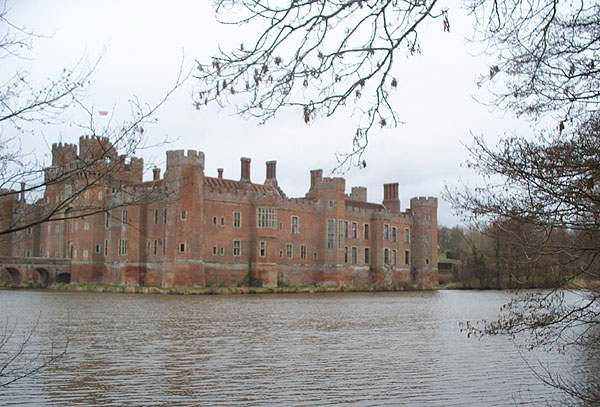
Castle and wide moat Herstmonceux Castle has a chequered history. It was built in the 15th century as a castle-style palatial residence by one Roger Fiennes, Treasurer to the court of Henry VI. By the 18th Century, the castle was in the hands of Robert Hale-Naylor, who had the interior of the castle dismantled in 1777 on the advice of fashionable architect Samual Wyatt. The contents were sold off, and other materials used to build a new mansion, designed by Wyatt, nearby. The outer walls remained as a romantic ruin till the 20th century.
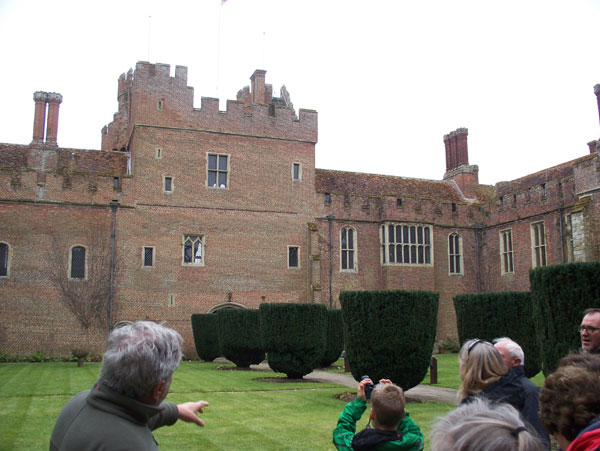
Radical restoration work was started in 1913 by Colonel Lowther and completed for Sir Paul Latham by the architect Walter Godfrey. Despite appearances, everything visible from the inner courtyard is 20th century work.
In 1946 the castle and estate passed into the hands of the Admiralty and by 1957 was the home of the Royal Greenwich Observatory, with the castle being used for accommodation and the grounds housing various telescope domes.
By the 1970s the Observatory had moved out and in 1992 the castle was bought by Queens University of Canada with funds provided by Alfred Bader. In 1994 the Queen’s International Study Centre opened.
The most striking thing about the castle is its size – it is one of the biggest brick-built castles in England and one of the largest early brick-built structures.
The grounds and gardens are normally open to the public, and on some days a guided tour of the Castle is available at extra cost. (Pay at reception in the Castle). It is worth taking the tour, as you will see much of the ground and first floors, as well as the courtyard. The interior contains various bits of architectural salvage from older houses.
The gardens and woods are also worth exploring.

If visiting the castle by car, it is recommended that you do not use postcode navigation, but instead navigate to Bradley Road, Herstmonceux or to the Wartling Road running northward from the A27 at Pevensey.
The only public entrance, shared with the Observatory Science Centre, is off the Wartling Road. The ticket hut for the castle grounds is opposite the Science Centre.

Inner Courtyard
Inner Courtyard
Staircase from older house
Staircase
Fireplace surround from older house
Fireplace surround
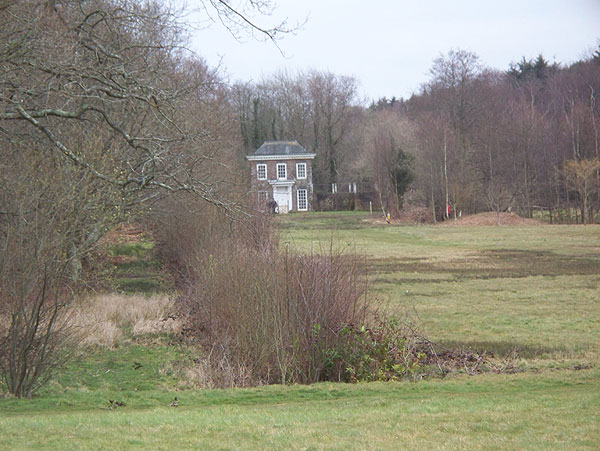
Folly House distant view
Folly House

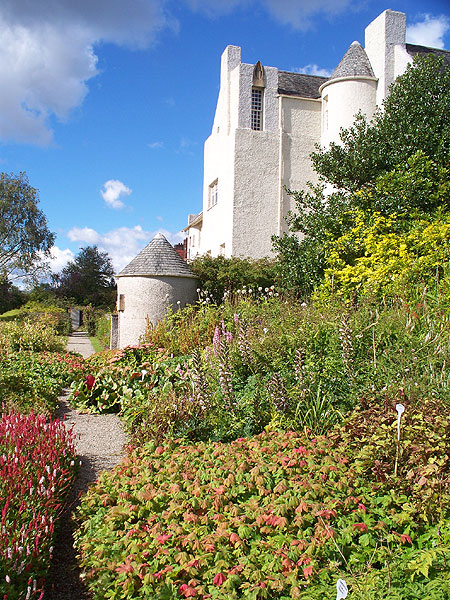
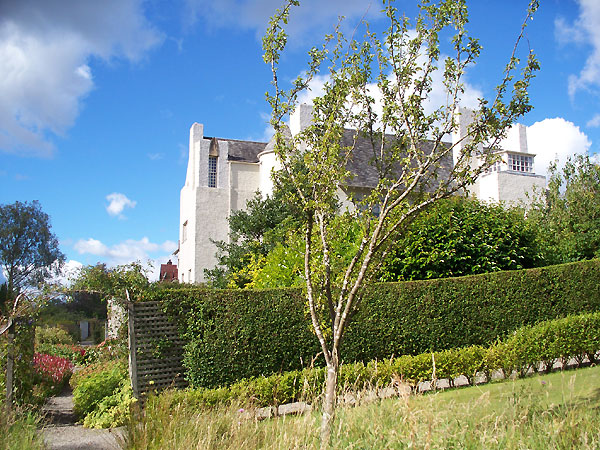
The Hill House, Helensburgh, Scotland

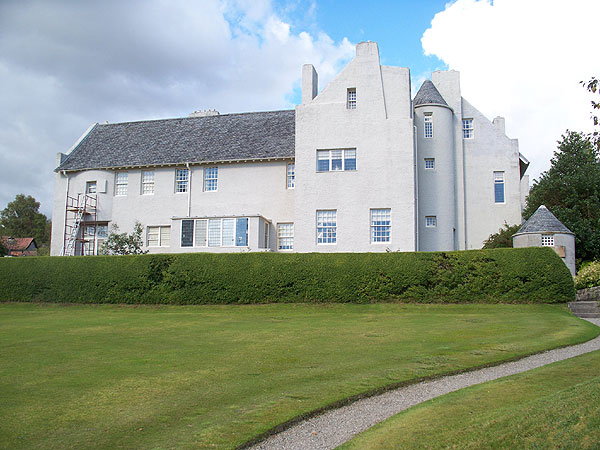
House from south lawn National Trust for Scotland
The Hill House was built in 1902-3 with Charles Rennie Mackintosh, arguably Scotland’s most famous architect and designer, as architect. It was commissioned by the Glasgow publisher Walter Blackie, and remains a remarkably complete example of Mackintosh’s unique vision. It is also widely acclaimed as a work of art and design associated with the Art Nouveau movement at the turn of the 20th century.
Though very modern for its time, the house does not entirely turn its back on tradition, for some of its details evoke the spirit of old Scottish castles and tower houses.
Parts of the interior decor were designed by Mackintosh’s wife, Margaret Macdonald Mackintosh, a talented artist in her own right.
The house was originally run with the aid of several servants, and had only one private owner after the surviving Blackies sold it. It was acquired by the NTS in 1982, and they have gradually returned the house to its original appearance.
The entrance passage and hall incorporates a change in level and has elaborate rectangular lampshades, originally lit by gas, now electricity.
To the right of the entrance is the library, containing many Blackie publications. The drawing room is a large room with a bay window facing the Clyde. The fireplace is made of small putty-coloured tesserae with oval decorative panels. Above it is Margaret Macdonald Mackintosh’s gesso panel depicting a sleeping princess in her bower. There is also a writing desk designed by Mackintosh.
The Dining Room has dark walls with a lighter frieze and ceiling. None of the furniture was designed by Mackintosh.
Beyond the hall are the service quarters.
Upstairs are an Edwardian bathroom and a number of bedrooms. The main bedroom is L-shaped and has a barrel ceiling over the bed. The walls are stencilled and copies of Margaret Macdonald Mackintosh’s silk hangings hang over the bed. In the upstairs east wing rooms, traces of the original decorative schemes have been uncovered.

The house can be reached by car or train. It is a must-see if you are interested in Mackintosh or art nouveau. There is a cafe in the service wing.
Thumbnails (no interior photography).

House from east garden
House from east
House from east
House from east
House from south-west
House from SW

Moirlanich Longhouse, Central Scotland

National Trust for Scotland
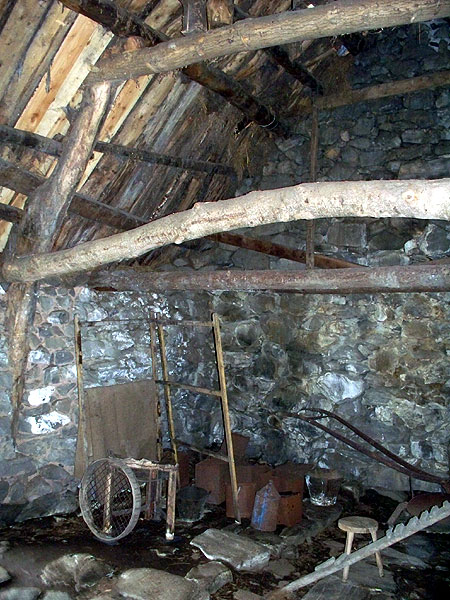
This house and connected byre is typical of a rural 19th century or early 20th century dwelling. The roof is supported by crucks and was originally thatched, though the thatch was raked back in the 1940’s and covered with corrugated iron sheeting.
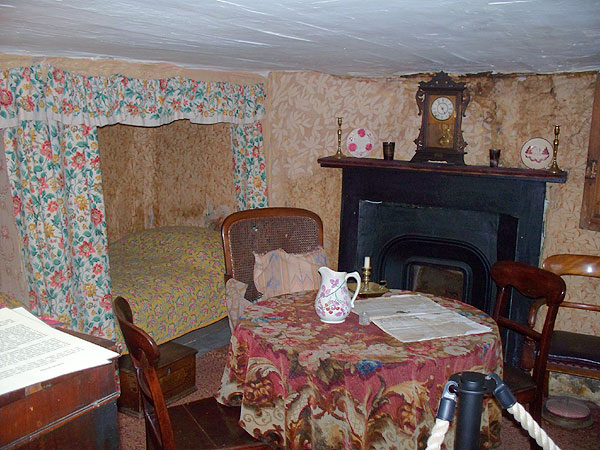
Inside, the house still has many of its original features, including a Scotch dresser, box beds and a ‘hingin lum’ or hooded fireplace. Walls were papered, and in places there are over twenty layers of wallpaper, some of which has been separated and displayed.
There is a parlour kept for entertaining the minister and the landlord, and a kitchen and bedrooms for everyday use.
Nearby is an interpretation display hut with a small exhibition.
The opening hours are restricted to two afternoons a week in the summer.
I visited the house during a tour of fine Highland scenery.
Thumbnails

Parlour with table etc
Parlour
Kitchen with fire hood
Kitchen
Byre with cruck beam
Byre

Menzies Castle, Scotland

Menzies_0171 Private Trust
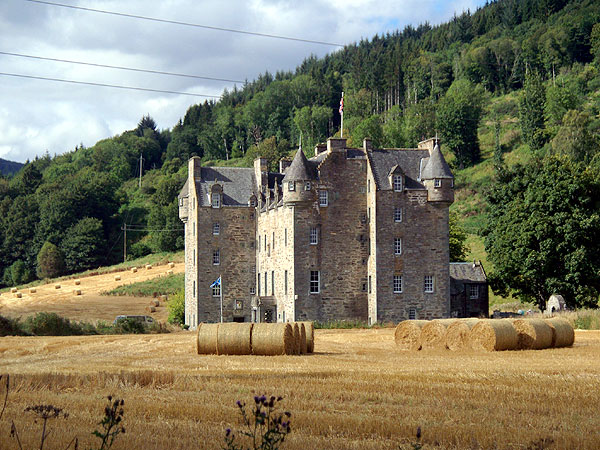
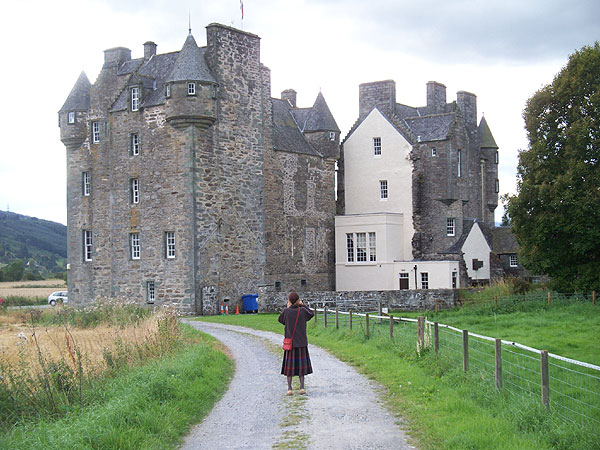
Castle Menzies (pronounced ‘Mingis’) was built in the 16th century (exact date unknown), possibly on the site of an older castle.
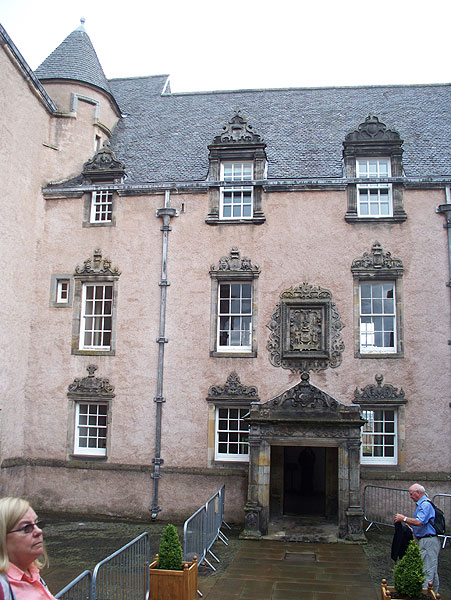
In 1577 the upper storey and roof were altered, adding the series of dormer windows with their elaborate pediments. This completed the construction of a Z-plan house, representing a transition between a fortified tower-house and a mansion.
Despite the domestic features, the house was involved in conflict in 1646, 1715 and 1746.
In the early eighteenth century a new block of apartments was built against the north (rear) side of the main block and the west side of the north tower. A new entrance was made in the middle of the main block. This block was deemed unsalvable in the 1970’s (riddled with dry rot) and subsequently demolished. Marks of its former presence can be seen at the rear. Pictures of the vanished block can be seen on the Canmore website: http://canmore.org.uk/site/25670/castle-menzies and in particular
http://canmore.org.uk/collection/1461079 showing the rear in 1942.
In 1840, another wing was constructed on the west side of the main block. This block still stands today.
On approaching the castle, its striking appearance immediately marks it as a classic Scottish castle. It stands unfenced in open fields, in front of a high escarpment.
The castle was acquired by the Menzies clan in 1957 in a greatly dilapidated condition. Since then the 16th century building has been restored with, it would seem, rather limited resources, followed by the restoration of the 19th century wing.
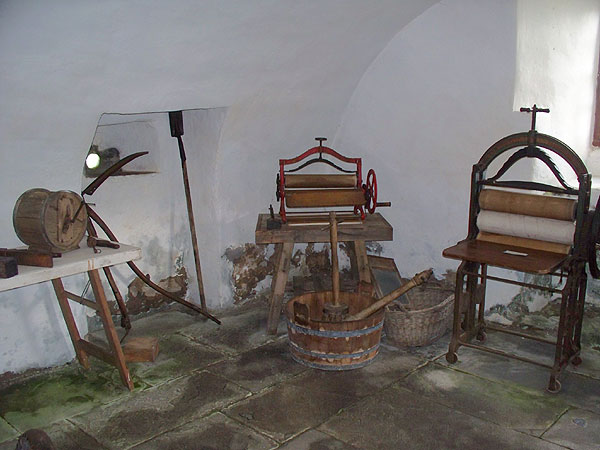
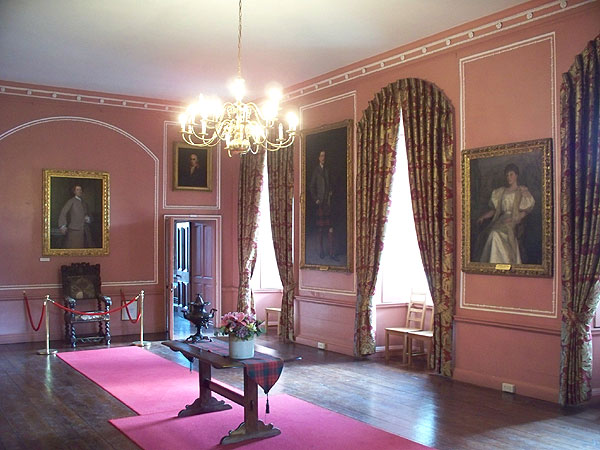
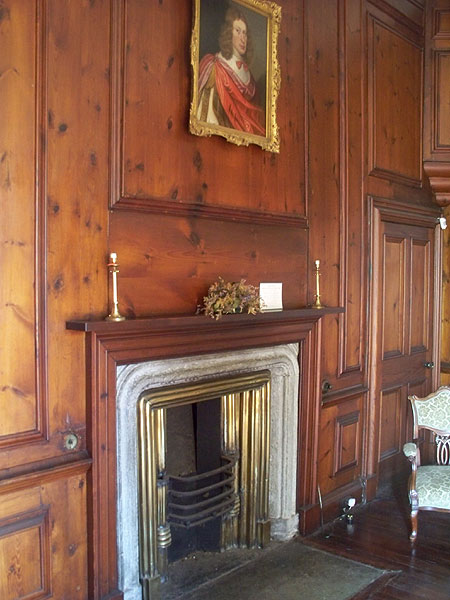
The ground floor consists of vaulted chambers including a kitchen. On the first floor of the main block is a great hall, panelled and with a plaster ceiling, and a withdrawing room with a fine pendant plaster ceiling.
On the second floor are two more large rooms with plaster ceilings.
The third floor is now an attic-like space open to the pitched roof. There are many other smaller rooms (the total for the castle is about 70).
In the 19th century wing, the first floor hall (Dewar Room) is the only room of note open to visitors.

The castle with its many rooms, some elegantly restored, is a fascinating place to visit. Various objects are identified by handwritten labels, which gives the place a dusty charm quite different from the high-budget National Trust for Scotland or Scottish Heritage properties.
Thumbnails:

Larder with old items
Larder
1st floor hall
1st floor hall
1st floor Withdrawing room
1st floor Withdrawing
1st floor Withdrawing room
1st floor Withdrawing
South wall close-up
South wall
2nd floor hall with displays
2nd floor hall
Attic (3rd) floor with exposed beams
Attic (3rd) floor.
Top S. tower Victorian bedroom
Top S. tower room
Dewar Room, C.19 block

Rear, from NE
Rear, from NE

Argyll’s Lodging, Stirling

Courtyard view Historic Scotland
Argyll’s Lodging is a splendid and complete example of a 17th century townhouse. Situated on the upper approaches to Stirling Castle, its fine architecture marks it out as a property intended for a great nobleman serving the royal court.
It is entered by a courtyard. Across the courtyard a door gives access to a hall (ground floor cellar). On the first floor above are the principal rooms – the High Dining Room, the Drawing Room and other furnished rooms.
Back on the ground floor the original and extended kitchens can be seen, and there are gardens at the back.

See Stirling Castle entry for more details.
Thumbnails:

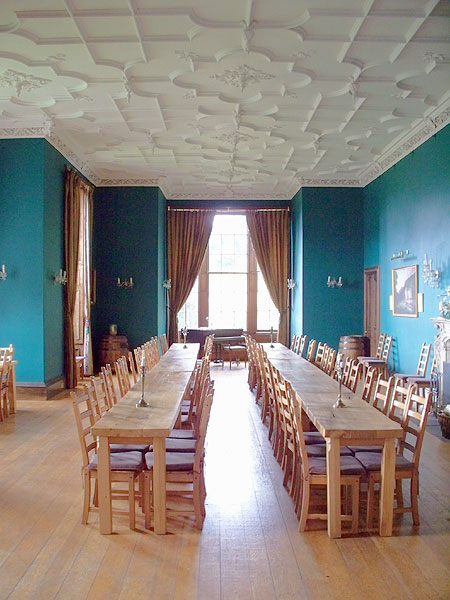
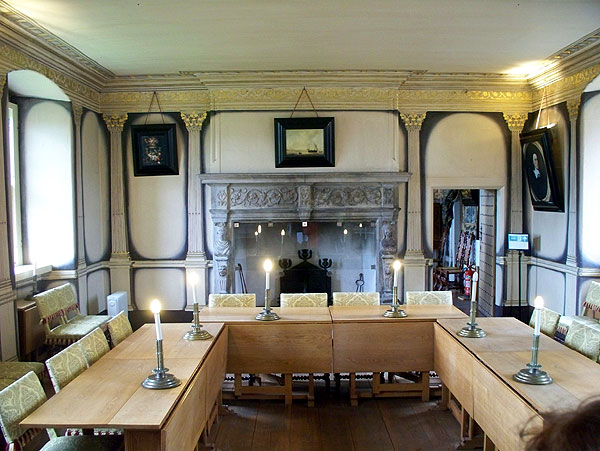
High Dining Room
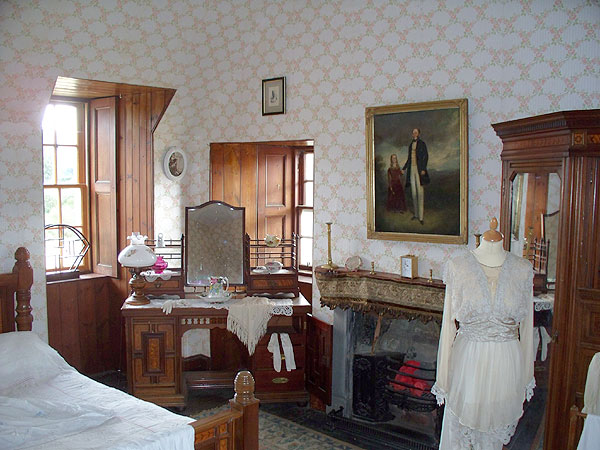
High Dining Room
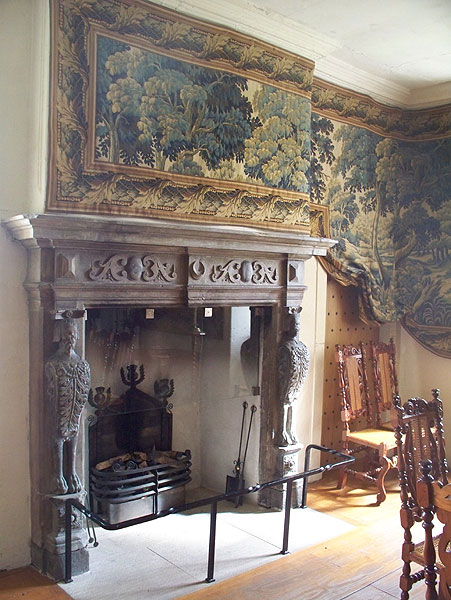
Drawing Room fireplace
Drawing Room
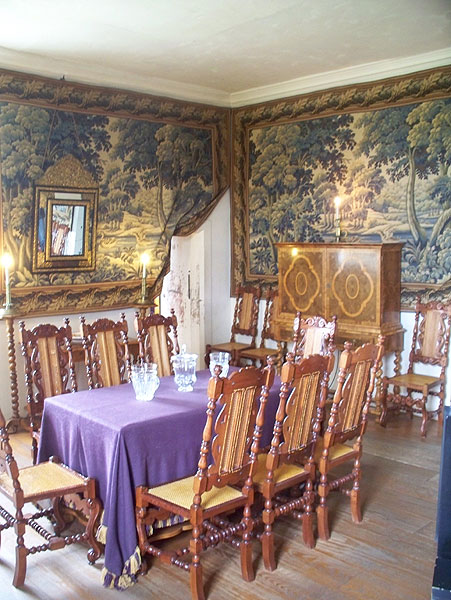
Drawing room table
Drawing room table
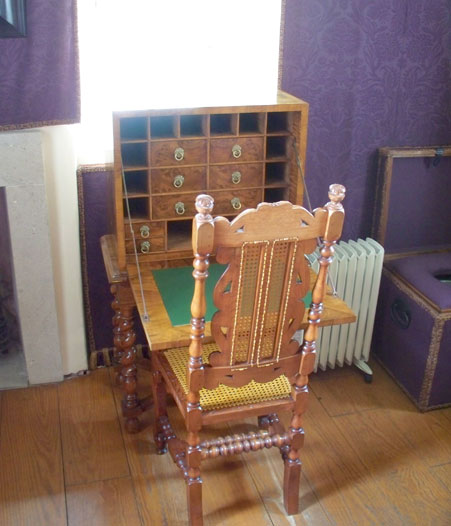
Small cabinet on table
Cabinet