 National Trust.
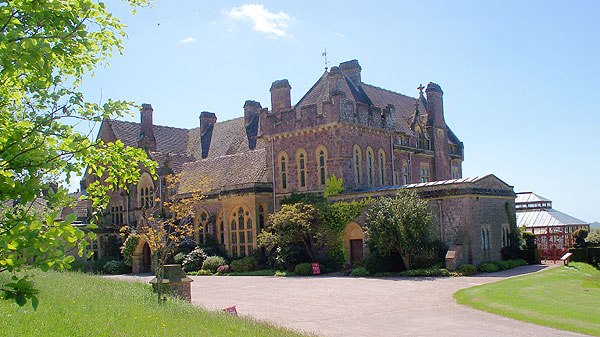
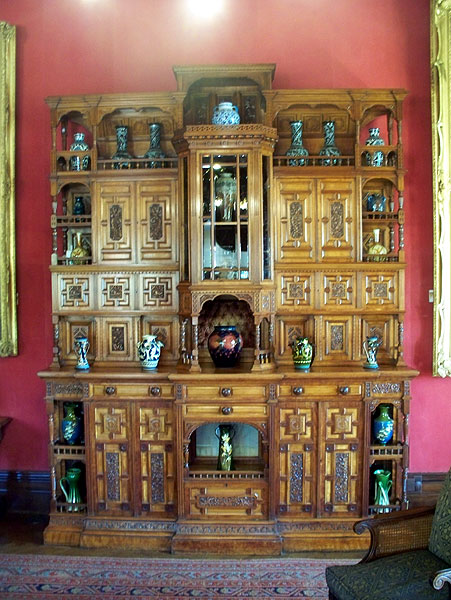
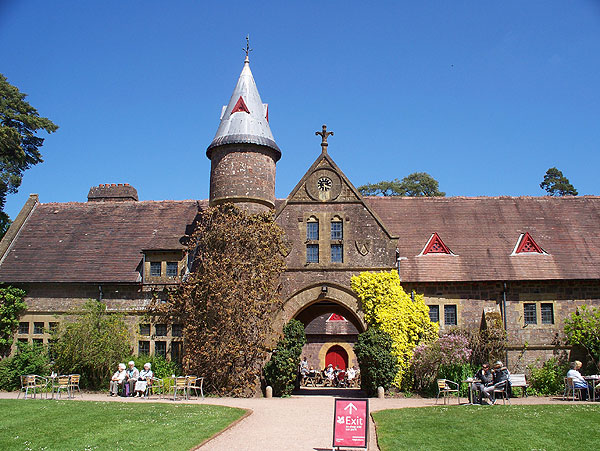
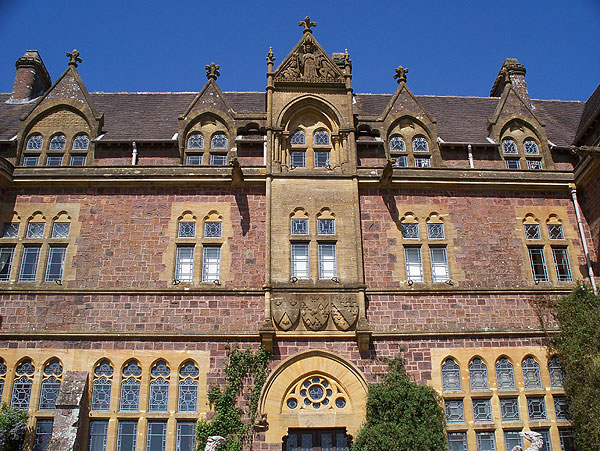
The house was built in 1869-1874. Designed in a Gothic style of gables and mullioned windows by noted Victorian medievalist William Burges, it was intended to conceal interiors of exceptional richness. The client however shied away from Burges’ riotous designs, and few were carried out. Instead, Heathcoat-Amory hired John Diblee Crace, but even his designs were thought too bold and colourful, and were largely covered up in later years. The National Trust has sought to restore the nineteenth-century work wherever possible. The vast gardens, based on a nineteenth-century design but greatly enlarged by the 3rd baronet and his wife, are much admired.
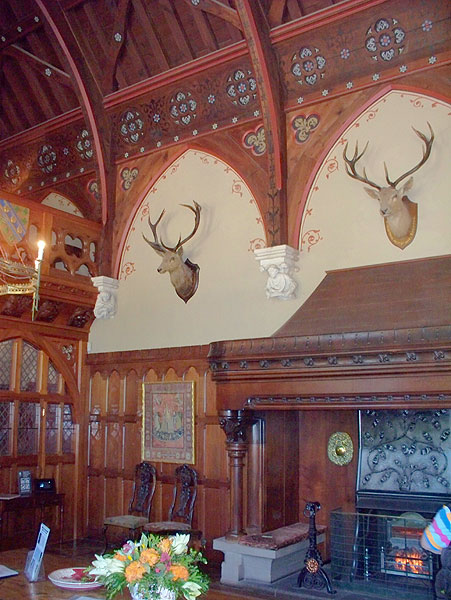
The hall, with medieval-style Gothic arches, gallery, timber vault, painted furniture and curious carvings, is the only room to be completed more or less as Burges intended. Recently a bedroom has been reworked using Burges’ original design drawings and given a patterned ceiling, bird wallpaper, and furnished with exotic original Victorian furniture made to his designs. Elsewhere are boldly painted, compartmental ceilings and elaborate chimneypieces. The overall impression is of bold designs and bright colours.
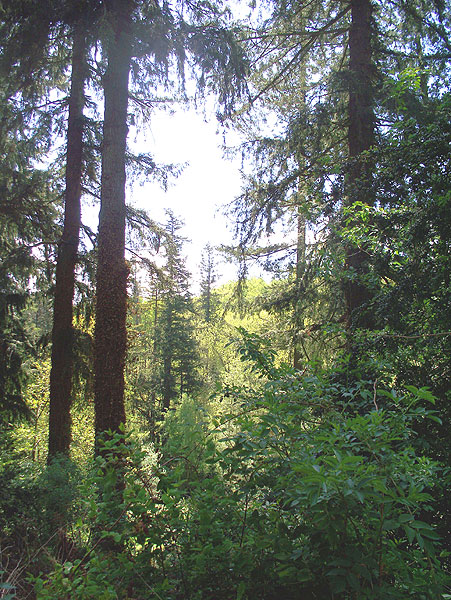
Outside, the gardens are the sort where you can happily wander about for ages trying to see everything. The stable block looks notably Burges, as do the corner towers on the walled kitchen gardens. Beyond the kitchen garden, and accessed from it, you will find the childrens’ play area and the Douglas Fir Walk.
The main gardens are accessed via the house and contain formal sections, and a lot of woodland gardens with winding paths.
Well worth a visit especially if you are into Victorian Gothic. There is enough here for an all-day visit.
Revisited May 2015.
Category: National Trust
Birmingham Back to Backs
National Trust.
You have all heard of “Back to Back” housing, with its connotations of urban slums. But what exactly is it, and what were the layouts like? To find out, you really have to go see some of the real thing. Such housing once existed in vast numbers, but today hardly any remains.
The examples preserved by the National Trust face onto a street and courtyard in central Birmingham. Three pairs of back-to-backs on Inge Street adjoin a terrace of five blind-back houses on Hurst Street. These tenements make up the north and east sides of the inner court. The yard contains two wash-houses and the outside toilets. Four back-to-backs have been fitted out to show what life was like here at different dates.
Until I actually saw the back-to-backs I had only a hazy idea of what they were like. These were cramped 3-room dwellings just one room wide and one room deep, extending over three floors, plus attic, with no toilet or bathroom. Everything was poor, shabby or peeling, and the construction, with walls a single brick thick, was cheap and flimsy. Up to 8 or 10 people crammed into each dwelling. Construction of such buildings was banned from 1876, but some were still lived in nearly a century later.
Today the NT have knocked through some openings to convert four cramped dwellings into a ‘tour’ but you are still strongly advised to book your conducted tour well in advance. Inge Street is within walking distance of Birmingham New Street rail station. This isn’t a prime commercial area, and when I visited, it looked like free on-street parking might be available for those totally determined to drive.
After visiting here, you might be interested in the covered market (nearby) the municipal art gallery (walk or bus ride) or the Jewellery Quarter (bus ride).
Packwood House, Warwickshire
National Trust.
The house surrounds a front lawn on three sides, and was originally a timber-framed Elizabethan house. It still retains its massive Elizabethan chimneystacks and many gables, but has been greatly altered and updated over the centuries, being largely reconstructed in brick. The last private owner of the house, Graham Baron Ash (his name, not his title) undid much of the Georgian and Victorian alterations and re-introduced all manner of period features, such as leaded casements, floors, beams and chimneypieces from other old buildings. He also built a long gallery and converted a barn into a great hall to complete his vision of how a Tudor house should be.
Today, the house contains period furnishings, including fine Jacobean panelling, mostly introduced by Graham Baron Ash. Some of the contents came from Baddesley Clinton nearby. The elaborate gardens are also a showpiece.
A visit here doesn’t disappoint, and there is plenty to see inside and out.
Baddesley Clinton, Warwickshire
National Trust.
The medieval house is built around three sides of a courtyard, and surrounded by a moat. Grey walls with mullioned windows fall sheer to the water, and there are tall red-brick Elizabethan chimneys towering above the roofs. The small panelled rooms, filled with mostly seventeenth and eighteenth-century oak furniture, are intimate and homely. The Ferrers family was Catholic, which is why they never had the funds to radically alter and improve the house. Three priest hiding places can still be seen within the manor house.
Today, the moated setting is striking, and the visit begins by walking the bridge across the moat. The tour continues through various rooms around the courtyard garden, both downstairs and upstairs, and including a look at the priest holes, one of them low down in a former sewer. A notable room is in the gatehouse above the passage. There are some pleasant gardens, both in the courtyard and in the grounds surrounding the moat. My visit included an hour-long guided tour of the grounds around the moat, which while not obligatory does provide visitors, particularly those who didn’t buy the guidebook, with some extra information about house and grounds.
Note that Packwood House (NT) is close by, and it is possible to fit in visits to both in one day.
Bradley, Newton Abbott, Devon
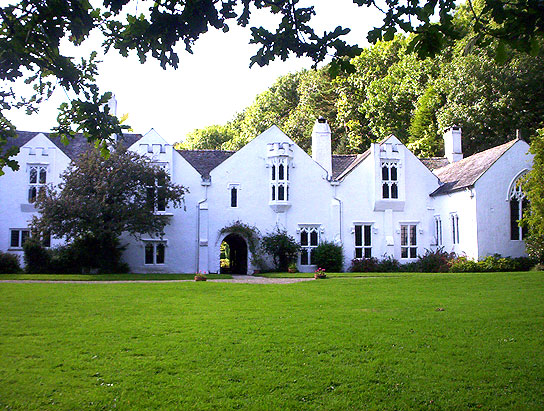
A white manor house sits in green meadows surrounded by woodland. The L-shaped house, with many gables and tall chimneys, retains most of its medieval features. The dining room (former kitchen) has a fireplace opening formed of four tons of Dartmoor granite. The hall is the only spacious room. On the walls of an upstairs room is preserved a late medieval pattern of stencilled black fleur-de-lys. Also upstairs in a panelled room is some fine seventeenth-century plasterwork in high relief, looking well preserved. There is a collection of Pre-Raphaelite paintings and Arts & Crafts furniture. Much of the furniture is 18th century and listed on room cards. The chapel, which has an array of carved wooden bosses on the ceiling, should not be missed.
The interior was interesting. Outside, one can walk round with the guidebook and look at when each part was altered. Extensive woodlands surround the house. I finished my visit by exploring these, and found a back exit which eventually leads into a housing estate.
The house is half a mile from Newton Abbott town centre, on the Totnes road. The opening dates and times are somewhat restricted. The signs on the main road are inconspicuous. Note that there are no toilet facilities or tea room on site.
Good news: you can park at the site from 1.30 for the opening at 2:00 pm. It’s possible to get there by train, but I found that, unless you figure out the bus routes, it’s rather a tedious walk from the station and you need to know what foot route to take. Leave the house grounds on foot the same way you came in, if you don’t want to get lost in a housing estate.
Stowe Landscape Gardens, Bucks.
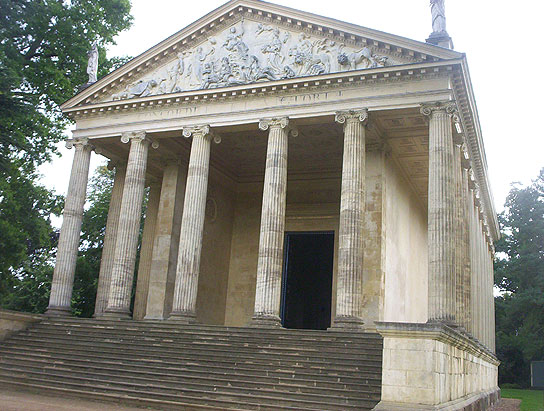
The National Trust acquired the gardens in 1990, and since then have restored over 40 temples and monuments in the Georgian gardens, said to be the most influential landscape gardens in Europe. There are lakes, trees and valleys, with a variety of walks and vistas occupying a wide area. Checking out all the monuments and visiting the furthest reaches of the park can take many hours.
I have visited the park on several occasions and usually find something fresh to enjoy each time. The Park part-surrounds Stowe School, so if you visit in term-time, don’t be surprised to encounter some of the jeunesse dorée at leisure.
Aug 2012 update: A new NT visitor reception (New Inn) opened early 2012 at the opposite end of the Gardens. Road access from Buckingham is now shorter and simpler. There is a 500 metre walk or land-train ride from the New Inn car park to the new garden entrance. The refurbished New Inn visitor reception is worth a visit.
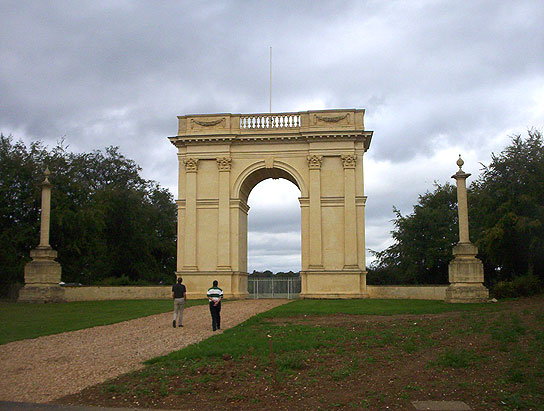
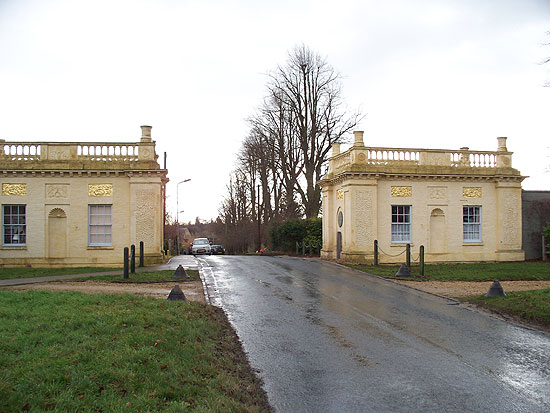
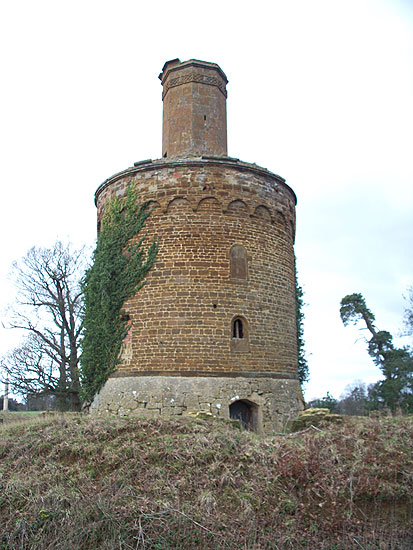
After visiting the Park, you might take up the challenge of visiting some of the outlying monuments. The Corinthian Arch which dominates the usual approach from Buckingham is easy to access – just drive up to it (or walk back from the new visitor centre). The Wolfe Obelisk, 100 ft high, is accessible from the far end of the old NT car park, (MK18 5DQ) a few hundred yards past the Stowe School entrance, as is the small Conduit House, an octagonal pavilion. “Stowe Castle” can be viewed through binoculars if you stand in the right spot near the Gothic Temple, and the back of it can be acccessed by road. (There is now a set of rural industrial units next to it). There are one or two others in outlying positions including the Bourbon Tower, closer to the gardens than the Wolfe Obelisk, but obscured by trees and with no obvious path to it.
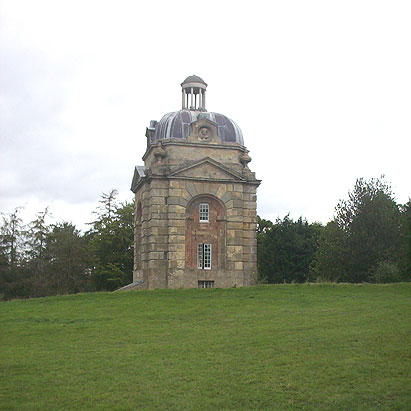
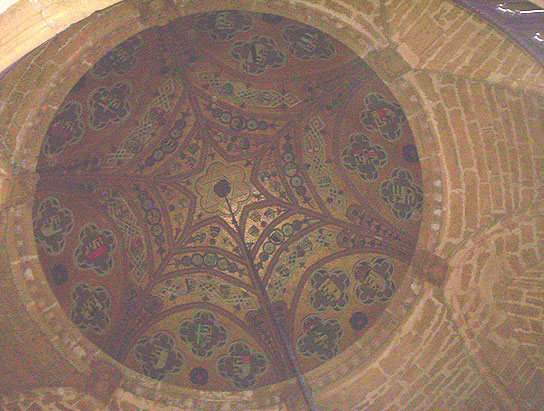
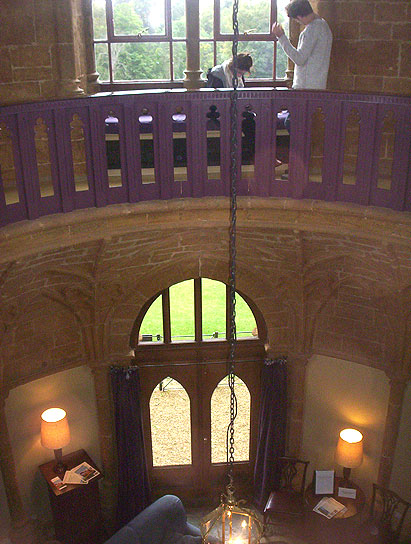
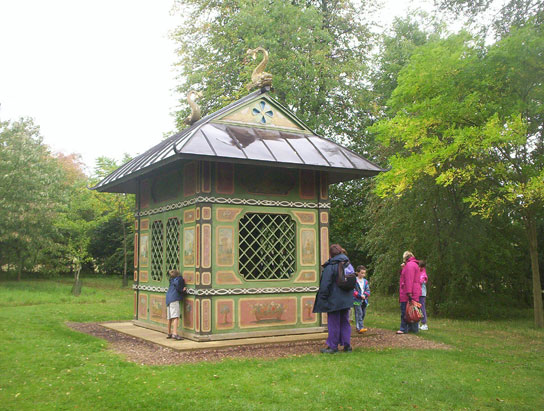
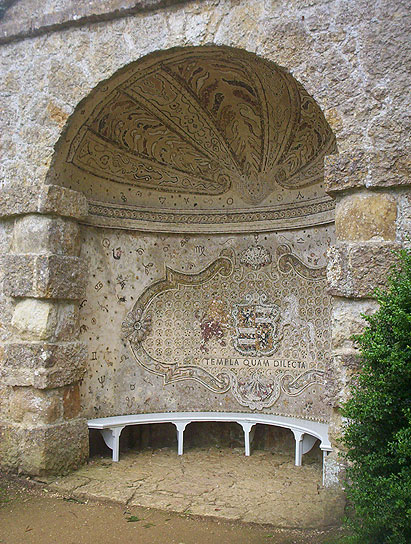
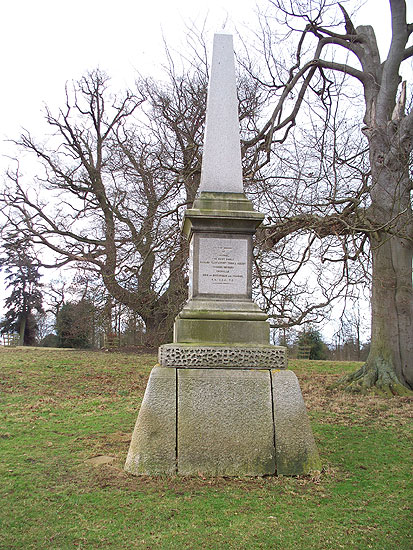
The route to the Bourbon Tower (pic. below) starts near the far end of the old NT car park, at the same point as the path to the Wolfe Obelisk. A weathered signpost points towards the Wolfe Obelisk, and, in the opposite direction, to the Bourbon Tower. Walk alongside the private road leading to the Stowe playing fields, and at the T junction cross over it and enter the field ahead containing a small obelisk and the Tower. From this field one also has a clear view of “Stowe Castle”. The tower has a ditch and the remains of a wall surrounding it; the entrance is on the far side. The tower is in poor condition, with former windows blocked up. There is an interesting hole under the outer wall, which leads to a small rectangular stone-lined chamber, possibly an ice-house.
Hughenden Manor, Bucks.
National Trust.
The house, originally built towards the end of the 18th century, was bought by Victorian prime minister and novelist Benjamin Disraeli, who had it radically re-modelled in a Gothic style. The three-storey brick house is surounded by formal gardens, park and woodlands totalling 1500 acres. The west wing of the house was added in 1910. During the second world war, the house was used as a secret intelligence base, where aerial photography of Germany was analysed, and maps made for bombing missions.
Today, the fine gothic-styled ground floor rooms are displayed with rich furnishings and contents, and windows overlooking the garden. Upstairs, the Disraelis’ bedroom has been re-created, and his study is now much as he left it. In the basement and elsewhere are displays about the house’s WWII role. I enjoyed exploring the extensive gardens and park.
Revisited 27 May 2021: The NT have now gained some rooms in the west end of the house, formerly rented out, and turned them into exhibition space for a new exhibition devoted to the WWII mapmaking. At the time of my visit, the basement and upstairs were closed.
Ham House, London
National Trust.
A great red-brick palace by the Thames, largely created in its present form by Elizabeth, Countess of Dysart, in the 17th century. There are lavish interiors and many paintings and objets d’art. Outside, the formal seventeenth-century layout of the gardens, in which the garden is devised as a series of contrasting compartments, is being re-created. Typically, the treed ‘wilderness’area is actually designed with walks and hornbeam hedges, and four little summerhouses. East of the house a period kitchen garden is being restored, and used to grow vegetables. There is an orangery and other outhouses.
There is plenty for the visitor to look at, both inside and out. A half-day visit is suggested, and a ferry ride across the river is Marble Hill House (EH).
Farnborough Hall, Oxfordshire
National Trust.
The house, a restrained building of honey-coloured stone, remains largely as created in 1745 to 1750 by its owner William Holbech, probably with help from architect Sanderson Miller. The front door opens into an Italianate hall with rococo plasterwork ceiling. Other grand rooms with fine plasterwork follow.
Outside, the grounds have a lake, and Farnborough’s most distinguishing feature, a long curving grassy terrace that rises for ¾ mile giving panoramic views over the surrounding country. Hedges mask the steep drop below the terrace, and it is backed by a line of trees and shrubbery. Partway up is a little pedimented temple with Ionic columns, and further along is a two-storey domed pavilion. A curving stone staircase gives access to the upper room, which has rococo plasterwork and fine views out. At the end of the terrace is an obelisk.
Botallack Count House, Cornwall
National Trust.
This mining administration building does not rate an entry in the National Trust handbook, but is an interesting old house, now used by the NT as an exhibition and information centre, where you can collect useful maps and trail guides. If you park carefully in the car park, you can sit in your car and watch ships go by for as long as you like.