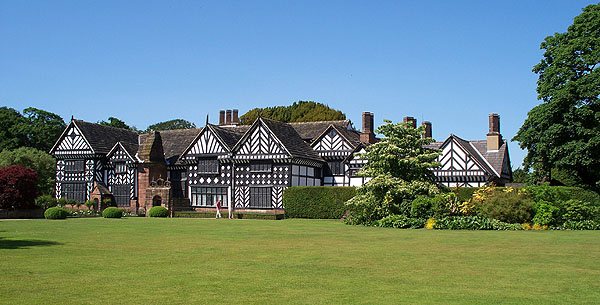
Speke Hall, Liverpool

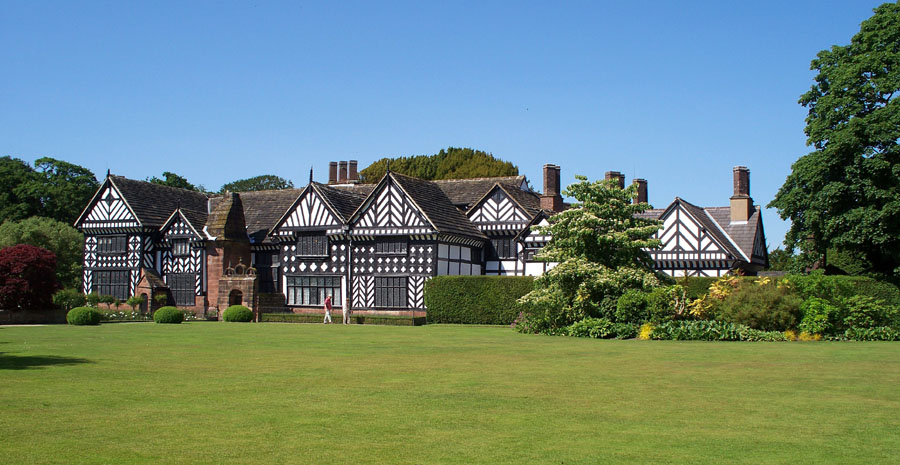
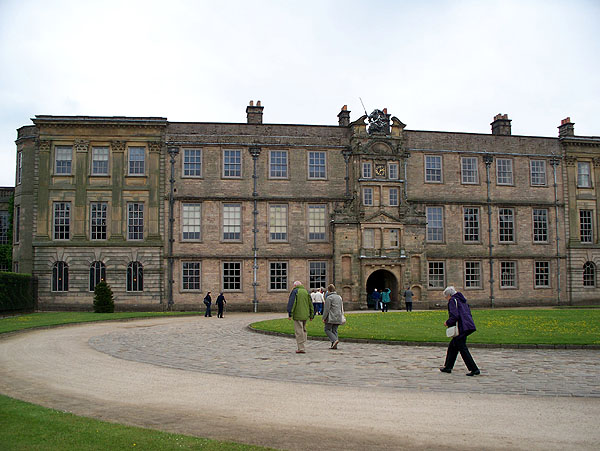
Speke Hall South front
National Trust.
Speke Hall was built in stages during the sixteenth century by the Norris family, and now comprises four timber-framed ranges built around a central courtyard. The south-eastern corner with the Great Hall appears to be the earliest part, and the east range, containing the kitchen and scullery, is the latest.
The house later was neglected, and when purchased by Richard Watt in 1795 it appears to have been derelict, with the west wing in complete decay. A full restoration was not carried out until the 1850’s, and this gave the interiors their present antiquarian character. William Morris wallpapers were put up in various rooms. The Tudor-style furniture was mostly introduced in the 19th century.
The double-height Great Hall is of irregular shape and contains two fireplaces and elaborate wooden panelling and bay windows. The Great Parlour has an ornate plaster ceiling, and a large fireplace with above it carved wood panels representing William Norris II with his two wives and nineteen children. At the other end of the room is a massive oak buffet containing pieces of older carving.
The Blue Drawing Room was fitted out in the 17th century. It is presently decorated with William Morris wallpaper, and furnished with a suite of Louis XV style furniture purchased in the 19th century. There are several bedrooms on display. The arrangement of the kitchen and scullery dates from the Victorian renovations of around 1855, and the present cooking range was installed about 1910.
There are formal gardens around the house (mainly behind to the South) and a substantial park with woods, a kitchen garden and orchard, maze and visitor block (formerly a farm).

The black and white exterior of the house is striking, and the interiors contain many features and furnishings of interest. Outside, one can enjoy the formal gardens and walk in the wider grounds, which form an oasis of green in an area which today is heavily industrialised, with the airport a few hundred yards away. The River Mersey should be visible from the south edge of the grounds. (Click on images to enlarge)
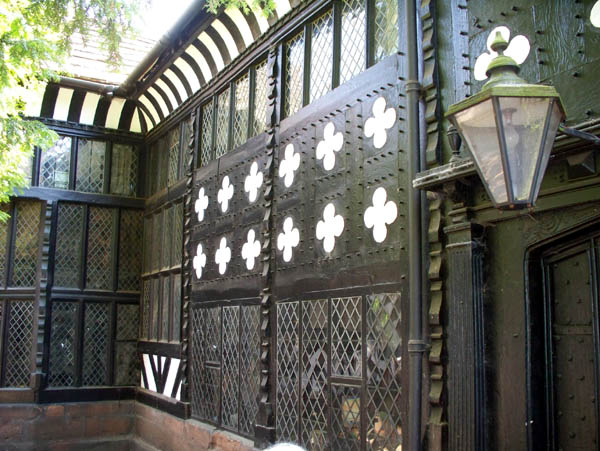
Speke courtyard wall
Courtyard
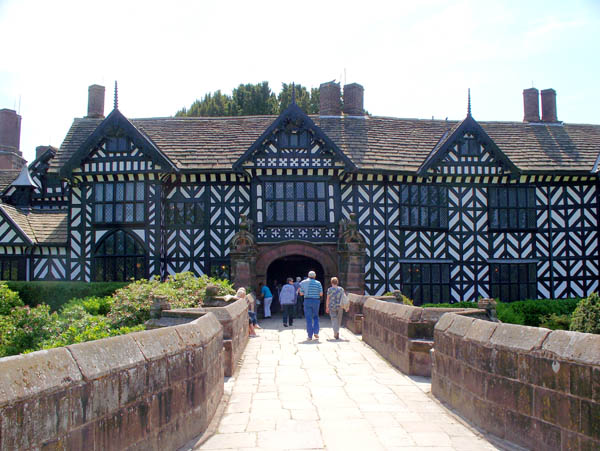
North Front, Speke
North Front
Speke Hall South front
South Front

Alderley Edge, Cheshire

Alderley Edge is famous for the sandstone ridge above the town, which can be visited by parking in the National Trust’s useful but easy-to-miss car park and walking one or more of the marked trails. The views apparently used to be more open, with the Edge being bare until the 18th century, but now the ridge is quite wooded, and good views over the Cheshire plain and to the hills of the Peak District can be had only from a few vantage points.
The Edge is associated with legends, the best known one being about a farmer meeting a wizard, and also with the writer Alan Garner and his novels, some of which are set in the surrounding country. The woods contain the remains of many old mines. Mining for copper and other metals went on in the area from prehistoric times to the 20th century, and there are many old relics. A stone circle however was apparently built in Victorian times.
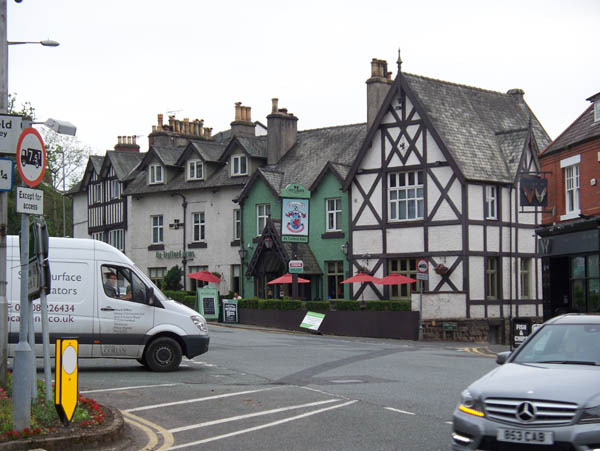
From the town, go up the High Street and take the left uphill fork just before the large half-timbered pub on the right.
I walked around one of the trails to the edge of the woods and saw some distant hills.

Turn left at this pub for the Edge
Turn left here for the Edge

Alderley Edge, the town, lies in one of the most sought-after residential districts in Britain. If you have to spend some time there, you could patronise one of the smart cafes and shops etc in the High Street, in hopes of spotting some famous footballer or soap star, or you could wander around the side streets spotting elegant Victorian villas lurking behind exotic flowering trees. There are one or two buildings in the High Street that might be old, including the Barclays Bank and a large pub with lots of external wood.

Tatton Park, Cheshire

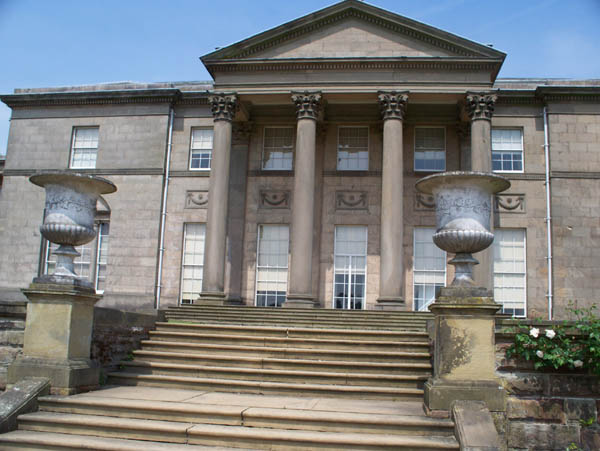
Tatton South FrontNational Trust.
Tatton Park is a complete historic estate with the Neo-Classical mansion, a Tudor Old hall, 50 acres of landscaped gardens, a working farm and over 1000 acres of deer park. It was owned for hundreds of years by the Egerton family. The core of the present mansion was completed around 1716. The mansion was then extensively altered in the fashionable Neo-Classical style in two stages between 1780 and 1813, by the architects Samuel Wyatt and his nephew Lewis Wyatt.
The Mansion is richly furnished and has a valuable collection of paintings and books. In the Library, facsimiles are displayed of one or two of the more interesting volumes, including the Wallington Manuscript facsimile (a diary of the Civil War period which makes very interesting reading with its enthusiastic descriptions of executions and civil warfare).

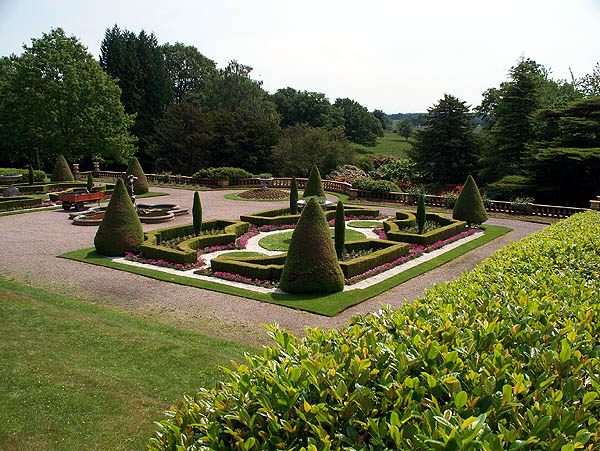
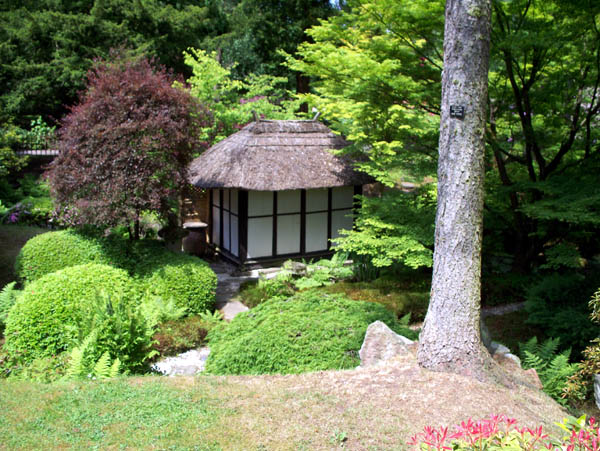
The Gardens have many areas with flowering trees etc, several large ponds, a Japanese garden (seen from perimeter), Italian Garden, 6 acre kitchen garden, tropical and temperate conservatories.

When I visited, I enjoyed an interesting special tour conducted by two “servants” which started at 10.30 am. Then I visited the gardens (large and impressive) then made a free-flow visit to house. Total 4.5 hours. (Click on images below to enlarge)

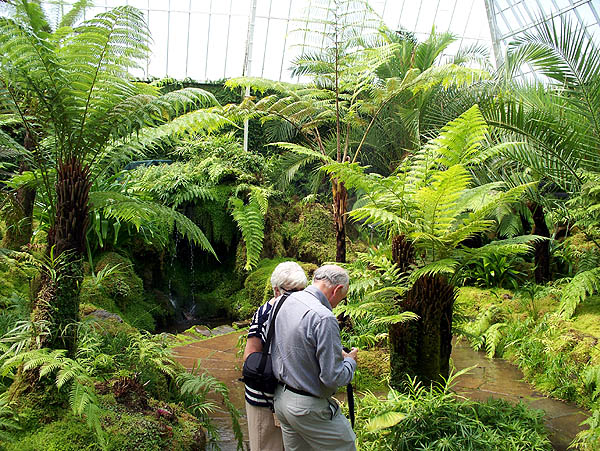
Tatton Fern House interior
Fern House
Tatton Italian Garden
Italian Garden
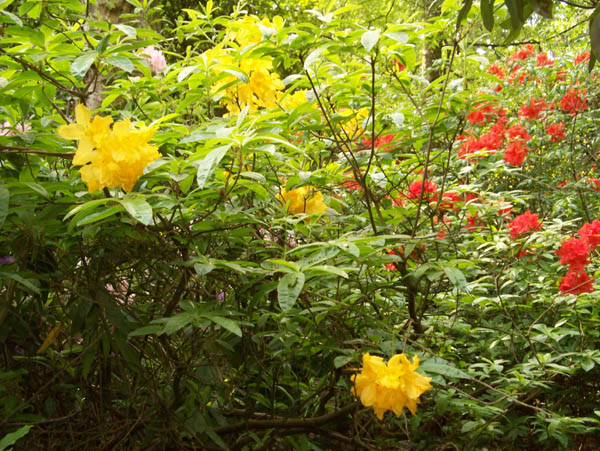
Tatton Shrubs
Shrubs
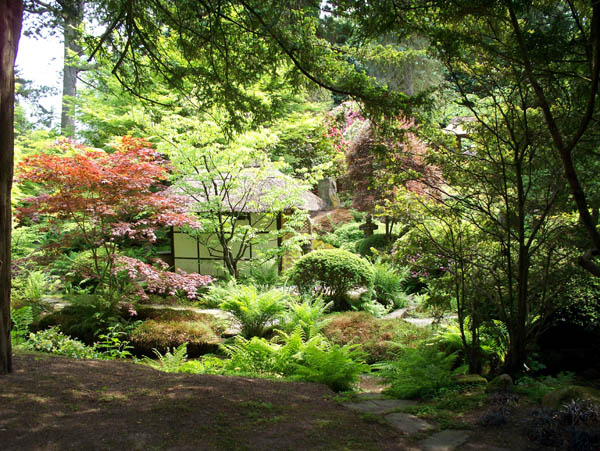
Tatton Japanese Garden
Japanese Garden
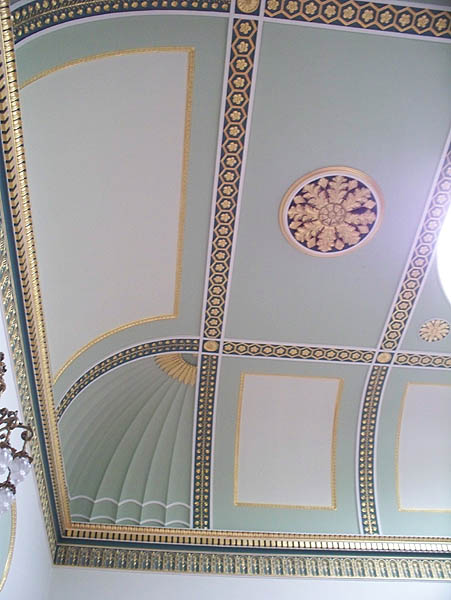
Stairwell ceiling, Tatton
Stairwell ceiling
Urn at staircase
Urn
Tea House, Japanese Gdn
Tea House
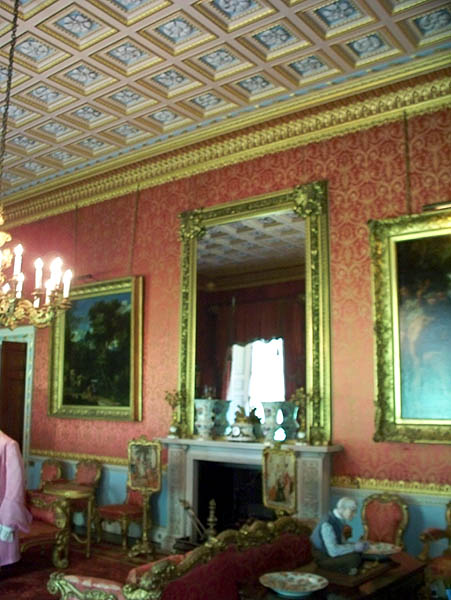
Tatton Drawing Room
Drawing Room
Maurice Egerton Exhibition Room
Exhibition Room

Lyme Park, Cheshire

Lyme Park - North Front
National Trust.
Lyme Park has been gradually developed since the Middle Ages. It was largely rebuilt during the reign of Elizabeth I, and the centre of the north front dates from this period. The Palladian courtyard, South front and West front date from the 18th century, and further alterations, mainly affecting the interiors, were carried out by the architect Lewis Wyatt in the 19th century. Wyatt altered floor levels, access routes and the functions of many of the principal rooms as well as changing the decor.
Internally, the house has a generally Jacobean aspect. Some rooms, like the Drawing Room, have survived from the Jacobean period with minor alterations, while others have been reworked, while still being fitted out in a Jacobean style.
The house was owned by the Legh family from the Middle Ages till 1946.
On the first floor, many of the principal rooms are on display, while on the second floor, the Long Gallery and some other rooms can be seen. A tour can take around 2 hours.
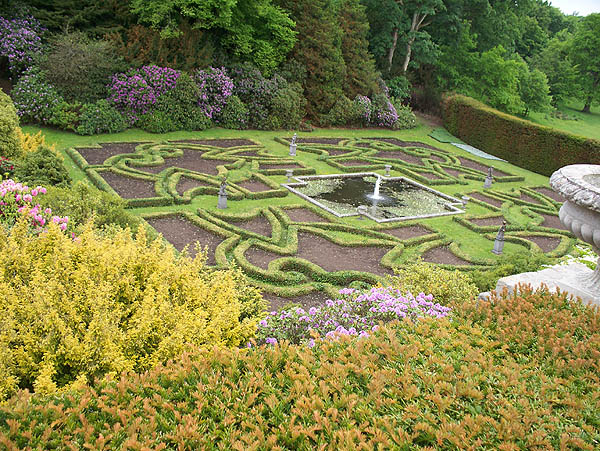
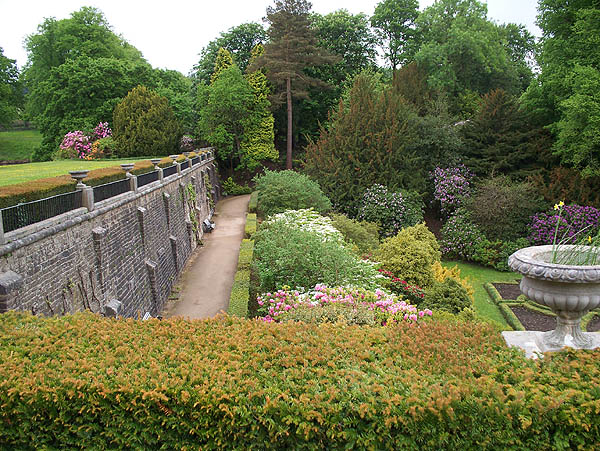
The gardens, mostly to the south, are very fine, with a lake and large changes of level. The Dutch formal garden seen from far above is particularly impressive. There is also a substantial park (not seen).
Photography of the interior of the house is not permitted, but I took some pictures of the gardens (click on images to enlarge).

Dutch garden from above
Dutch Garden
Dutch Garden from above
Dutch garden
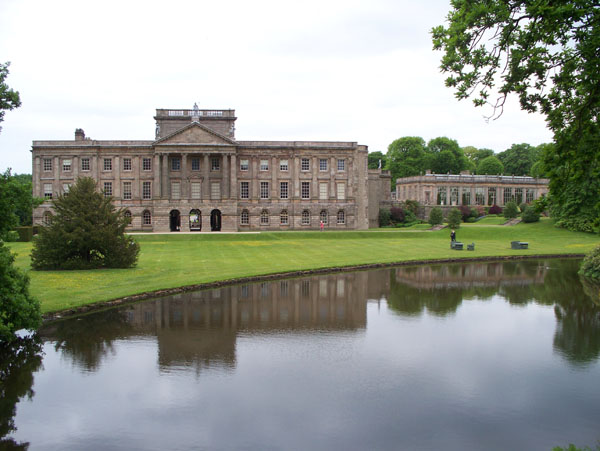
South Front from gardens across lake
South front
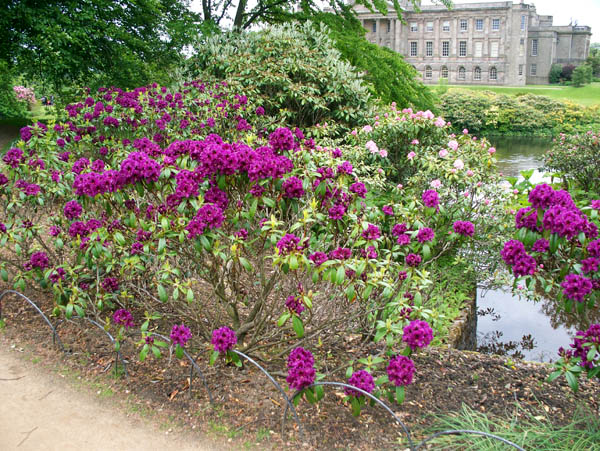
Informal garden with lake & house
Informal gardens
"Killtime" Ravine Garden
Ravine

Quarry Bank Mill, Cheshire

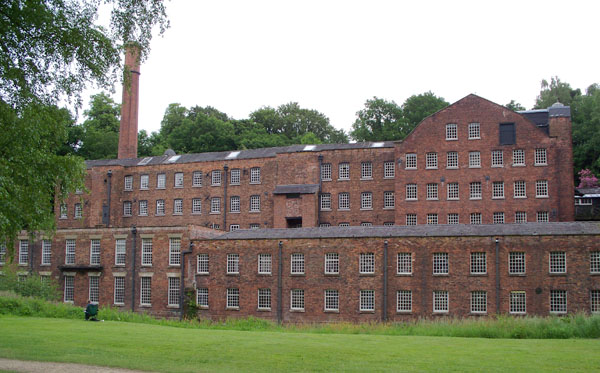
Quarry Bank Mill National Trust.
The Mill was started in the 18th century and remained in the ownership of the Greg family for five generations. The business closed in the 1950’s. The workers, housed nearby, included children as young as nine, and unpaid pauper apprentices. The cotton was cheap because it was produced by slaves in the southern United States. The mill was powered by water-wheels, and later by steam.
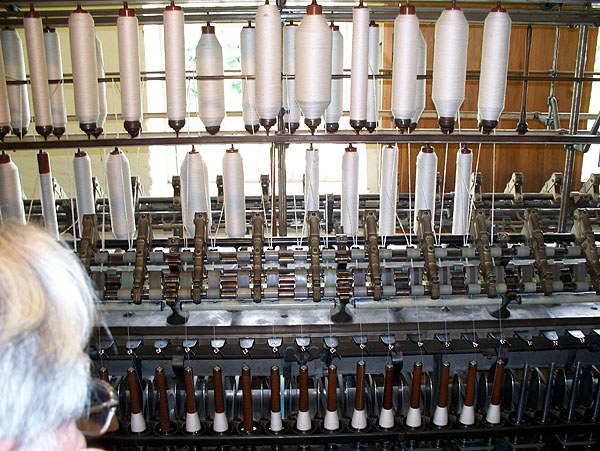
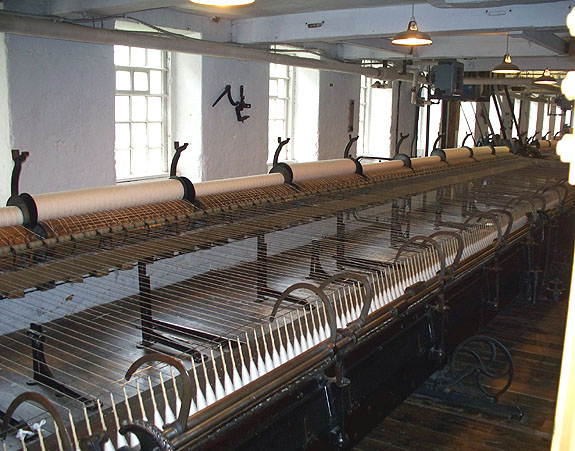
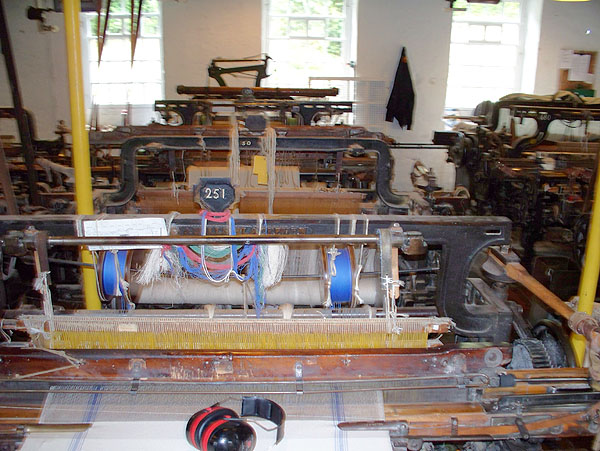
The original mill building contains exhibitions and representative old spinning and weaving machines, which can be seen running (noisy!). The machines were originally powered by water or steam power (latterly electricity), and in the lower levels a working restored water wheel and some working steam engines can be seen. It’s interesting to see what impact the production of cotton cloth had (social change, industrialisation, riots) and what ingenuity went into producing a piece of cloth.
Beyond the mill, the Quarry Bank garden and kitchen garden can be seen. Further afield are the Apprentice House and the Styal Village (not seen).
This is an interesting site, and a proper visit will occupy about half a day.

Spinning machine
Spinning machine
Quarry Bank spinning machine
Spinning machine
Quarry Bank Looms
Looms

Wightwick Manor, Wolverhampton

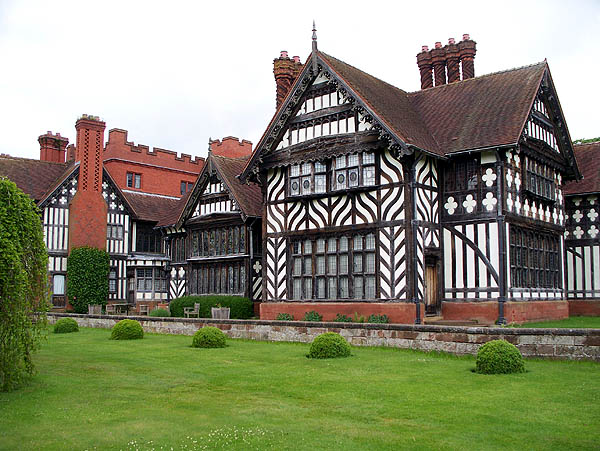
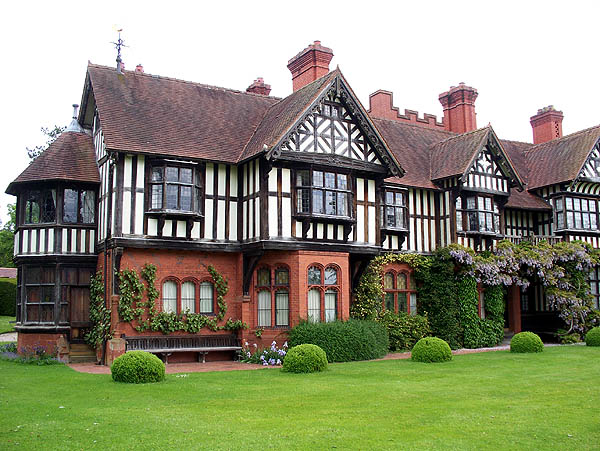
Wightwick Manor (E)
National Trust
Wightwick Manor is one of the finest surviving examples of a house furnished under the influence of the Victorian Arts and Crafts Movement. Thought built in the late nineteenth century, it is designed to look like a late medieval house, with its external black-and-white timbering and small-paned leaded windows. The eastern half, which was built later, is the more richly decorated, with stripes, swirls and quatrefoils, said to be in the style of Tudor buildings of the Welsh Marches.
Inside, the house has a more or less medieval-style interior, with all the latest 19th century conveniences. The contents, collected at various periods in the house’s history, include Pre-Raphaelite art and other collectibles from the Victorian period.
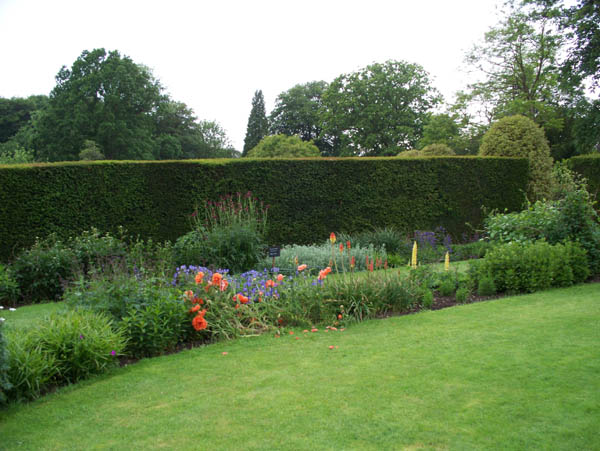
The formal gardens and grounds of 19 acres include two lakes, a vegetable garden and woodland.
Wightwick Manor (pronounced “Wittick”), inside and out, is a must-see for fans of Victorian art, design and architecture.

A few miles away I stumbled on the “Tudor House” at Histons Hill, Oaken, by the side of a busy road. It looks as if it has been crumbling there since the Tudor period, but in fact was built during the 20th century by the architect KH Smith, using timbers from several ancient buildings.

Wightwick Manor (W)
West ext.
Wightwick Manor formal garden
Garden
"Tudor House", Oaken
"Tudor House"

Knole, Kent

National Trust
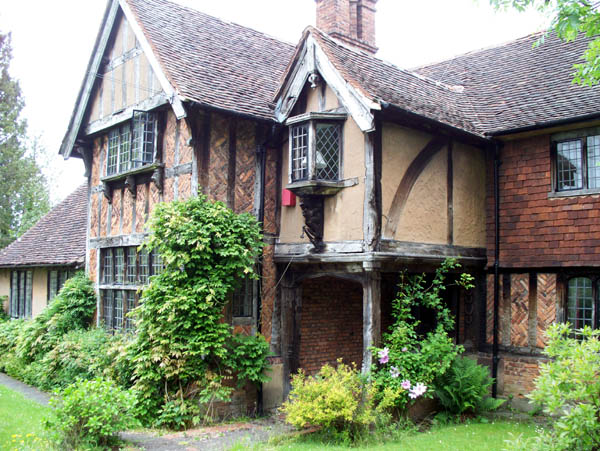
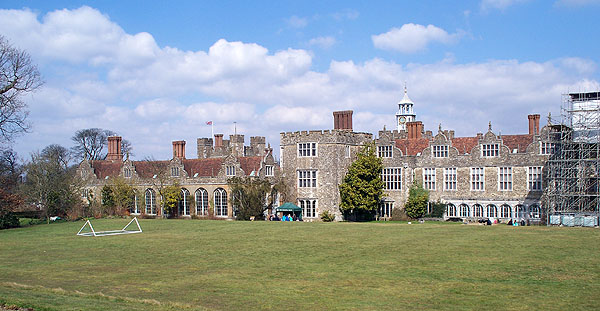
One’s first impression of Knole is that it’s big. The frontage is very long, and is exceeded by the depth, and there are seven courtyards. On the approach one can also see part of the massive wall of Lord Sackville’s walled garden.
Passing through the arched main entrance, one enters the Green Court, with some fine frontages. Visitor reception and the garden are to the right. Note that after checking in (or paying) at the visitor reception, one is expected to present one’s ticket at the garden entrance (if open) and at the Great Hall.

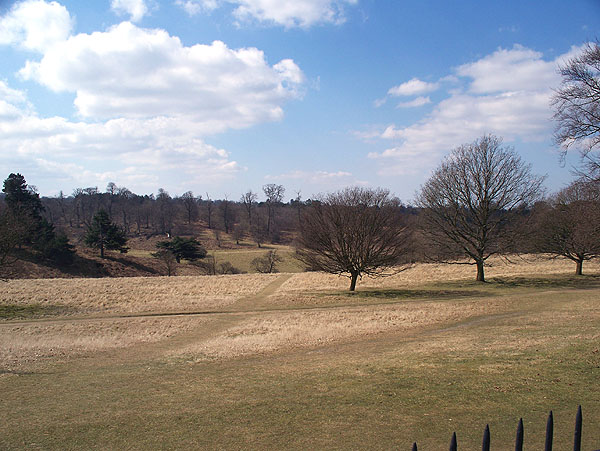
It’s worth making the effort to come on a Tuesday, when Lord Sackville’s walled garden is open. The walled garden is the size of a municipal park and features trees rather than flowerbeds in a variety of differing areas. It wraps around two sides of the house, (SW & SE) and these exteriors can not be seen from outside the garden. (Actually when I visited, the south end of the house was wrapped in scaffolding and plastic, and not visible anyway.) The wider park (huge) is rather bare and brown by comparison.

The Stone Court has some fine frontages. The Great Hall is an impressive room with a fine carved screen. Beyond it, only a fraction of Knole is open to visitors, mostly in areas behind the SW and SE frontages. There is a large collection of paintings, and some very old furniture collected from Royal palaces, and a collection of fine china. There is a room with furniture made of silver. The house dates from the Tudor period, and has not been radically remodelled since, so expect everything to look … old. At least one area is alarmed, so don’t let your brat run around unchecked 🙂

Be aware that the interior of the house is unheated and draughty, so if you visit on a chilly, breezy spring day, dress as for outdoors, as it will be as cold as the park! The old ‘Estate Office’ is the only visitor room that is properly heated.

If you have time, walk around the outside towards the tea-room to look at the north exterior and peer into the Stable Court (private).

Knole is a healthy 1.5 mile walk from Sevenoaks railway station, mostly uphill. Parking at the house is £4 (NT members free).

Knole parkland
Knole parkland, west
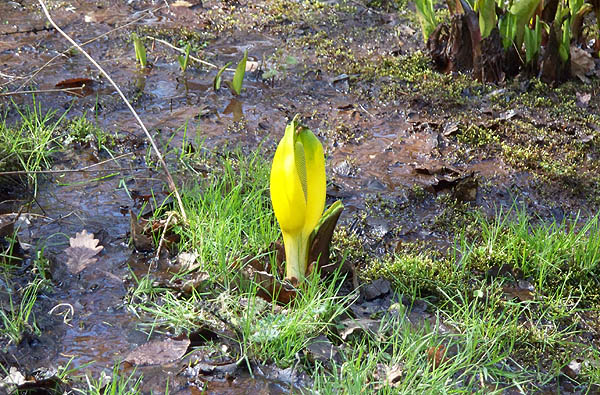
Marsh plant in walled garden, Knole
Garden, Marsh plant
Knole, SW front
Knole, SW front
Knole,  Stable Court
Stable Court
Knole, Stone Court
Stone Court

(click on images to enlarge)
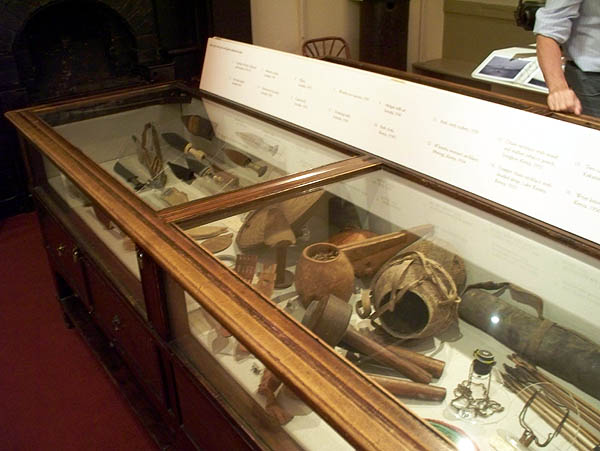
Cragside, Northumberland

Cragside view from South
National Trust
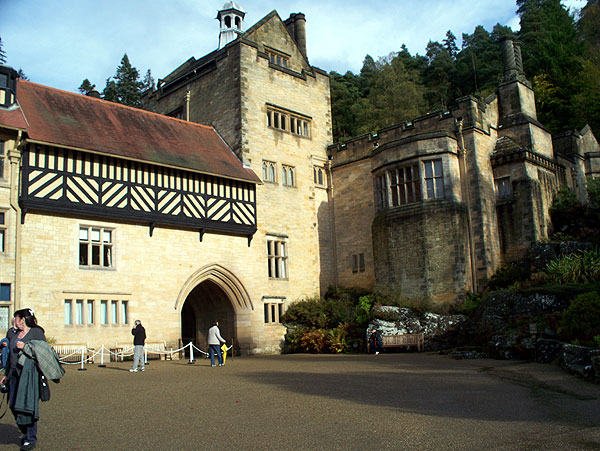
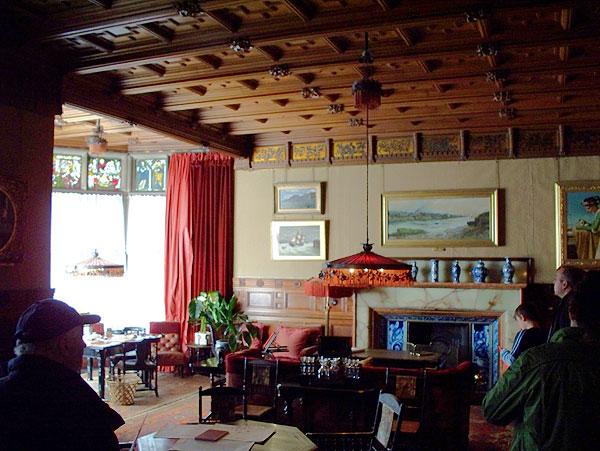
Cragside was bought by the Victorian industrialist and arms manufacturer Willian George Armstrong, and the house was greatly extended between 1863-1884. Externally, the house is a jumble of English baronial styles, with mullioned windows, battlements, decorated barge boards, shouldered gables, tall decorated chimneys, steep roofs, and mock timber-framing, and has an irregular outline. Inside it has a number of unusual features incorporating Armstrong’s ideas, often very advanced for the time, including a water-powered spit turning mechanism, electric lighting from a hydro-generator on the estate, a hydraulic powered lift and a sauna suite. There are several rooms with elaborate Victorian interiors. The large drawing room, finished in a Classical Renaissance style, has a vast chimney piece, elaborately carved in marble. A long gallery is lined with pictures and other objects.

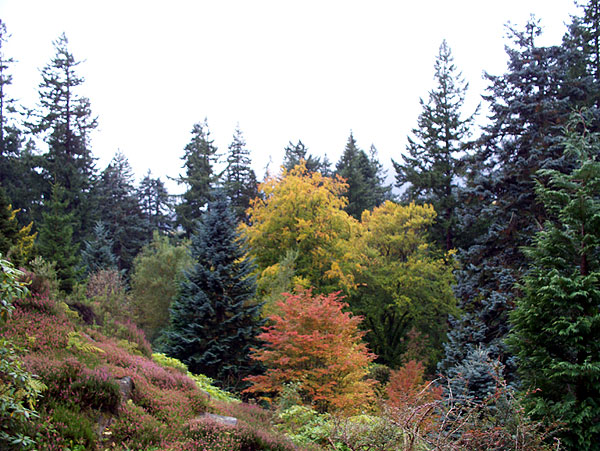
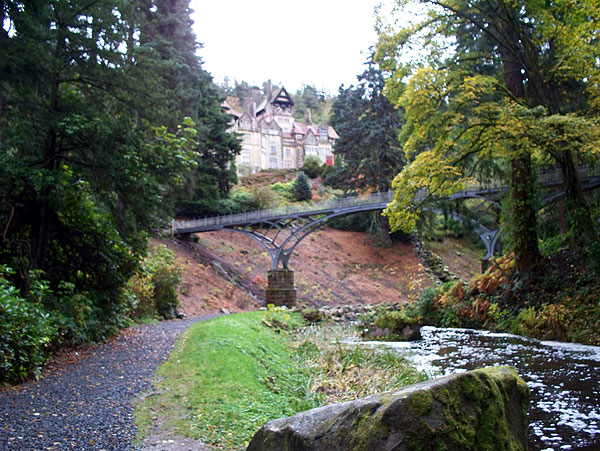
From the house, there are spectacular views over the woodland below. A rockery garden plunges down to a stream and an arched metal bridge. Out in the estate there are several of Armstrong’s installations to visit, and 40 miles of footpaths to explore. You can walk to the pair of lakes above the house and back in an hour or so, but the signposting on the paths is vague and the climb is steep.
The exhibition centre & tea rooms are next to the lake visible from the entrance. The formal gardens are 1/4 mile from the house, or from the main car park. The’re quite pretty but could be skipped if you are short of time.
A ‘hopper’ minibus provides free transport around the above-mentioned ‘near’ parts of the estate for those who have difficulty in walking. You can drive your car around a 6-mile one-way circuit to access the ‘far’ parts of the estate. Cragside is a clear candidate for an ‘all day visit’.
Visited 2012 and 2016.

Library interior
Library
View near House
View near house
View of Iron Bridge and house
Iron Bridge and house
Library bay window
Library
Dining Room stained glass
Dining Room glass
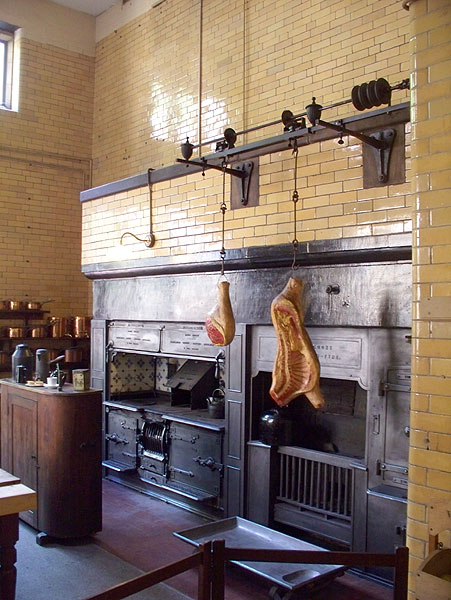
Kitchen
Kitchen
Morning Room
Morning Room
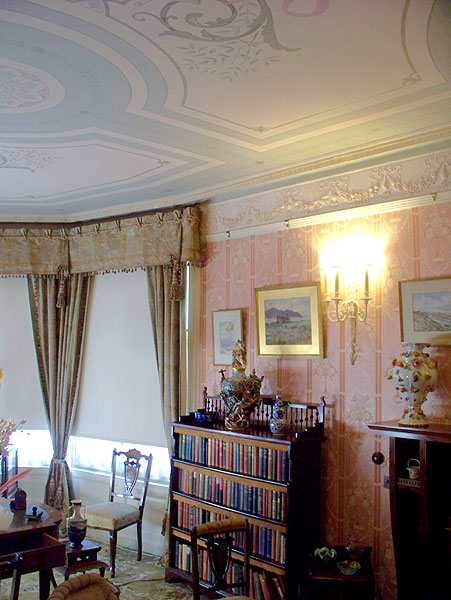
Drawing Room
Drawing Room
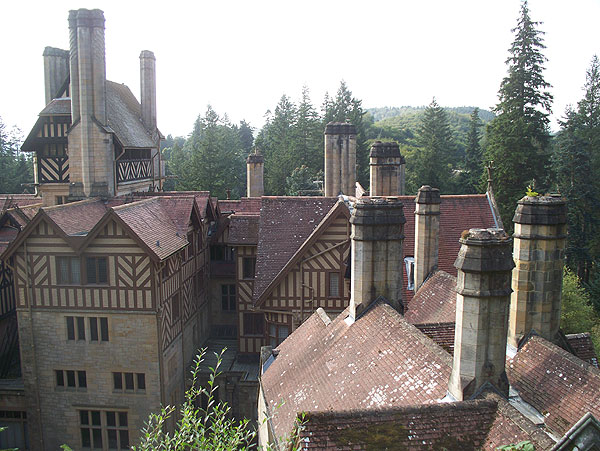
Roofs from path above
From above
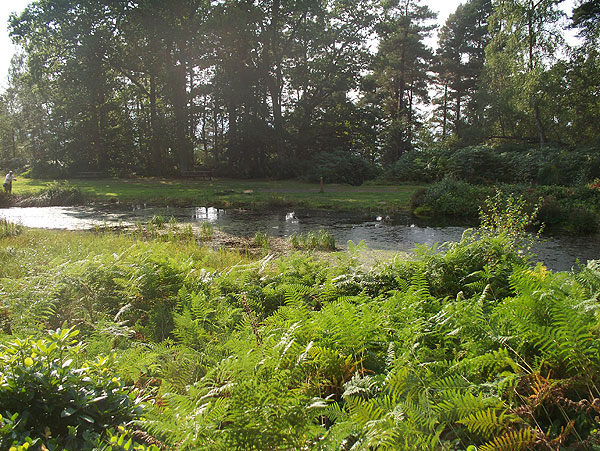
small lake in woods
Slipper Lake
Nelly's Moss North Lake
North lake

Wallington, Northumberland

Wallington South & West frontsNational Trust.
The 18th century house stands in extensive grounds, and the south front can be seen from a mile away on the approach route. Behind the house (north side) is a green surrounded by stable blocks etc.
Inside the house, one you leave the entrance hall, the preferred route is to turn right and go around the ground floor in an anti-clockwise direction, finishing with the south front rooms (Library, Drawing Room and Dining Room). Then go upstairs. Alternatively, you could go upstairs first. Noteworthy items in the house are the fine collection of Chinese porcelain, the pre-Raphaelite murals in the central hall, and the plasterwork in the south-facing ground floor rooms. Pictures, furniture, porcelain figures and a collection of dolls’ houses may also be of interest.

Outside, the Walled garden (half a mile from the house) is said to be well worth a visit. Unfortunately I was unable to see it because of lack of time. A full visit to house and grounds could take several hours.
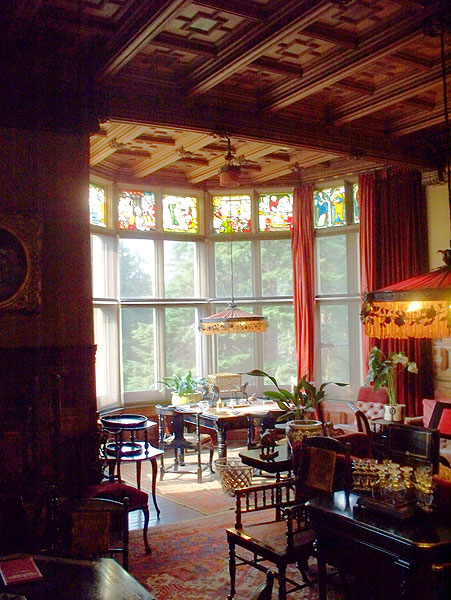
Dining Room view
Dining Room
Central Hall with murals
Central Hall

Portmeirion, Gwynedd

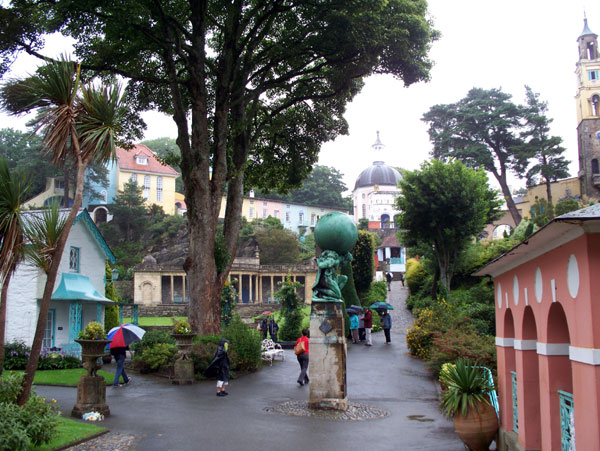
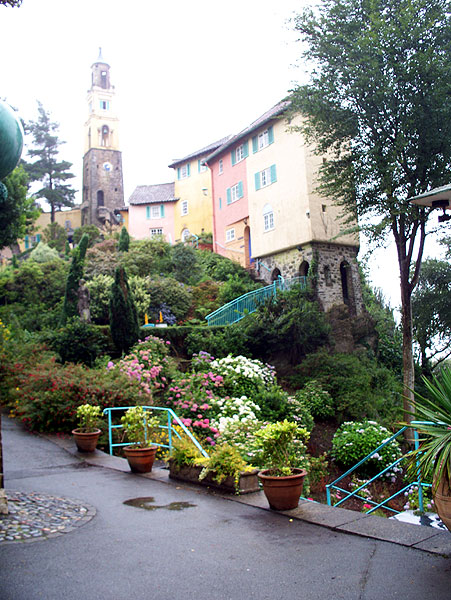
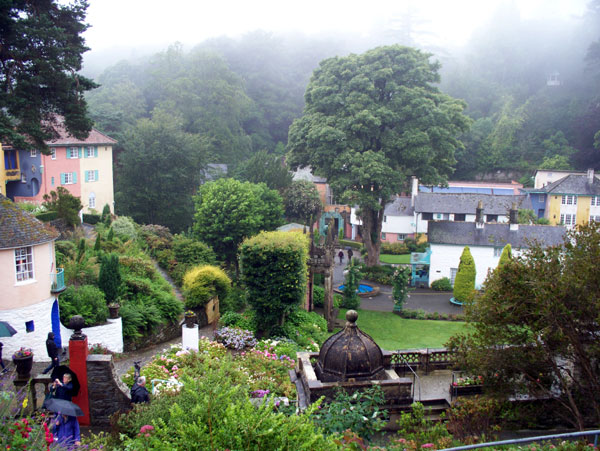
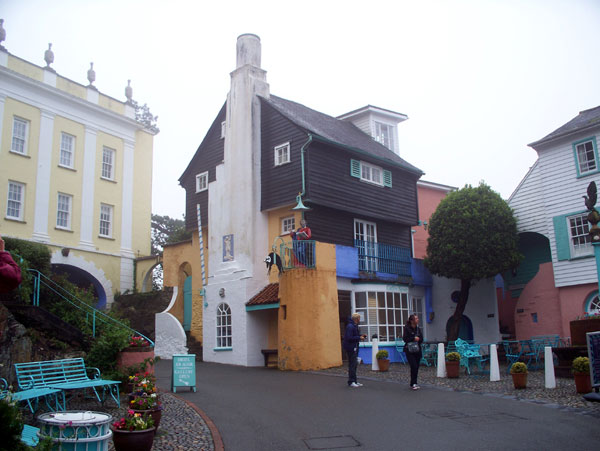
View of  Portmeirion villagePortmeirion is one of the premier visitor attractions in Wales. It is situated just outside Porthmadog, overlooking the sea. Best known as the set of Patrick McGoohan’s “The Prisoner” TV series, it is also a mid-priced hotel complex. Visitors can enter the Village area daily on payment of a fee.
Portmeirion was originally developed by architect Clough Williams-Ellis to demonstrate that commercial development to re-vitalise an estate could be carried out without ugly over-development. The quaint Italianate ‘Village’ occupies a quite small part of the estate. The buildings and terraces incorporate bits of architectural salvage, obtained cheaply by Williams-Ellis in the days when any old and surplus building could be summarily knocked down. Many of his structures are just one room deep or are painted with ‘tromp d’oeil’ effects.
There are the usual facilities of a large visitor attraction. There is a ‘land train’ to encourage visitors to get out of the village and explore the miles of paths and the grounds with their lakes and sub-tropical plants.
The ‘Village’ buildings form part of the hotel room and self-catering accommodation. There is also the shore hotel and Castell Deudraeth hotel, which you may glimpse as you drive in.
Portmeirion has its own website.

Portmeirion view
Village
Portmeirion view
Village
Portmeirion square view
Village