
Submarine Museum, Gosport, Hampshire.

HMS Alliance
The Royal Navy Submarine Museum offers a guided tour of one full-size submarine, HMS Alliance, plus exhibits of several small or miniature submarines, including the very early Holland 1 and a well-preserved X24 minature submarine. There are museum galleries depicting submarine operations, with plenty of audio-visual, and a collection of weapons systems control panels as used for launching missiles, plus a Trident rocket.
The admission fee is significant but worth it if you are interested in submarine warfare. If you’ve never been inside a submarine you may be surprised at how little free space there is and how every square foot of bulkhead is covered with pipes, cables, or equipment.
Visit time ~3.5 hours.

Visiting: It might be worth looking at online mapping to see where you are going before setting off (they say a picture is worth 1000 words.) It’s easy to drive past the entrance without spotting it. The site is on the Haslar Road, a few yards past the end of a single-lane bridge that spans part of the harbour, but there is no in-your-face signage, and sat-nav will probably deliver you to an adjacent site, e.g. Fort Blockhouse which is about 100 yards further on.
The site can be reached by ferry from the Historic Dockyard area which is quite close as the crow flies. The ferry seems rather pricey, but the land access alternative goes through miles of congested built-up area.
Portchester Castle, Hampshire

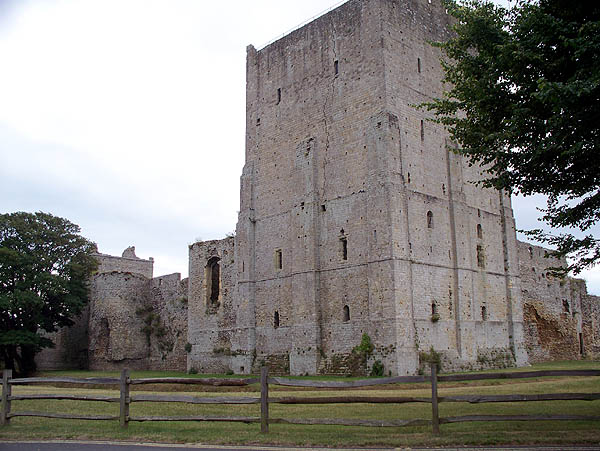
Castle Keep
English Heritage.
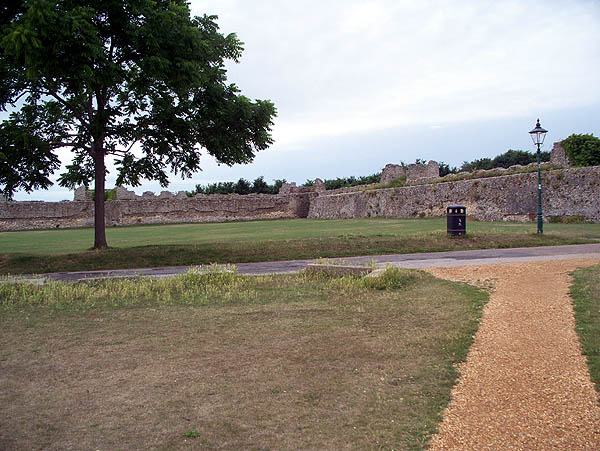
Portchester Castle is the most impressive and best-preserved of the Roman ‘Saxon Shore’ forts in Europe, and was built in the late 3rd century. It is the only Roman stronghold in northern Europe whose walls still mostly stand to their full six metre height, complete with most of the original 20 towers.
It later housed a Saxon settlement, and after the Norman invasion a Norman castle was built in one corner. The castle was used in the middle ages, and was used as a prison during the Napoleonic Wars.
The size of the circuit of Roman walls is impressive, and the medieval keep is worth seeing and has an interesting exhibition in the basement. Rooms in the keep can be reached by modern stairs. Note that in fair weather the more agile visitor can ascend a narrow spiral stone staircase to the roof, from which there should be great views of the harbour, etc. (I didn’t try it in the rain).
The castle is right on the waterfront, so don’t omit to walk out of the seaward gate and have a look.
Visiting: If you pass the obvious car park to the left, there is a smaller one on the right a few yards from the castle entrance. Admission to the Roman fort is free, but there is a charge for visiting the medieval keep. An audio guide is available. The keep has modern stairs to all floors except the roof (see above).

Roman walls
Roman interior

Bishop’s Waltham Palace, Hampshire

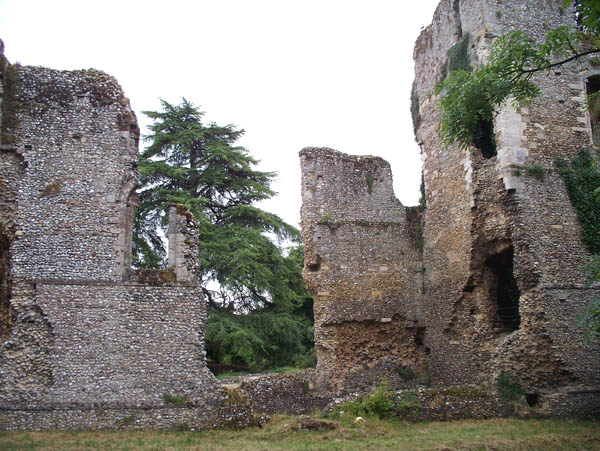
Palace ruins
English Heritage
Bishop’s Waltham was a medieval palace used by the wealthy Bishops of Winchester. Also on the site is the Bishop’s Waltham town museum, in a farmhouse adapted from the palace’s lodging range.
There are extensive ruins of this large palace still standing.
I happened to be nearby in the early morning, so had a look over the wall, but was not able to get inside.
Worth a look if you are in the area. Admission free.

Historic Dockyard, Portsmouth

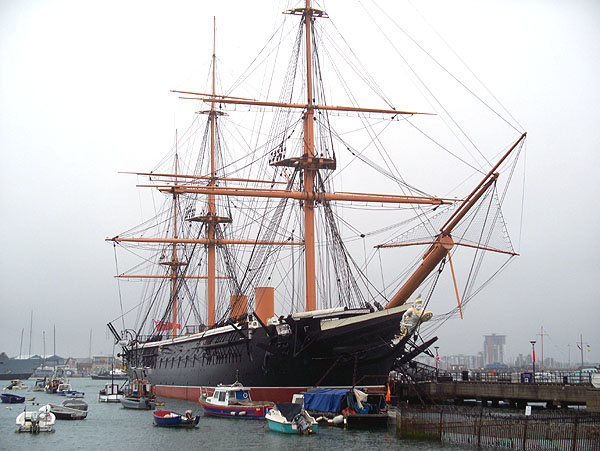
HMS Warrior
HMS Warrior

The Historic Dockyard is on the waterfront and next to the working Royal Navy dockyard. The ticketing reflects the presence there of several major attractions, and you can elect to buy a ticket for one, or the whole lot. The all-attractions tickets are much better value for money, but this assumes you are staying in the area and can visit on two or three days.
The major attractions are:
HMS Warrior: One of the very few surviving ‘transition’ warships, with an iron hull, armour plate, and a steam engine, but also rows of cast-iron cannon* poking out of gunports, and masts and sails. She made all previous battleships obsolete, but was soon superseded. Visit time ~1.5 hours.

HMS Victory: Admiral Nelson, Battle of Trafalgar: need I say more? Classic wooden battleship with 3 decks of cannon. Visit time ~1.25 hours.

Mary Rose: Now in a new-for-2013 museum which displays some of the 19,000 artefacts alongside the half-ship. The museum is on three levels. Artefacts such as cannon are displayed in their proper positions opposite the Mary Rose’s decks and there are museum galleries with more artefacts and exposition at the ends. Includes cases of the only Tudor longbows you’ll see anywhere. Fascinating. New for July 2016: the bulky pipework and the barrier with small windows have been removed, offering an unobstructed view of the ship. On the topmost level, above the glass barrier there is nothing between you and the ship. Every few minutes the lights dim, and dioramas of the crew at work or in action are projected onto the hull. Visit time ~3 hours.

Harbour Cruise: A cruise around the harbour, taking you past whichever of the Royal Navy’s ships are in port at the time. I saw a (or is that ‘the’) carrier, and three Daring-class destroyers, plus sundry other warships. Time: ~45 mins.

Royal Naval Museum: Seems to be confined to the age of sail, and Trafalgar.

Other attractions: There are several other things (see the official website.)
Monitor M33: In a drydock near the Victory. You can now see around the restored interior of this ship. See separate entry for M33.

Travel: It’s easy to get right into Portsmouth by car along the motorway. You could park at the convenient but expensive pay-on-exit multi-storey car park near the Historic Dockyard, but it is less stressful and just as convenient to use the Portsmouth Park & Ride.
The Portsmouth railway station is actually on the harbour nearby.

Jutland 2016 Exhibition (temporary): An optional extra in the ticketing scheme. Worth a look if you know little about this important battle. A fair number of small artifacts are on display, and there are some video clips and survivor accounts.

*mostly fibreglass replicas.

Hinton Ampner, Hampshire

National Trust.
Hinton Ampner is best known for its fine garden and stunning views to the south. The country house itself represents the fifth rebuilding on the site. It was remodelled in 1960 by Ralph Dutton, the 8th and last Lord Sherborne, after a devastating fire destroyed the interior and most of the contents.
The house, previously Victorian, has been remodelled in a Georgian manner to contain Ralph Dutton’s collection of Georgian and Regency furniture, Italian pictures and objets d’art.
I found the house of more interest than the gardens. Dutton seems to have been particularly fond of objects made of porphyry, and of tables and cabinets inlaid with semi-precious stone.
If you like formal gardens, look at the Sunken Garden behind and below the house. The garden descends in a series of terraces.
If you are looking for the Walled Garden, you already saw part of it, as a section is fenced off to serve as the reception route.
A small old church also stands in the grounds.
I have not included any pictures of Hinton Ampner, as I arrived there after two hours in a hot car on one of the hottest days of the year, and the sole thought in my head on leaving the car was to buy some chilled water ASAP.

Stonehenge, Wilts.

English Heritage.
One of the iconic English monuments. It is easily found at the A303/A344 junction and you could make it a stop en route to the south-west. There have been plans to expensively re-work the surroundings and visitor access, but when I visited in 2007, one had to park across the road from the stones in the EH car-park, and then cross under the road via a tunnel. One could walk around the stones in a circle but not walk amongst them. The site is open daily. (Admission charge) A free audio tour is available.
Druid myths apart, the site is impressive, the standing stones are colossal and the prehistoric workmanship amazing. A number of fallen and unstable stones were re-erected in the 20th century to restore the circle to more like its ancient complete form.
The ancient monument enthusiast will find other monuments in the same area.