There was originally an Abbey of the Premonstratensian Order here, but after the Dissolution of the monasteries, the remains of the buildings were converted into a large rambling house, owned for centuries by the Cary family. The Abbey, by now largely Georgian in character, was purchased by the local council in 1930 for use as an art gallery. The building is said to be divided into 122 rooms, rambling over 20 different levels and with 265 steps. However, in recent years the building was found to be in need of urgent major repairs, and was closed for a time, re-opening in 2008.
Today, the Abbey houses an enlarged art collection, including Pre-Raphaelite paintings by Holman Hunt and Edward Burne-Jones, and sculpture by Frederick Thrupp. In the gardens are some abbey ruins and a hothouse.
Adjacent to the house is the historic Spanish Barn.
The abbey is well worth a visit, both as a historic house and as an art gallery. One can get lost wandering around a large number of rooms at various different levels.
It is possible to visit Torre Abbey by train, as it is an easy walk from Torbay station.
Revisited May 2022
Category: South-west
location
Oldway Mansion, Paignton, Devon
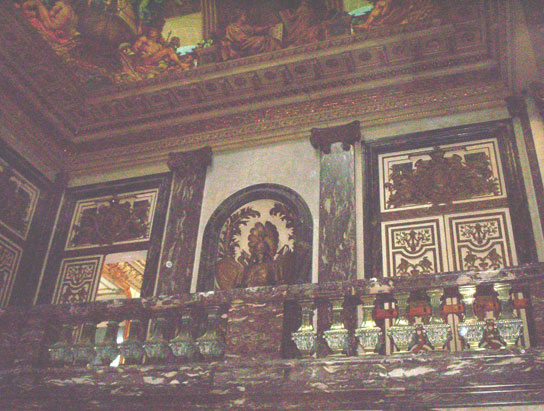
The Oldway Mansion was built around 1875 by Isaac Merritt Singer (of sewing machine fame) and remodelled by Paris Singer, his 3rd son, in 1904-7. The remodelling was intended to make the house resemble the Palace of Versailles. After use as a hospital in WWI, a country club, and a training centre for RAF cadets in WWII, it was acquired cheaply by Paignton Urban District Council, who use most of it for civic offices.
Oldway Mansion is set in 17 acres (69,000 m2) of gardens, which are laid out on an Italian theme by the French landscape gardener Achille Duchesne. Beneath the eastern elevation of the building is the maze, which consists of dwarf box hedging and flower beds. To the south of the mansion there is the grotto garden where a waterfall passes over a rocky cave into a pool below. The grounds of the mansion contain many sub-tropical plants and shrubs.
The mansion and its grounds can be visited free of charge by members of the public, and it is one of the most popular tourist attractions in Torbay. The mansion has a small museum with exhibits linked to the building’s history, including antique Singer sewing machines. Oldway Mansion is a Grade II* listed building.
In May 2010, it was reported that Torbay Council had reached an agreement with the property developers Urban Splash, which will transform Oldway Mansion into a £10million 85-bed hotel, and build around 160 homes on the site. The contract was valued at £1 million and allowed for around £3 million of repairs needed at the mansion. Torbay’s mayor Nicholas Bye supported the plan, while opposition councillors expressed concerns that the site had been undervalued.
Bastards!!
is my immediate reaction to this news, coupled with a suspicion that Torbay Council’s next move is to squander tens of millions on a shiny new prestige office block for themselves.
(If you think my reaction intemperate, reflect on how much public money councillors squander on new prestige offices for themselves given half a chance. Newham council reportedly spent £111 million on theirs, and if you Google you might find an even more outrageous example.)
As of Sept 2011 the mansion and grounds were still open to the public. I urge you to go and visit the place while you still can, and if you live locally, to protest loudly and rudely against the plans.
When I visited the site in 2008 (free of charge), the mansion looked extremely impressive on its slightly elevated site. Inside, the Versailles-style décor of the hall and staircase is gob-smacking, but not much else of the interior is on view. Outside there are large and well-kept formal gardens, which complement the house, and a round building, the Rotunda, which was built in 1879 and used for horse exercising. The Mansion can be visited by train, though it’s a bit of a tramp from Paignton railway station.
Lundy Island, Devon
National Trust & Landmark Trust.
The car-free island encompasses a small village with an inn and Victorian church, and the 13th-century Marisco Castle. For nature-lovers there is a variety of flora and fauna. The waters around Lundy were designated the first Marine Conservation Area, and offer opportunities for diving and seal watching. Lundy is financed, administered and maintained by the Landmark Trust. There are cottages to rent, and also a campsite.
Access is normally by Lundy’s own ship, the MS Oldenburg. Sailings are from Bideford or Ilfracombe. It is possible to go for a day trip, which gives one about four hours ashore, enough time for an active person to visit the village and other locations on the half of the island nearer the landing pier. If you stay for a week, various away-from-it all experiences are possible, including doing as little as possible :-).
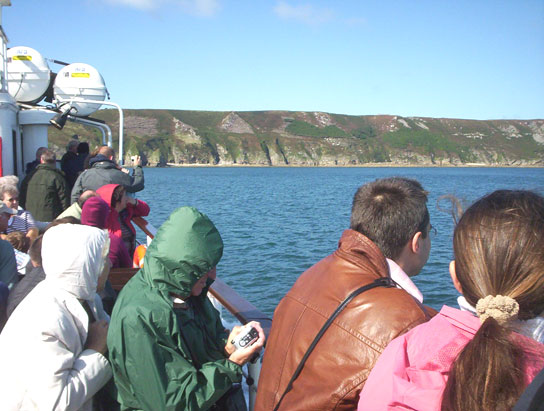
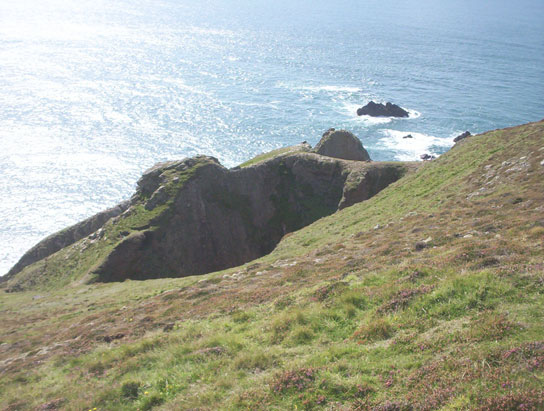
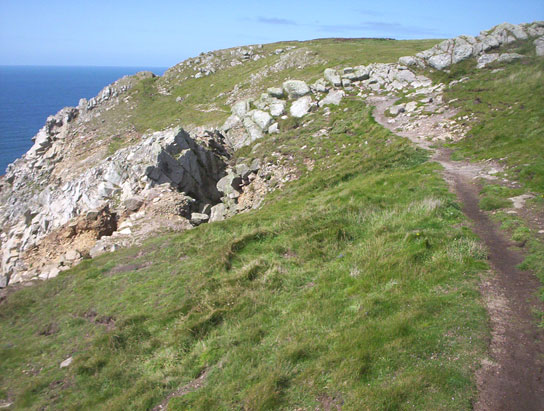
I went for a day trip, and got to the island on the second attempt, the first attempt being cancelled at short notice because of rough sea conditions. On the voyage, the sea was fairly calm, and the whole day was sunny. I visited the village, the pub, the church, the converted castle (now holiday lets), and various points of interest including the lighthouse in the middle of the island. There are some old ruins, the relics of granite mining on Lundy (a topic you can look up if you are interested.) The voyage itself is quite enjoyable on a fine day with good visibility, as various landmarks and ships slowly move in and out of view. As we approached, Lundy got bigger ahead of the ship quite suddenly.
Coleton Fishacre, Devon
National Trust.
Not an ancient house, but built in the 1920’s for the D’Oyly Carte family, Coleton Fishacre is built of local Dartmoor shale and roofed with slate, and with its straggle of roofs it fits unobtrusively into the landscape. Inside, all is Arts & Crafts and Art Deco in style, and much use of limed oak and pine. At the west end of the house is a saloon 40 feet long, and furnished in yellow and green.
The interior is interesting, as all the rooms are furnished as though the 1930’s inhabitants had just left. Outside is a large 30-acre garden planted on a steeply sloping site, with many semi-tropical plants and flowers, and glimpses of the sea.
Access to the site is by a single-track road (“reversing required”) and roads in the area are narrow. There are other attractions in the area for walkers.
Totnes Castle, Devon
English Heritage.
This was a classic Norman motte and bailey castle, founded soon after the Conquest to overawe the Saxon town. A later stone shell-keep crowns its steep mound, and gives sweeping views across the town rooftops to the River Dart. The shell-keep wall is in a fair state of preservation, as can be seen in stock photos.
Apart from the view, there’s not a large amount of things to look at, but the circular shell keep itself looks rather iconic. You’d think that a castle on a high mound would be easy to spot, but if I remember correctly I had a lot of difficulty finding it, because the crowded old buildings block any view of it from street level. If you don’t have any luck with brown signs, find a good street map and track it down with that. The old centre of Totnes is not car-friendly so if you arrive by car it would be best to park it in a car park on the edge of the town centre and continue on foot. When I was last there, it was possible to drive up the length of the old high street and under the building that spans the street, but I really wouldn’t recommend it! Also, the exit from the top of the high street onto the ring road is hazardous, because of poor visibility and high-speed idiots.
Other EH castles are in the same area of South Devon.
RNAS Culdrose, Cornwall

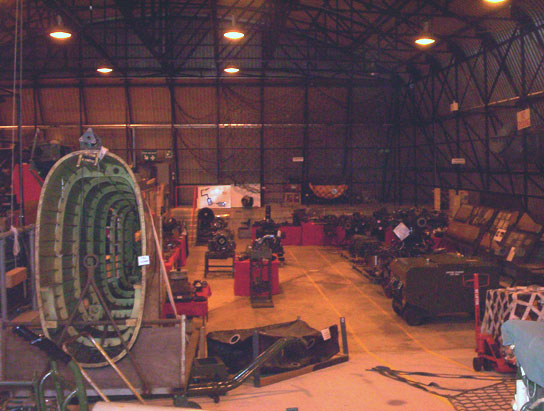
It’s wise to arrive in good time for the tour so that you can get signed up in time for departure. The high point of the tour I went on was going inside a huge hangar where helicopters were being maintained. It was all really interesting.



Overbeck’s, Devon
National Trust.
This is a museum of curiousities, set in an exotic semi-tropical garden. The last owner of the house, scientist and inventor Otto Overbeck, filled the house with his collections. There is a cabinet devoted to his inventions, which include an electrical “Rejuvenator”, designed to inject new life into the old and tired by passing electricity through the body. Also in the museum is a “Polyphon” a music box using large sheet steel disks, which plays music encoded as punched holes, also display photographs of various shipwrecks, and under the stairs a collection of dolls’ houses. The garden has some very steep slopes, and views over coastline and estuary.
This isn’t the easiest place to get to, as the roads leading to it are single-track, steep and twisty, and not suited for anything bigger than a minibus. There is a small car park near the house, for visitors, and if it’s full, finding alternative parking could be troublesome. If you are feeling really fit, it’s possible to park at East Soar and walk up (2 miles), or walk up from the ferry (1/2 mile). The NT handbook cautions drivers against paying too much attention to one’s sat-nav and advises following the brown signs from Marlborough towards Salcombe. As I recall, it was steep and narrow the direct way and steep and twisty by the brown sign route, neither an easy drive.
Minack Theatre, Porthcurno, Cornwall
This is an unusual theatre, being an open-air theatre on a cliff-side site overlooking the sea. I went to a play there in 2007, and found that I could hear and see perfectly well. Stone bench seating is provided as-is, and a ticket doesn’t allocate you to a seat as in a conventional theatre. You are advised to take something to sit on, and suitable clothing in case of light rain, and arrive early if you want a decent seating position. Ticket prices are quite low, compared with my local theatre.
As for the programme, they generally offer popular fare. If you are staying in the area, and the weather isn’t nasty, it would make an unusual night out. There is an on-site café. Note that the site can be visited during the day, on payment of an entrance charge (and if you want a look now, check the website’s web-cams!)
Finch Foundry, Devon
(National Trust)
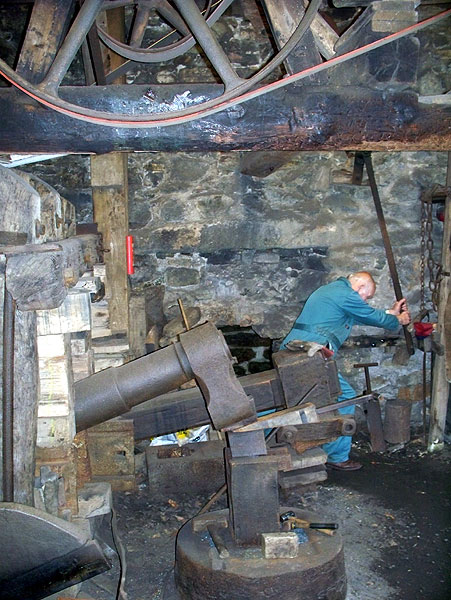
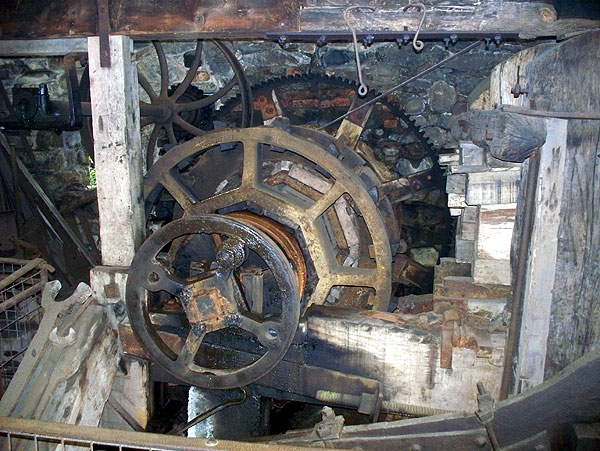
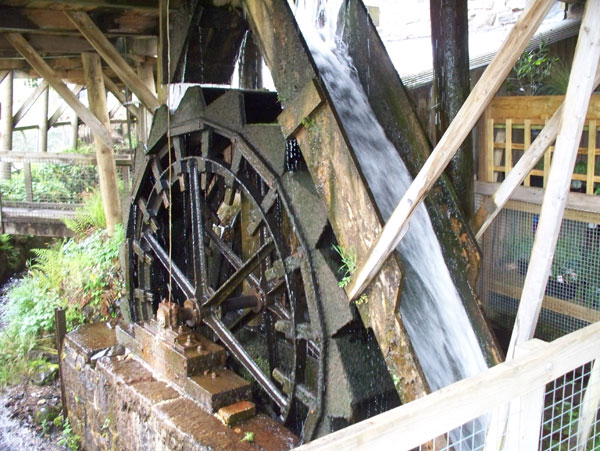
This is the last remaining water-powered forge in England. The buildings and workshops have been preserved and the machinery is in working order. There are hourly demonstrations and tours, when you can see the waterwheels driving the tilt hammer and grindstone.
Upstairs is a small museum giving the history of the forge. In the grounds are a pleasant garden and a teashop. A Quaker cemetery adjoins the site. From the site one can take a circular riverside walk of about a mile and a half.
An interesting site, worth a visit.
Access to the car park is narrow, with a height restriction.
Compton Castle, Devon
National Trust.
A jumble of buildings and curtain walls enclose a courtyard. There are towers incorporated into the house and curtain wall, a great hall rising to the roof, a chapel, and an ancient kitchen wing. The house was built between the fourteenth and sixteenth centuries, and fortified in the reign of Henry VIII, no doubt in response to French raids on the Devon coast. The house was bought back by the Gilbert family in 1930 and restored as a family home after centuries of neglect.
The reconstructed great hall and a few other rooms are open to visitors, and there are rose, knot, and herb gardens adjoining. Don’t miss the rose garden (to left of front). This is a really unusual building and worth a visit if you are in South Devon. Opening dates are restricted to three days in the week. (Bradley (NT) nearby opens on the same dates.
Access to the house is via narrow lanes. Parking (on grass) at the house is limited and additional hard standing parking is available at the Castle Barton tearooms 100 yards away.