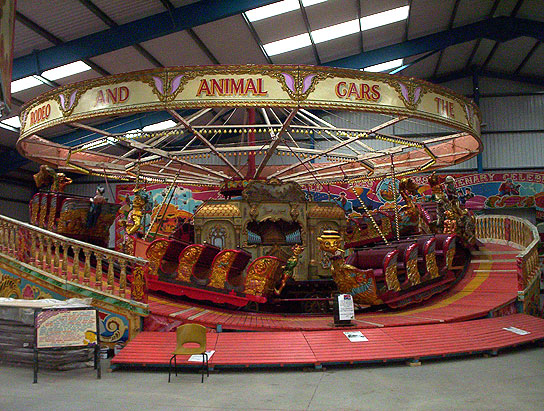
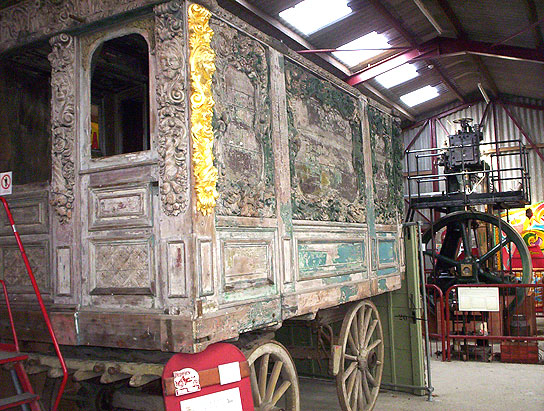
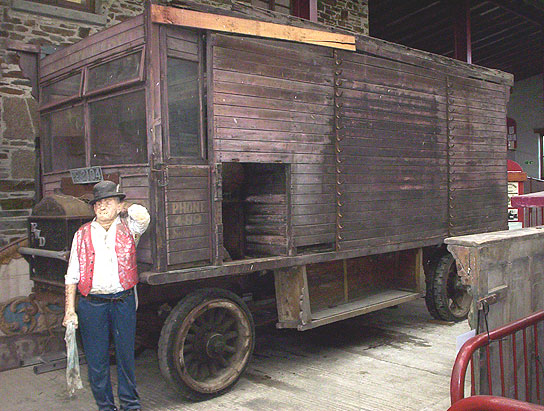
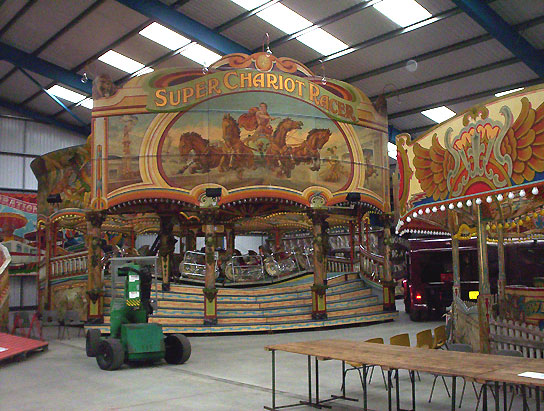
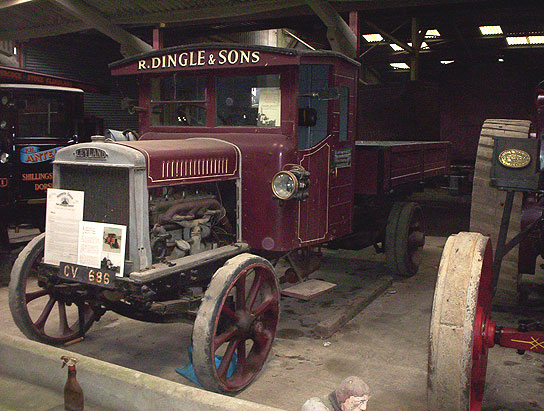
When I visited it in 2007 there were some stationary engines in steam, and other steam exhibits. Most exhibits were to do with fairgrounds, and included vehicles, some of them very ancient, sideshow displays, and, in a large barnlike hall, several complete fairground rides. It was quite interesting.
Today it seems they are offering more of the same, including working rides.
Category: South-west
location
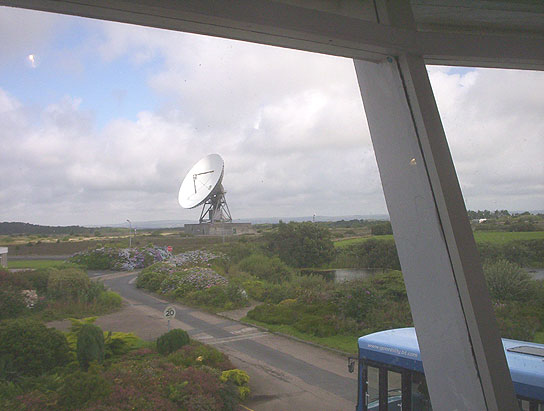
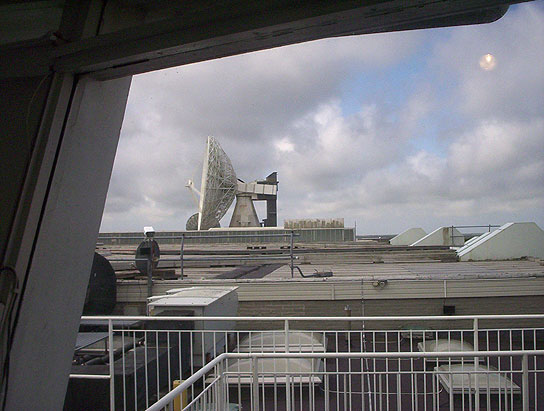
Goonhilly Satellite Earth Station, Cornwall

Until Easter 2010 the site had a visitor centre inside which the Connected Earth gallery told the history of satellite communications. There were many other interactive exhibits, a cafe, a shop and one of Britain’s fastest cybercafés (a one gigabit pipe and a theoretical maximum speed per iMac of 100 Mbit). There were also tours around the main BT site and into the heart of Arthur.
I visited the visitor centre while it was open in 2007, and found it quite interesting. I looked at the exhibits, climbed to the viewing gallery, and looked at my website via the cybercafe. The high point was a bus tour around the site, which allowed visitors to get a closer look at some of the monster dishes. What was a let-down was that some of the dishes were online and receiving signals, and we weren’t allowed to see any of it. It was like your friend asks you round to see his new satellite and Freeview, and he shows you his elliptical dish and spiky aerial. You’d be under-impressed, wouldn’t you?
On 11 Jan 2011 it was announced that parts of the site are changing hands, and there are also plans to upgrade the former visitor centre into “an outreach centre promoting space and space science for visitors, including local residents and schools”.
As with privately owned great houses, this may have been a case of “visit it while you have the chance”, but you can hope.
Cadbury Castle, Devon
This Iron Age hill fort site is near Furzdon House (see separate entry) and the village of Cadbury.
I would have liked to walk up to it, but on my first visit to the area it was not obvious where the preferred access was. There is a signed footpath starting from the village lane, about half a mile down from the A3072. Also, the satellite view shows what looks like a farm vehicle track running from a field on the A3072 up to the top, which is marked by a circle of trees.
The second time around, my sister didn’t care to walk up it in the hot sun:-)
Furzdon House, Cadbury, Devon
The house sits on rising land above a minor road. The Georgian frontage has two projecting wings and a central colonade. A dwelling has been on the site for 750 years, the last major rebuild being in the 18th century and the last major alteration being the addition of the library wing in 1815. The Coach Hall adjacent to the house serves as ticket office and tea room when the house is opened to the public. The estate is quite large and includes the Cadbury Castle hill-fort nearby (see separate entry)
When my sister and I visited the house, we were welcomed by Catriona Furzdon, the lady of the house, at the Coach Hall. We had a look at the gardens surrounding the house before joining a guided tour of the house interior. The house has some quite interesting rooms filled with old furniture, the details being ably narrated by our guide. The gardens around the house have various sub-sections and at the rear they look down on the older parts of the house. Behined the house are terraced beds of herbs and roses, and a thatched round house. Below the house and across the road is the Meadow Garden, which has trees and a pond. We enjoyed our visit here, as we liked the house and garden and had a warm welcome. We enjoyed the tea and cake too.
http://www.fursdon.co.uk
Botallack Count House, Cornwall
National Trust.
This mining administration building does not rate an entry in the National Trust handbook, but is an interesting old house, now used by the NT as an exhibition and information centre, where you can collect useful maps and trail guides. If you park carefully in the car park, you can sit in your car and watch ships go by for as long as you like.
Levant Mine and Beam Engine, Cornwall
National Trust.
On a cliff-top site sits an old beam engine in its original engine house, still in steam. On the same site are a small museum, a film about the mine, and the top of the shafts. By the car park is a small piece of underground mine tunnel that you can walk through. At varying distances are other relics of mining. The Botallack Count House (NT) is on the clifftops nearby, as are other various engine house ruins and ore processing floors.
This is a great site that in summer overlooks a blue sparkling sea. Indoors you can experience the sound and smells of the old engine in steam-powered motion – the only beam engine in the world still in steam on its original site. Outside, you can explore a landscape littered with mining ruins for as long as you like, or just sit and watch ships go by.
Less than a mile away is the Geevor mine (see separate entry) and the Botallack Count House is a mile or so in the opposite direction.
Cornish Mines and Engines – Pool
National Trust.
The National Trust has several more or less working Cornish mining engines in its care. At Pool, Cornwall, at the heart of the Cornish Mining World Heritage Site, are two great beam engines, preserved in their towering engine houses. The pumping engine on the main site is one of the biggest beam engines in the world, with a 90” cylinder. On the other side of the A3047 is another site, with the great beam of the Michell’s Shaft winding engine poking out of the side of the engine house. Both engines can be seen in motion from time to time, driven by electric auxiliary motors. The main site, with a museum, audio-visual, and walk-through of various buildings, has a lot to see besides the engine.
When visiting, you’ll find that you can park outside the Michell engine house on an area of gravel, and later drive across the road to the far end of the Morrisons’ car park and the larger site.
See also ‘Levant Mine and Beam Engine’
National Maritime Museum, Falmouth, Cornwall
The Museum is housed in a modern purpose-built building on the waterside in Falmouth. Internally it is divided into a number of “zones” containing permanent or temporary exhibitions. Besides what’s on display, there are large archives and reserve collections. Unsurprisingly, the museum contains quite a lot of boats, and some more small craft of historic interest are moored at a pontoon outside. There is also a glass-walled tidal room in the basement when at the right state of tide one can see fish outside. There is a section of Cornish-related materials.
There is plenty to look at, though it can be a challenge to find one’s way around or, for instance, locate the walkway to the external pontoon. I remember the basement where I tried to photograph some fish through the glass wall. A museum visit can occupy several hours.
Parking nearby can be expensive. However if you park at the Ponsharden park + ride, you can take the “Park and Float” = parking + a boat trip to the quay near the Maritime Museum, qualifying you for discounted entry.
Also in Falmouth: Pendennis Castle.
Antony, Cornwall
National Trust.
The house, built in its present form between 1718-24, stands on a peninsula near the Tamar estuary. It is a charming and modest house, not particularly large, but the furnishings and the collection of portraits are of exceptional quality. The landscaped grounds include formal and woodland gardens.
I remember the house had some modern sculpture in the grounds. The house was also used as a set for the recent “Alice in Wonderland” movie.
Mount Edgcumbe, Cornwall
 Cornwall Council.
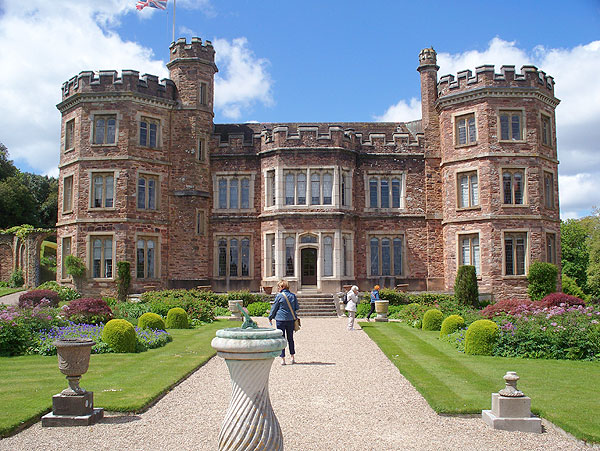
The house was originally Tudor, with later modifications, but during WWII it was hit by incendiary bombs, burnt out and largely destroyed. Commencing in 1958, the house was rebuilt for the 6th Earl using a steel frame and concrete floors. However the house and estate were bought jointly by Plymouth City Council and Cornwall County Council in 1971. The 865 acres of magnificent grounds and gardens became a country park.
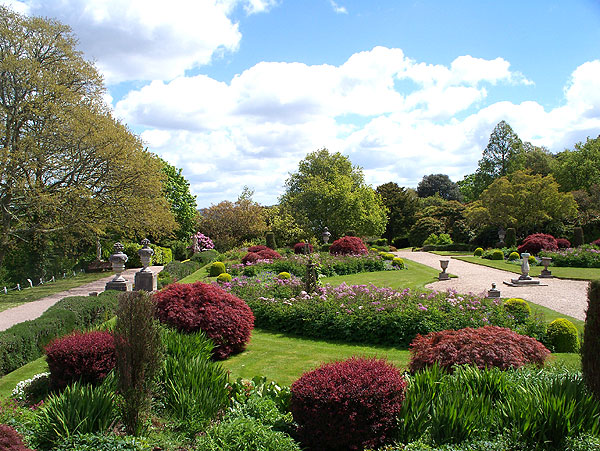
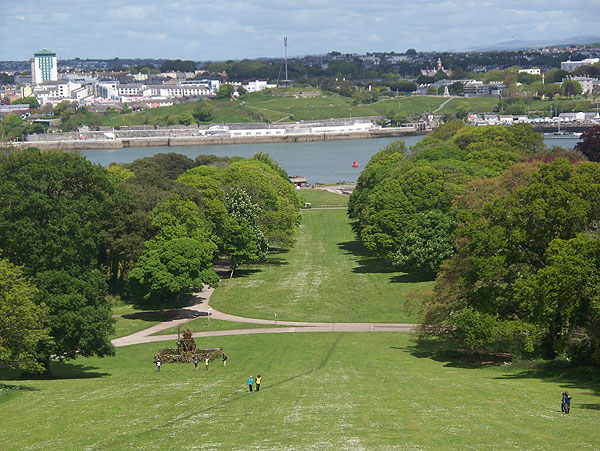
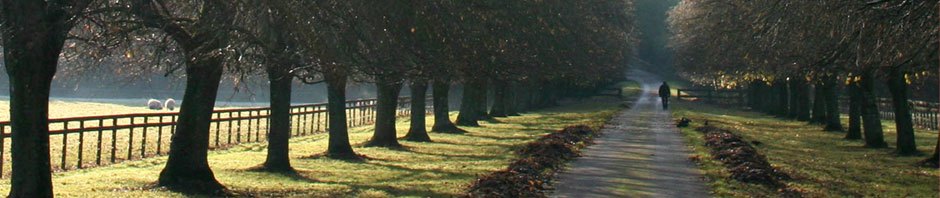
The site is overlooking the Tamar estuary, just across the water from Plymouth. The house stands quite high up, while the large and lavishly planted formal gardens are near the shore and the ferry. The parkland, with deer park, walks, ruins and follies, is so big that even the most energetic visitor could walk his or her legs off trying to see it all. There is car parking at service buildings close to the house.
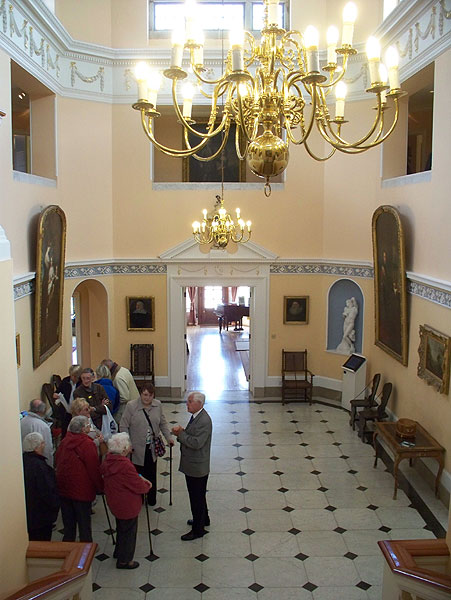
The house and contents are worth seeing, and the gardens are Grade I listed. The interiors of the reconstructed downstairs rooms are very fine, with period furniture and other items. Upstairs on my latest visit I found a 3-room exhibition of a shipwreck. Besides the large formal gardens already mentioned, next to the house (and included in the house admission) is the Earl’s garden.
All this merits a whole-day visit, but visitors who are travelling some distance may be tempted to take in the nearby Antony (NT) or Port Eliot (private) as well.